
Pythagorean Theorem Calculator
Calculate the missing side of a right triangle easily
What is Pythagorean Theorem Calculator?
A Pythagorean Theorem Calculator is a convenient online tool that helps you calculate the missing side of a right triangle using the Pythagorean Theorem formula: a² + b² = c², where c is the hypotenuse. This calculator is widely used by students, teachers, engineers, and anyone dealing with geometry or construction calculations. It eliminates the need for manual squaring and square root operations, providing instant and accurate results.
With this calculator, you can easily determine the length of any side of a right triangle whether it is one of the legs (a or b) or the hypotenuse (c). The tool is designed with a soft pink theme and a responsive canvas-style layout, making it visually appealing and easy to use on both desktop and mobile devices. For a special right triangle with two equal legs, a Triangle Calculator finds the other leg and the hypotenuse from a single leg length.
Before you use the theorem, check that the triangle really has a right angle. The theorem only works when one angle is exactly 90 degrees. If the angle is not a right angle, the sides do not follow a² + b² = c², and the calculator answer will be wrong. A square corner, a set square or a 3, 4, 5 check can confirm the right angle on site.
How to Use It
Using the Pythagorean Theorem Calculator is simple and intuitive:
Enter the known values for any two sides of the triangle.
Leave the side you want to calculate blank.
Click the Calculate button.
The calculator will instantly display the missing side value below.
This user-friendly interface ensures that anyone can solve right triangle problems in seconds, without manual calculations or errors.
For a curved edge rather than a straight side, an Arc Length Calculator measures the curve of a circle from its radius and angle. It is the right tool when the shape is round, not triangular.
Pythagorean Theorem Formula and Worked Example
The formula in the calculator is a² + b² = c². The two shorter sides are a and b. The hypotenuse, c, is the longest side and it sits opposite the right angle.
To find the hypotenuse: c = square root of (a² + b²)
To find a leg: a = square root of (c² minus b²)
Take sides a = 3 and b = 4. First square each side: 3² is 9 and 4² is 16. Add them: 9 + 16 is 25. Take the square root of 25, which is 5. So the hypotenuse is 5.
Enter 3 and 4 in the calculator above and leave the hypotenuse blank. It shows Hypotenuse (c): 5.00. This matches the worked example exactly.
The same steps work the other way. If the hypotenuse is 5 and one leg is 3, the other leg is the square root of (25 minus 9), which is the square root of 16, which is 4. Check it: 3² + 4² is 9 + 16, which is 25, which is 5².
Advantages
Using a Pythagorean Theorem Calculator has several key benefits:
Quick and Accurate: Get instant results without manual calculations or errors.
Time-Saving: Ideal for students and professionals who need fast answers.
Educational Tool: Helps learners understand how the Pythagorean Theorem works in practical situations.
Accessible Anywhere: Fully responsive design ensures it works on desktops, tablets, and mobile phones.
Easy to Use: Only one side needs to be left blank for calculation, making it intuitive even for beginners.
Free to Use: No registration or payment required, making it accessible to everyone.
By offering these advantages, this calculator becomes an essential tool for anyone studying geometry or working with triangular measurements.
The 3, 4, 5 Triangle: The Builders Shortcut
The numbers 3, 4 and 5 are the simplest Pythagorean triple. Square them and the sum works out exactly: 9 + 16 is 25, which is 5 squared. No rounding is needed, so the check is exact.
Builders use this triple to set out a right angle. Mark 3 units along one edge, 4 units along the other edge, and the gap between the two marks should measure 5 units. If it does, the corner is square. If it is short or long, adjust the edges until it measures 5.
The same trick works at any scale. Multiply each number by the same amount and the triple still works: 6, 8 and 10, or 9, 12 and 15, or 30, 40 and 50. Large triples suit foundations and fences, small triples suit picture frames and shelves.
Other triples work the same way. The numbers 5, 12 and 13 make another exact triple: 25 + 144 is 169, which is 13 squared. The numbers 8, 15 and 17 work too: 64 + 225 is 289, which is 17 squared. Learn one triple and you can check a right angle without a calculator at all.
FAQs
Can I calculate the hypotenuse using this calculator?
Yes! Simply leave the hypotenuse field blank and enter the other two sides. The calculator will compute the hypotenuse automatically. The 3, 4, 5 example on this page is a good first test: enter 3 and 4 and the answer should come out as 5.00.
Can I use this calculator on a mobile phone or tablet?
Absolutely. The calculator has a responsive design, so it works perfectly on any device, including smartphones and tablets. The layout adapts to a small screen, so the buttons and fields stay easy to tap.
What happens if I enter all three sides?
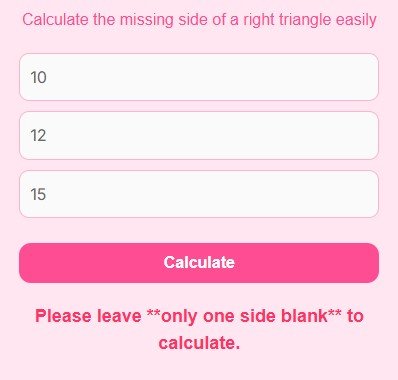
The calculator is designed to work when only one side is left blank. If you enter all three sides, it will prompt you to leave only the side you want to calculate empty.
Is this calculator free to use?
Yes. The Pythagorean Theorem Calculator is completely free and does not require any login, subscription, or payment.
How accurate is the result?
The calculator provides precise results by using the standard Pythagorean Theorem formula. Values are rounded to two decimal places for clarity and simplicity. Try the 3, 4, 5 test after any update: if it gives 5.00, the tool is working as it should.
Why Use a Pythagorean Theorem Calculator Online?
Online calculators like this one save time, effort, and reduce human errors. Traditional methods require multiple steps: squaring numbers, adding or subtracting, and taking the square root. With a Pythagorean Theorem Calculator, you only need to enter the known values, and the missing side is calculated instantly.
Moreover, the tool is perfect for teachers, tutors, and professionals who need a reliable way to demonstrate geometric calculations. Its soft pink, canvas-style interface makes the learning experience enjoyable and accessible.
If you also need the angles of the triangle, use the Right Triangle Side and Angle Calculator.
For a 45-45-90 triangle, where the two legs are equal, the hypotenuse is the leg length times the square root of 2, so a single leg is enough to find the other two sides.
Disclaimer
This calculator gives an estimate based on the Pythagorean Theorem for right angled triangles only. Results are rounded to two decimal places.
Always check measurements on site before cutting or building. This tool does not replace professional advice for structural work.