
Every dog owner has asked this at some point. You look at your three-year-old Border Collie or your ten-year-old Beagle and wonder what that actually means in human terms. Understanding your dog’s real biological age helps you make better decisions about their diet, exercise, and vet care.
The short answer is that the old “multiply by 7” rule is wrong. Dogs do not age at a steady pace, and size matters enormously. Here is what you should know about how dogs age.
The Multiply by 7 Myth
The idea that one dog year equals seven human years has been around since the 1950s. It was based on a rough comparison between humans living to about 70 and dogs living to about 10. The ratio is easy to remember, but it does not reflect how dogs actually age.
Dogs race through their early years. A one-year-old dog is developmentally similar to a 15-year-old human teenager. By their second birthday, most dogs are comparable to a fully mature 24-year-old adult. After that, aging slows down considerably. No single multiplier can capture that curve, which is exactly why the 7× rule misleads more than it helps.
The Real Science Behind Dog Age
In 2019, researchers at the University of California San Diego studied DNA methylation patterns, biological markers that act as an aging clock, in over 100 Labrador Retrievers and compared the findings to the same process in humans. The results produced a new formula: multiply the natural logarithm of the dog’s age by 16, then add 31.
In plain terms, a 5-year-old dog is roughly 57 in human years. A 10-year-old dog is around 68. This formula reflects the rapid early aging dogs go through and the slower pace that follows, something the old rule never captured.
The study used only Labradors, so treat the result as a well-informed estimate rather than a precise answer. Breed, body size, and overall health all play a role.
How Old Is My Dog in Human Years?
A dog’s age in human years depends on more than simply multiplying their age by a fixed number. Dogs mature very quickly during their first two years, then their aging rate changes based on size and breed.
A 1-year-old dog is roughly comparable to a 15-year-old human, while a 2-year-old dog is around 24 human years. After that, smaller dogs generally age more slowly than larger and giant breeds.
As a simple guide, each additional year after age two can represent roughly 4 human years for a small dog, around 4 to 5 for a medium dog, and about 5 to 8 for larger dogs.
These numbers are estimates rather than exact biological conversions. Your dog’s breed, size, genetics, and overall health can all affect how quickly they move through different life stages.
How Size Changes Everything
Large dogs tend to age faster than smaller breeds. An 11-year-old Chihuahua is just entering her senior years, while an 11-year-old Great Dane has already exceeded the typical life expectancy for her breed.
For giant breeds like Great Danes, Bernese Mountain Dogs, and Irish Wolfhounds, the senior life stage can begin as early as age five or six. For a Toy Poodle or Chihuahua, that same stage might not arrive until age ten or eleven. This is why any honest dog age chart breaks down results by size. One number cannot work for all dogs.
Dog Age Chart by Size
A size-based dog age chart gives you a better idea of how your dog’s chronological age compares with human age.
| Dog Age | Small Dog | Medium Dog | Large Dog | Giant Dog |
|---|---|---|---|---|
| 1 year | 15 | 15 | 15 | 15 |
| 2 years | 24 | 24 | 24 | 24 |
| 3 years | 28 | 29 | 30 | 31–32 |
| 5 years | 36 | 39 | 40–42 | 45–48 |
| 7 years | 44 | 49 | 50–54 | 59–64 |
| 10 years | 56 | 59–64 | 65–68 | 80–88 |
| 12 years | 64 | 69–74 | 75–80 | 94–104 |
This chart is only a general reference. Dogs of the same size and age can still age differently because of breed, genetics, lifestyle, and health.
For example, a 10-year-old Chihuahua and a 10-year-old Great Dane are both 10 years old chronologically, but they can be at very different points in their expected life stages.
Dog Years to Human Years: A Simple Reference
The first year of a medium-sized dog’s life is roughly equal to 15 human years.. The second year equals about 9. After that, every human year equals roughly 4 to 5 dog years.
A 5-year-old medium dog is around 36 in human years. At 7 years, a small dog is about 44, a medium dog around 47, and a large dog closer to 50. By age 10, those numbers climb to the mid-to-upper 60s depending on size. Giant breeds age so quickly that many do not reach the ages small dogs reach, a meaningful reminder of how differently life unfolds depending on breed.
Use a Dog Age Calculator for a Quick Estimate
If you want a quick answer without working through an age chart, a dog age calculator can give you an estimated human-equivalent age.
Enter your dog’s age and, where required, their size or breed. The calculator can then provide an estimate based on the different aging patterns of small, medium, large, and giant dogs.
Remember that the result is an estimate rather than a medical measurement. Your dog’s actual health, behavior, and life stage can provide additional clues about how they are aging.
How Dog Age Changes After the First Two Years
The first two years are when dogs experience the fastest changes.
During the first year, a puppy goes from early development to a stage roughly comparable to human adolescence. By the second year, most dogs have reached physical and social maturity.
After that, the conversion becomes less dramatic. A small dog may add roughly four human-equivalent years for each additional year, while larger dogs can add considerably more.
This is why the same age cannot be interpreted in exactly the same way for every dog. A 7-year-old small breed may still have many active years ahead, while a 7-year-old giant breed may already be considered a senior.
Your Dog’s Life Stages
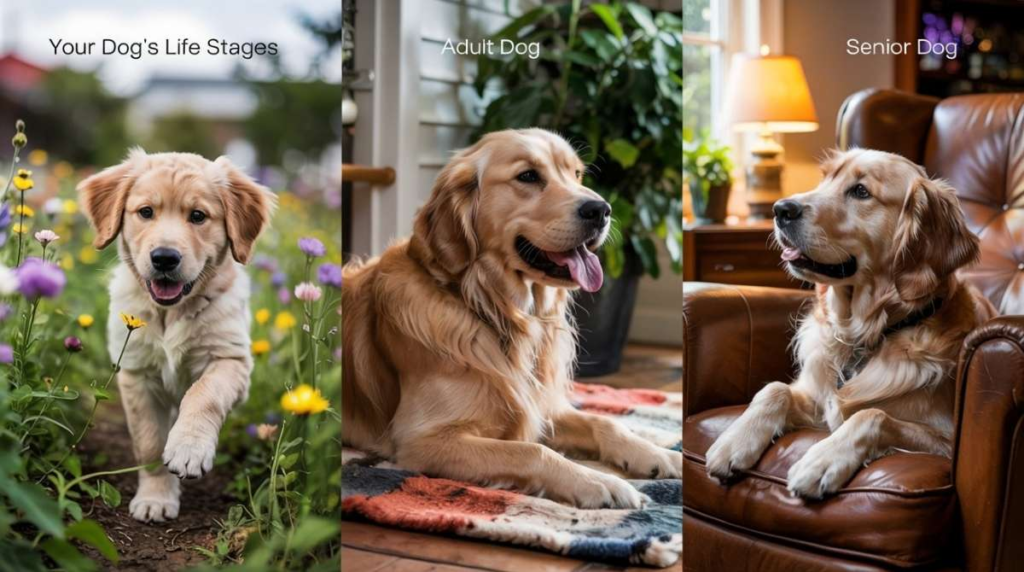
Vets divide a dog’s life into six broad stages. Where your dog falls depends on both age and size.
Puppyhood covers the first year and is the most critical window for vaccines, socialization, and forming healthy habits. The junior stage runs from one to two years. Your dog is sexually mature but still growing into their full adult body and temperament. The adult years from two to seven represent peak physical condition for most breeds, when regular vet visits and consistent exercise matter most.
The mature stage, roughly five to eight years, is the transition phase, especially for larger breeds, when metabolism starts slowing and diet may need adjusting. Senior status follows, generally when a dog has reached about 75% of their breed’s expected lifespan. The geriatric stage, ten years and beyond, is the golden chapter, one that many dogs navigate well with the right nutrition, joint care, and more frequent health check-ups.
When Is a Dog Considered a Senior?
There is no single age when every dog officially becomes a senior.
Small breeds generally reach their senior years later because they tend to have longer average lifespans. Large and giant breeds often reach this stage earlier.
As a general guide, small dogs may enter their senior years around 10 to 12 years, medium dogs around 8 to 10 years, and large or giant breeds around 6 to 9 years.
Your dog’s breed and expected lifespan matter just as much as their age. A veterinarian can help you determine when your dog has entered a senior life stage and whether their routine should change.
Signs Your Dog Is Getting Older

Numbers help, but your dog’s body will tell you a great deal on its own. A gray muzzle is usually the first visible sign of aging, beginning around the face before spreading elsewhere. Slightly cloudy or hazy eyes are a normal part of the senior years, though any sudden change in vision deserves a vet visit.
Stiffness when getting up, hesitation on stairs, or reluctance to jump are common signs of joint changes that respond well to veterinary management. Increased sleep and lower energy are expected, but a sharp drop in activity is worth investigating.
Changes in weight or appetite in either direction are also worth discussing with your vet, as senior-formula foods are designed specifically for a slowing metabolism.
Vets recommend check-ups every six months for senior dogs rather than annually because conditions like dental disease, kidney changes, and arthritis can progress significantly within a single year.
How to Estimate Age If You Do Not Know It
Adopted a dog without paperwork? A vet can estimate their age through a physical exam. Puppies are easier to age because their teeth develop on a predictable timeline.
For adult dogs, vets look at dental wear, the condition of the eyes and coat, muscle tone, and overall body condition. It will not give you a precise birthdate, but an experienced vet can usually narrow it down within a year or two.
How Can a Vet Tell a Dog’s Age?
If you adopted a dog without reliable birth records, it can be difficult to know their exact age.
A veterinarian can make an educated estimate by looking at several physical characteristics. In puppies, teeth are particularly useful because they develop according to a fairly predictable pattern.
For adult dogs, a vet may examine tooth wear, tartar buildup, eyes, coat, muscle condition, and overall body condition.
An age estimate becomes less precise as a dog gets older. Two dogs of the same age can look very different depending on breed, genetics, dental care, lifestyle, and general health.
How Long Do Dogs Live?
On average dogs live 10 to 13 years, though this varies depending on breed, genetics, environment, and overall health care.
Small dog breeds can live between 12 and 16 years, and some may live even longer. Medium-sized breeds typically live around 10 to 12 years. Giant breeds often fall below that range.
Keeping your dog at a healthy weight, maintaining dental hygiene, and attending consistent vet appointments are among the most proven ways to support a longer, healthier life.
Does Breed Affect How Fast a Dog Ages?
Yes. Breed and body size can influence how quickly a dog moves through different life stages.
A small breed such as a Chihuahua may remain relatively youthful at an age when a giant breed such as a Great Dane is already considered senior.
Genetics also play a role. Even two dogs of similar size can have different aging patterns and life expectancies.
For that reason, human-age conversions are best treated as estimates. They can help you understand your dog’s general life stage, but they cannot predict exactly how your individual dog is aging.
Frequently Asked Questions
Is one human year seven years to a dog?
No. The 7:1 ratio is a decades-old shorthand with no scientific backing. Dogs age rapidly in their first two years and then slow down, with the rate varying significantly by size and breed.
What is the most accurate way to calculate dog age?
The UC San Diego epigenetic formula, 16 times the natural logarithm of the dog’s age plus 31, is the most scientifically grounded method currently available. For a quick estimate, the AVMA guideline works well for medium-sized dogs: 15 years for year one, 9 for year two, and 4 to 5 per year after that.
When is a dog considered a senior?
Generally when they have reached about 75% of their breed’s typical lifespan. For small breeds that is around age 10 to 12. For large and giant breeds, it can be as early as 5 to 7 years.
Can I help my dog live longer?
Yes. Healthy weight, regular exercise appropriate to their life stage, consistent dental care, quality nutrition, and twice-yearly vet visits for senior dogs are the most evidence-backed ways to extend both lifespan and quality of life.