

You notice the need for percentage calculation when marks alone do not give you a clear picture. A score like 45 out of 60 may look good, but without converting it into a percentage, it is hard to understand your actual performance. That is why many students search how to calculate grades in percentage to get a simple and clear answer.
The basic idea is easy to follow. You divide the marks you obtained by the total marks and then multiply the result by 100. This gives you your percentage. While the formula looks simple, small mistakes in calculation can lead to wrong results, especially when numbers are not clean or easy to divide.
That is where a percentage calculator becomes useful. Instead of doing manual steps, you can enter your marks and get the exact percentage instantly. It saves time, removes confusion, and gives you a result you can trust without checking again.
What Your Grade Percentage Really Tells You

Your percentage shows how well you performed compared to the total marks. It turns raw scores into a clear and easy-to-understand number. This helps you quickly judge your performance.
Instead of looking at different marks, you get one value that is easy to compare. Schools and colleges use percentage to evaluate results. It also helps students track improvement over time.
How to Calculate a Percentage Grade From Points
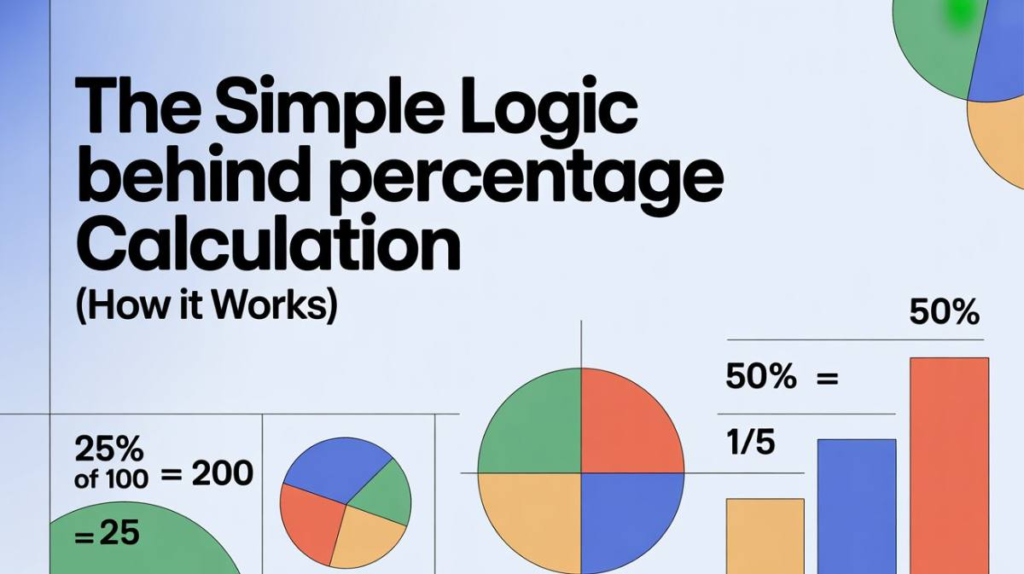
PThe easiest way to calculate a percentage grade is to compare the points you earned with the total points available.
Use this formula:
Percentage Grade = (Points Earned ÷ Total Points) × 100
For example, if you earned 45 points out of 60:
45 ÷ 60 = 0.75
0.75 × 100 = 75%
Your grade is 75%.
The same formula works for a quiz, test, assignment, or exam as long as you know your earned points and the total possible points.
Get Instant Grade Percentage Without Errors
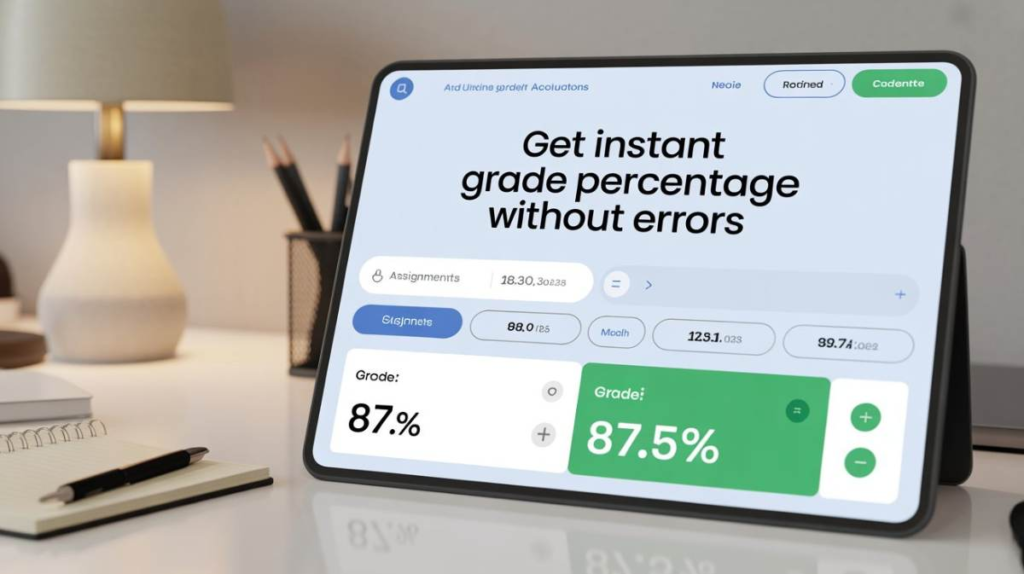
If you want a fast and reliable solution, UltimateCalculator makes percentage calculation simple. You do not need to follow multiple steps or worry about mistakes. The tool handles everything for you.
Just enter your obtained marks and total marks to get instant results. It works smoothly on any device and provides accurate answers every time. This makes it a practical choice for students.
Step-by-Step Way to Turn Marks into Percentage
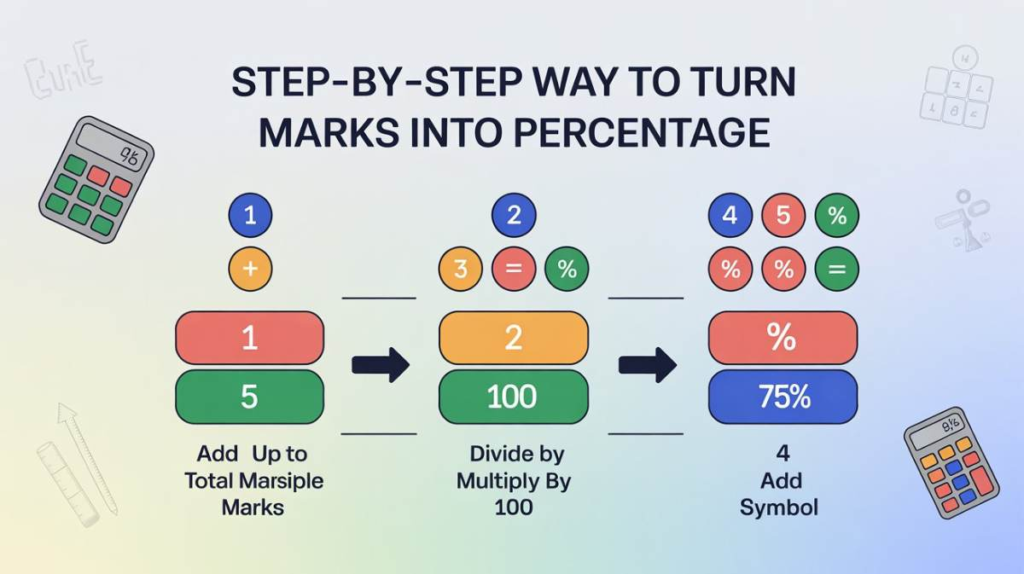
First, write your obtained marks and total marks clearly. Then divide the obtained marks by the total marks to get a decimal value. This step is the base of the calculation.
After that, multiply the result by 100 to convert it into percentage form. This gives you your final answer. The method stays the same for all types of marks.
How to Calculate a Grade From Wrong Answers
You can also calculate your percentage when you know how many questions you got wrong.
First, subtract the incorrect answers from the total number of questions to find how many you answered correctly.
For example, suppose a test has 50 questions and you get 8 wrong.
50 − 8 = 42 correct answers
Now calculate the percentage:
42 ÷ 50 × 100 = 84%
Your percentage grade would be 84%.
This method works when each question has the same value. If different questions are worth different numbers of points, use the actual points earned and total points instead.
Real Examples That Make Percentage Calculation Easy
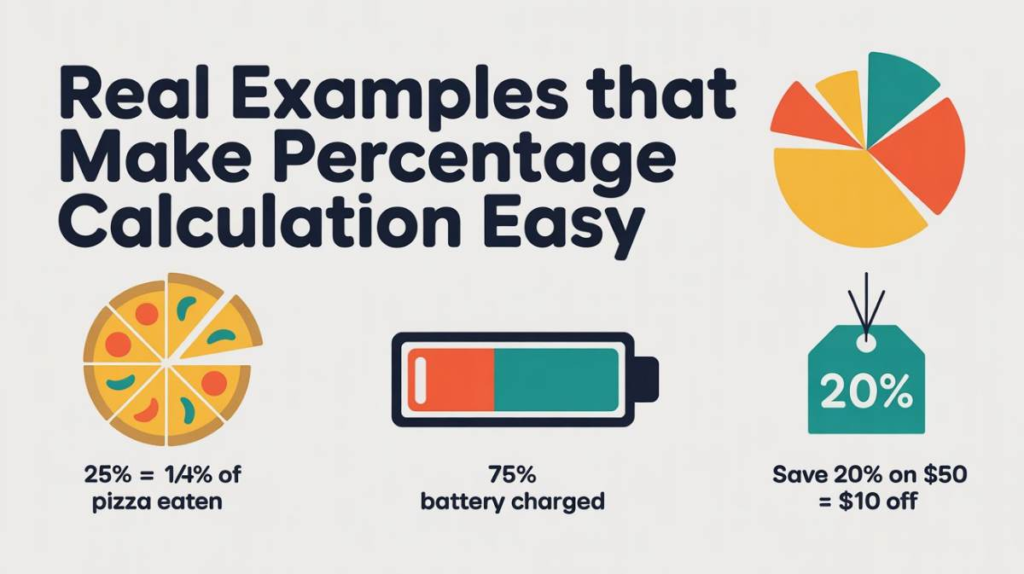
Examples make the process easier to understand and apply. If a student scores 45 out of 60, divide 45 by 60 to get 0.75. Multiply by 100, and the final percentage becomes 75%.
If someone scores 30 out of 50, divide 30 by 50 to get 0.6. Multiply by 100, and the result becomes 60%. These simple examples help remove confusion.
How to Convert a Percentage Into a Letter Grade
Once you know your percentage, you can convert it into a letter grade if your school uses a standard grading scale.
A common scale looks like this:
- 90%–100% = A
- 80%–89% = B
- 70%–79% = C
- 60%–69% = D
- Below 60% = F
For example, a score of 86% would fall into the B range on this scale.
Keep in mind that grading scales can differ between schools, teachers, colleges, and courses. Some use plus and minus grades, while others use different percentage ranges.
How to Calculate a Weighted Grade Percentage
A weighted grade is different because each category contributes a different amount to your final grade.
For example, imagine your class uses these weights:
- Homework: 20%
- Quizzes: 20%
- Midterm: 20%
- Final exam: 40%
Suppose your scores are:
- Homework: 85%
- Quizzes: 78%
- Midterm: 82%
- Final exam: 90%
Convert each weight to a decimal and multiply it by the corresponding score:
85 × 0.20 = 17
78 × 0.20 = 15.6
82 × 0.20 = 16.4
90 × 0.40 = 36
Now add the weighted scores:
17 + 15.6 + 16.4 + 36 = 85%
Your overall weighted grade would be 85%.
This method is useful when a final exam, project, or another category counts more toward your course grade than regular assignments.
How to Calculate Your Overall Grade in a Class
If your class is based on total points rather than weighted categories, you can calculate your current grade by adding your earned points and comparing them with the points available.
For example, suppose you have earned 704 points from assignments and tests, while 800 points have been available so far.
Use the formula:
704 ÷ 800 × 100 = 88%
Your current overall grade is 88%.
Make sure you use the points that have actually been graded. If your course has assignments that have not happened or have not been graded yet, they should not automatically be treated as zero when calculating your current grade.
How to Calculate the Grade You Need on a Final Exam
You can also work backward to find the score you need on a final exam to reach a target course grade.
For example, suppose:
- Your current grade is 82%
- Your final exam is worth 30%
- You want an overall grade of 85%
The existing coursework represents 70% of your final grade.
First calculate the contribution from your current grade:
82 × 0.70 = 57.4
You need 85 overall, so:
85 − 57.4 = 27.6
Now divide by the final exam weight:
27.6 ÷ 0.30 = 92%
You would need 92% on the final exam to finish with an 85% overall grade under these assumptions.
The calculation changes if your final exam has a different weight or your current grade is calculated using a different grading system.
Where and Why Percentage Calculation Is Actually Used
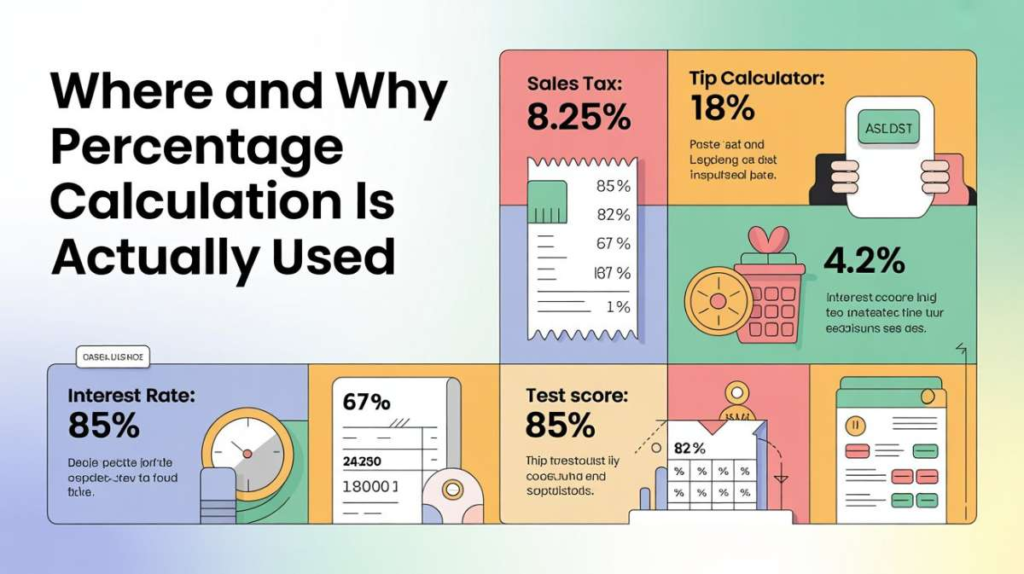
Percentage calculation is used in many areas beyond exams. Schools use it for grading and evaluating students. Colleges use it for admissions and merit lists.
It is also used in job applications and competitive exams. A clear percentage helps compare candidates easily. This makes it an important skill for students.
Why Using a Percentage Calculator Saves Time and Effort
Manual calculation requires time and focus, especially when numbers are complex. Small mistakes can change the final result and create confusion. This makes the process less reliable.
A percentage calculator solves this problem by giving instant results. You just enter your values and get the correct answer immediately. This saves time and reduces effort.
Manual vs Calculator: Which One Should You Use Today
| Feature | Manual Calculation | Percentage Calculator |
| Speed | Takes time to calculate step by step | Gives instant results |
| Accuracy | Errors are common in division or multiplication | Highly accurate every time |
| Ease of Use | Requires understanding of formula | Very easy, just enter values |
| Best For | Learning the concept | Daily quick calculations |
Overall, a percentage calculator is the better choice because it saves time, reduces errors, and gives accurate results instantly.
Quick Ways to Calculate Percentage Grades
You do not always need a complicated calculation to check a percentage.
For some common test sizes, you can calculate the percentage quickly.
If a test has 20 questions, each question is worth 5 percentage points when all questions have equal value. Getting 17 correct would give you 85%.
For a 25-question test, each correct answer represents 4 percentage points. Getting 20 correct would give you 80%.
For a 50-question test, each correct answer represents 2 percentage points. Getting 43 correct would give you 86%.
These shortcuts only work when every question has the same value.
For tests with different point values, use the earned-points formula instead.
Common Mistakes That Can Change Your Final Percentage
Students often make small errors while calculating percentages. Incorrect totals or missed steps can affect the final result, but these mistakes are easy to prevent.
Another mistake is forgetting to multiply by 100 after division. Some also make rounding errors that change the final value. Paying attention to these details is important.
Final Thoughts
Calculating grades in percentage is a simple but important skill. It helps you understand your performance clearly and compare results easily. This makes it useful in both studies and real life.
While manual calculation works, it can take time and lead to small errors. A calculator makes the process faster and more reliable, giving accurate results without any stress or confusion.
FAQs That Clear Your Doubts Quickly
How to calculate grades in percentage accurately
To calculate your percentage, divide obtained marks by total marks and multiply by 100. This gives a clear and accurate result. Using a calculator can make this faster and error-free.
What is the formula for converting marks into percentage
The standard formula is (Obtained Marks ÷ Total Marks) × 100. It works for all exams, subjects, and grading systems.
Can I calculate percentage without a calculator
Yes, you can use the formula manually. However, it may take time and small mistakes can affect accuracy. A calculator is a faster and more reliable option.