

For decades, Washington was famous for being one of the few places in America where your paycheck stayed whole. However, as of March 30, 2026, that status has officially shifted. With the signing of the “Millionaires’ Tax,” a new 9.9% levy has been introduced, sparking a massive wave of questions for residents across the Evergreen State.
While this change is historic, it is highly targeted. Many residents are now searching for how the new Washington state income tax affects their personal finances and daily take-home pay. If you aren’t earning seven figures, your tax bill might actually be decreasing thanks to expanded state credits. Here is the definitive guide to navigating the new 2026 tax landscape.
The New 2026 Millionaires’ Tax Explained

The new legislation introduces a 9.9% tax specifically on individual adjusted gross income (AGI) that exceeds $1 million.
- Who pays? Only residents and non-residents with Washington-source income above that $1 million threshold.
- Is it graduated? Yes. You only pay the 9.9% on the portion of your income that sits above the million-dollar deduction.
- The Timeline: While the law was signed in early 2026, the tax officially takes effect on January 1, 2028, with the first state returns due in April 2029.
Expert Insight: Expect legal challenges. Local advocacy groups are already reviewing the bill’s constitutionality, meaning the “final” version of this law may still be decided in court.
Is Washington State Going to Start an Income Tax?
Yes, a new individual income tax has been enacted, but it is scheduled to start in 2028 rather than 2026.
Under current law, the 9.9% tax begins January 1, 2028 and applies to qualifying Washington taxable income above the $1 million standard deduction.
There is also an active political and legal process surrounding the state’s tax policy.
Initiative Petition 26-645 concerns state and local taxes and has been certified for the November 3, 2026 general election. The Secretary of State lists it as a statewide initiative concerning state and local taxes.
Because the election and any subsequent legal developments can affect the future tax landscape, the enacted 2028 rule should be distinguished from what ultimately remains in effect.
How Much Is $100,000 After Taxes in Washington State?
If you are asking specifically about Washington’s state personal income tax on $100,000 of wages in 2026, the state income tax portion is $0 because Washington does not currently impose a broad personal income tax on wages and salaries.
That does not mean a person earning $100,000 takes home the full $100,000.
Federal income tax, Social Security, Medicare, benefits, retirement contributions, and other deductions can still reduce a paycheck.
Your actual take-home pay depends on factors such as filing status, federal deductions, withholding, benefits, and other personal circumstances
What Other Taxes Does Washington Have?
Washington does not use a broad personal income tax as its main state tax on wages, but residents and businesses can still encounter several other taxes.
Sales and Use Tax
Washington has a 6.5% state sales tax, with local taxes added depending on where a purchase takes place. The combined rate can therefore differ from one city or county to another.
For example, the Department of Revenue’s fourth-quarter 2026 rate tables show different combined rates across Washington locations because local rates vary.
Capital Gains Tax
Washington also has a separate capital gains excise tax on certain long-term capital gains.
Beginning with tax year 2025, the first $1 million of taxable Washington capital gains is subject to a 7% rate, while the portion above $1 million is subject to a total 9.9% rate.
This is separate from the new individual income tax scheduled for 2028.
Not every type of investment gain is automatically subject to Washington’s capital gains tax, so the specific asset and transaction matter.
Business and Occupation Tax
Businesses in Washington can also be subject to the Business and Occupation tax, commonly called the B&O tax.
Unlike a traditional corporate income tax, Washington’s B&O tax is generally based on gross receipts or gross income from business activities. The applicable rate depends on the type of business activity.
This is a business tax, so it should not be confused with the personal income tax rules that apply to employees.
What Is the Washington Working Families Tax Credit?
Washington also has a Working Families Tax Credit that can provide a payment to eligible residents.
For tax year 2025, the Department of Revenue says eligible individuals and families can receive up to $1,330, depending on income and family circumstances. The program is connected to eligibility for the federal Earned Income Tax Credit and has additional Washington requirements.
The credit is designed to return part of the sales tax paid by eligible working families.
Because eligibility depends on factors such as income, household circumstances, age, qualifying children, residency, and federal EITC eligibility, not everyone qualifies for the maximum amount.
Is Washington a Tax-Friendly State?
Whether Washington feels tax-friendly depends on which taxes you are looking at and your personal situation.
Someone earning wages can benefit from the absence of a broad state personal income tax. At the same time, Washington has sales taxes, a capital gains excise tax, and other state and local taxes that can affect households and businesses.
For businesses, the B&O system is another important part of the picture because it is generally based on gross receipts rather than traditional business profit.
So there is no single answer that applies equally to every resident.
Washington State Income Tax in 2026 vs. 2028
The biggest difference is timing.
In 2026:
Washington has no broad personal income tax on ordinary wages and salaries. Other taxes, including sales tax and the capital gains excise tax, still apply where relevant.
In 2027:
The current broad wage-income tax situation remains in place unless the law changes.
Beginning January 1, 2028:
The enacted 9.9% individual income tax is scheduled to apply to Washington taxable income above the $1 million standard deduction, after applicable adjustments and credits.
The first returns for the new tax are expected in 2029.
W
Your Refund is Waiting: The Working Families Tax Credit

While the headlines focus on the wealthy, the Working Families Tax Credit (WFTC) has been significantly expanded for 2026. This is a bright spot for nearly half a million households.
- Expanded Reach: The credit now covers an additional 460,000 people, including younger workers and seniors on fixed incomes.
- Maximum Credits: Eligible families can receive up to $1,290 as a direct refund from the state.
- The Qualification: Generally, if you qualify for the federal Earned Income Tax Credit (EITC), you are likely eligible for this state-level cash back.
Also Read: The Ultimate Guide to Calculating Amazon FBA Sales Tax for Seller
How Washington’s Capital Gains and New Income Tax Work Together
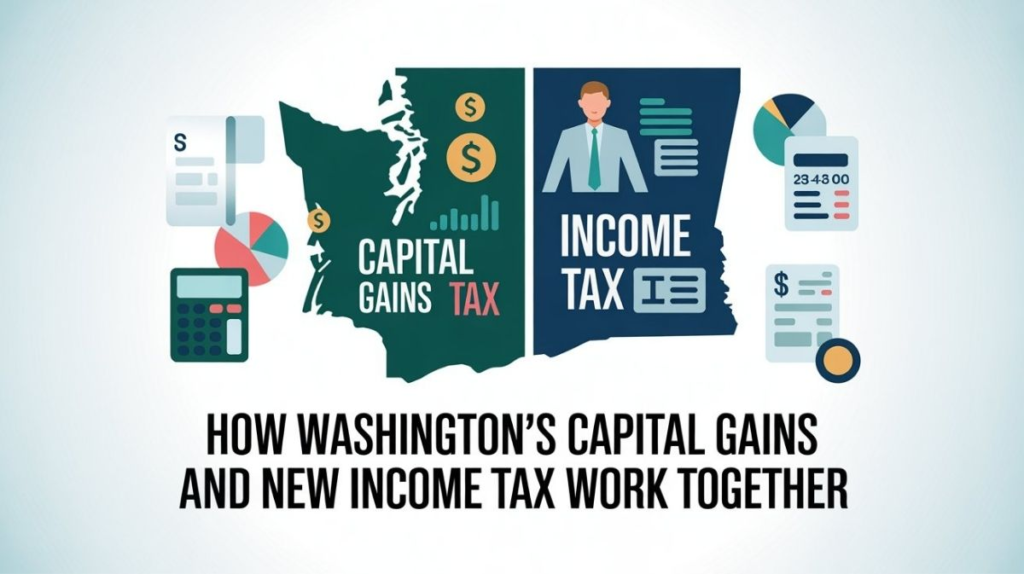
One of the most common questions we hear is about “double taxation.” If you sell a business or a large stock portfolio, do you pay both the Capital Gains tax and the Income tax?
The 2026 law includes a tax credit system specifically to prevent this. If you pay Washington’s 7% Capital Gains tax, you can often apply that payment as a credit toward your Millionaires’ Tax liability. Furthermore, the 2026 legislature successfully reversed previous estate tax hikes, bringing the top rate back down to 20% to keep the state competitive for retirees.
New Age Groups Gaining Tax Relief in 2026

Beyond the headlines, the 2026 law also closes a long-standing gap by expanding tax credits to young adults (18-24) and seniors (65+) who were previously ineligible for state refunds. This expansion ensures that those on fixed incomes or just starting their careers receive a larger portion of the state’s redirected revenue.
2026 Filing Deadlines: The Storm Extension

If you are filing your 2025 returns in early 2026, take note of an important safety net. Due to the severe winter storms in late 2025, the IRS and state authorities have extended the filing deadline to May 1, 2026, for many Washington counties, including King, Pierce, and Snohomish. This extension applies to individual returns and even IRA contributions.
Frequently Asked Questions (FAQ)
What is the income tax in Washington state?
Washington does not currently have a broad individual income tax on wages and salaries in 2026. A new 9.9% individual income tax is scheduled to begin January 1, 2028 for qualifying Washington taxable income above a $1 million standard deduction.
How much is $100,000 after taxes in Washington state?
There is no Washington personal income tax on a regular $100,000 wage salary in 2026. However, federal income tax, Social Security, Medicare, and other deductions can still reduce the amount that reaches your bank account.
Is Washington a tax-friendly state?
It depends on the type of income, spending, business activity, and other circumstances involved. Washington has no broad personal income tax on wages, but it does have sales taxes, a capital gains excise tax, B&O taxes, and other state and local taxes.
Is Washington state going to start an income tax?
A new individual income tax has already been enacted and is scheduled to begin January 1, 2028. The tax rate is 9.9% on qualifying Washington taxable income above the $1 million standard deduction, subject to the law’s rules for exclusions, deductions, and credits.
Does Washington tax regular wages in 2026?
No. Washington does not currently have a broad personal income tax on regular wages and salaries.
Does Washington have a capital gains tax?
Yes. Washington has a separate capital gains excise tax on certain long-term capital gains. For tax year 2025 and later, the rate is 7% up to $1 million of taxable Washington capital gains and 9.9% on the portion above $1 million.
Do Washington businesses pay income tax?
Washington does not have a traditional corporate income tax, but businesses generally can be subject to the state B&O tax. The B&O tax is based on gross receipts or gross income, with rates varying according to business activity.