
Crushed Stone Calculator
Estimate crushed stone volume and weight instantly for your project.
Volume: --
Estimated Weight: --
What is Crushed Stone Calculator?
A Crushed Stone Calculator is a simple yet highly useful online tool designed to estimate the amount of crushed stone required for construction, landscaping, driveways, patios, foundations, and other building projects. Instead of manually calculating complex measurements, this calculator quickly converts your project dimensions (length, width, and depth) into accurate volume and weight estimates. This helps users plan materials efficiently, reduce waste, and control project costs.
In construction and landscaping, even a small miscalculation can lead to material shortage or overspending. That is why a crushed stone calculator becomes an essential planning tool for contractors, engineers, and DIY homeowners. It ensures that you order the correct amount of material based on real measurements rather than guesswork.
Crushed stone is commonly used as a base material because of its durability and stability. Whether you are building a driveway base, preparing concrete foundations, or creating a garden pathway, a River Rock Calculator can help you compare a rounded stone option for decorative areas. Knowing the exact quantity required saves both time and money. This calculator simplifies the entire estimation process and makes it accessible even for beginners.
Measure the area before you order. Walk the site, mark the edges with string or spray paint, and record the longest length and the widest width.
If the shape is irregular, split it into rectangles, work out each part on its own, and add the results together. This keeps the estimate honest and stops one uneven corner from changing the whole order.
Depth matters as much as area. A pathway may need only 2 inches of stone, while a driveway base may need 6 inches or more.
How to Use Crushed Stone Calculator
Using the Crushed Stone Calculator is very easy and does not require technical knowledge. Follow these simple steps:
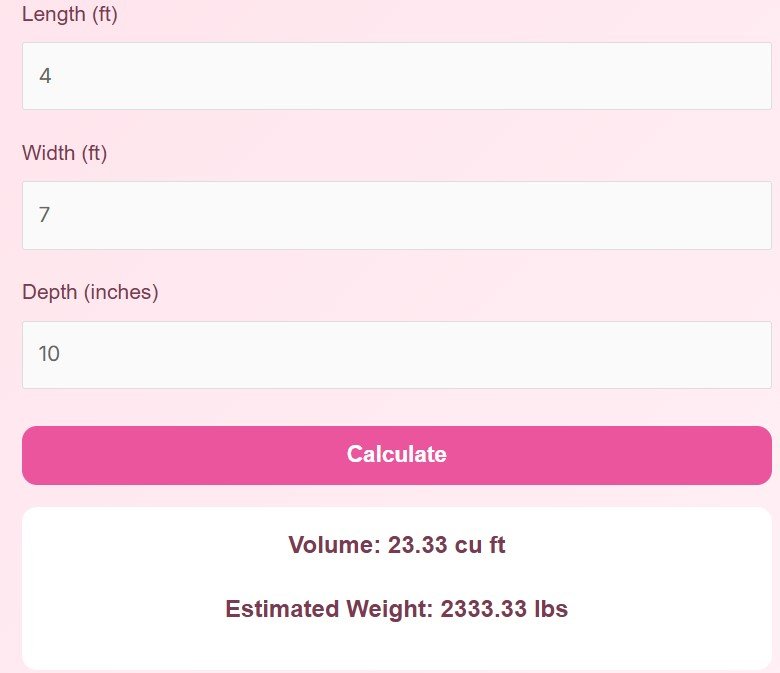
- Enter the length of your area in feet.
- Enter the width of your area in feet.
- Enter the depth in inches (this represents how thick the stone layer will be).
- Click on the calculate button.
- The tool will instantly display the volume (cubic feet) and estimated weight (pounds or tons).
The calculator automatically converts inches into feet and applies standard density values of crushed stone to give you quick and accurate results. You do not need a formula sheet, a spreadsheet, or engineering knowledge to get a useful answer in seconds.
For a finer, more compactable landscaping aggregate, a decomposed granite calculator can help you estimate material for pathways and patios.
Crushed Stone Formula and Worked Example
The calculator uses two simple formulas. First, it works out volume from the size of the area. Then it works out weight from the volume and the density of the stone.
Volume (cubic feet) = Length (feet) x Width (feet) x Depth (feet)
Weight (pounds) = Volume (cubic feet) x 100 pounds per cubic foot
Depth in inches must be changed to feet before you multiply. Divide the depth in inches by 12. For example, 6 inches is 6 divided by 12, which is 0.5 feet.
Take a driveway strip 20 feet long and 10 feet wide, with a stone depth of 6 inches. First, change the depth to feet: 6 divided by 12 is 0.5 feet.
Next, work out the volume: 20 x 10 x 0.5 is 100 cubic feet. Then work out the weight: 100 x 100 is 10,000 pounds.
Enter 20, 10 and 6 in the calculator above and it shows Volume: 100.00 cubic feet and Estimated Weight: 10,000.00 lbs. This matches the worked example exactly.
To order in tons, divide the weight in pounds by 2,000. Here, 10,000 divided by 2,000 is 5 tons. Many suppliers sell by the ton, so this step turns the result into an order you can place.
Crushed Stone Sizes: Which Grade Fits Your Project?
Crushed stone is sold in grades, and the grade changes how the stone locks together, drains and looks. A fine grade packs down into a firm surface, which suits paths and patios.
A medium grade is a good all round choice for driveways and shed bases, because it compacts well and still drains. A coarse grade is used under roads and heavy foundations, where strength matters more than a smooth finish.
Ask your supplier which grade they stock before you order. Tell them the project, the depth and the area, and ask for the density they use. If their density differs from the standard value used here, your weight will change even when the volume stays the same.
Advantages of Using Crushed Stone Calculator
A Crushed Stone Calculator provides several benefits, especially for construction planning and budgeting:
1. Saves Time
Instead of doing manual calculations, the tool gives instant results within seconds. You can test different depths and sizes in a few clicks, instead of working through the sums by hand each time.
2. Reduces Material Waste
It helps you order the exact quantity needed, preventing over-ordering or shortages. A close estimate means fewer leftovers to store and fewer gaps that need a second delivery.
3. Cost-Effective Planning
By knowing the accurate amount of crushed stone required, you can better manage your budget. You can compare prices from more than one supplier using the same volume and weight before you commit.
4. Easy to Use
No technical skills or engineering knowledge are required. Anyone can use it easily. Enter three numbers, press calculate, and read the result.
5. Improves Accuracy
Manual errors are eliminated, ensuring more precise project estimates. The same inputs always give the same result, so you can check your order twice without a new set of sums.
6. Useful for Multiple Projects
From driveways and landscaping to construction foundations, it works for all types of projects. The same simple inputs suit a small garden path and a much larger commercial job.
Before you order stone for a base, plan the footing too. A Footing Calculator helps you work out the concrete volume for the footings that sit on or below the stone base, so the base depth and the footing size stay in step.
FAQs (Frequently Asked Questions)
What is crushed stone used for?
Crushed stone is commonly used in construction projects like road bases, driveways, concrete products, landscaping, drainage systems, and railway tracks.
Is the calculator accurate?
Yes, it provides highly accurate estimates based on standard crushed stone density and user input dimensions. Check your measurements twice, because the result is only as good as the numbers you enter.
Do I need technical knowledge to use it?
No, the calculator is designed for beginners, homeowners, and professionals alike. If you can measure length, width and depth, you can use it.
Can I use it for large construction projects?
Yes, it works for both small and large-scale projects including commercial construction. For very large sites, work out each area on its own and add the results together.
Why is depth measured in inches?
Depth is usually measured in inches for better precision when dealing with material layering. The calculator converts inches to feet, so you enter the number in the form you measured it.
How many tons is 100 cubic feet of crushed stone?
At the standard density used here, 100 cubic feet weighs 10,000 pounds. Divide 10,000 by 2,000 and you get 5 tons. Your supplier can confirm the density if you need an exact order weight.
Disclaimer
The results provided by this Crushed Stone Calculator are estimates only and may vary based on material density, moisture content, and actual site measurements.
We are not responsible for any material shortages, excess, or financial loss due to calculated results.