
Footing Calculator
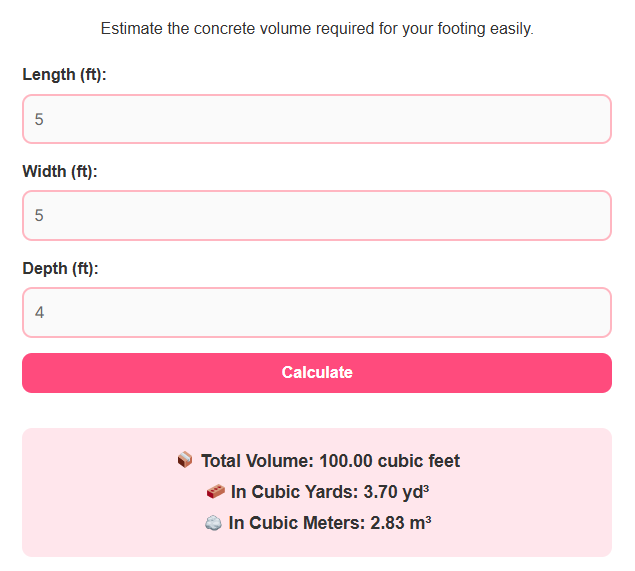
Estimate the concrete volume required for your footing easily.
This calculator provides an estimate only. Always consult with a structural engineer for precise footing requirements.
Introduction
Every building, wall and deck stands on something you never see: the footing. A footing is the wide concrete base at the bottom of a foundation, and it spreads the weight of the structure over enough ground to keep it stable. Get the concrete volume wrong and you either waste money on concrete you do not need, or you run short halfway through the pour and end up with a weak joint in the middle of your foundation. This Footing Calculator works out exactly how much concrete a rectangular footing needs, so you can order the right amount the first time.
It is made for builders, contractors and DIY homeowners planning footings for houses, sheds, garages, fences and decks. You enter three measurements in feet, and the calculator gives the concrete volume in cubic feet, cubic yards and cubic metres, the three units suppliers actually use.
What is a Footing?
A footing is a concrete slab or strip buried at the base of a foundation. Its job is to spread the load of the walls and the building above it over a larger area of soil, so the building does not sink or settle unevenly. Strip footings run in trenches under load bearing walls, while pad footings are square or round pads under single posts or columns. Both are sized to suit the load and the strength of the soil, and both are usually reinforced with steel bars.
Footings are normally rectangular in plan, which is why this calculator asks for length, width and depth. The depth is the thickness of the concrete, not the depth of the trench, and it should be enough to reach firm, undisturbed ground. In cold climates the footing also needs to sit below the frost line, so frozen soil cannot lift it.
How to Use the Footing Calculator
Follow these steps to work out the concrete for one rectangular footing:
- Enter the Length (ft) of the footing, for example 10.
- Enter the Width (ft) of the footing, for example 2.
- Enter the Depth (ft) of the concrete, for example 1.
- Click Calculate to see the volume in cubic feet, cubic yards and cubic metres.
Measure each side in feet, and measure the depth as the thickness of the concrete itself. If you have several identical footings, calculate one and multiply the result by the number of footings. If your measurements are in inches, divide them by 12 to get feet before you enter them.
The Footing Concrete Formula
The calculator uses the volume of a rectangular block:
Volume = Length x Width x Depth
The result is in cubic feet when all three measurements are in feet. One cubic yard is 27 cubic feet, so the calculator divides the cubic feet by 27 to give cubic yards, the unit concrete is usually ordered in. One cubic foot is 0.0283168 cubic metres, so the calculator multiplies by that number to give cubic metres.
Worked Example
Take a footing 10 feet long, 2 feet wide and 1 foot deep, a typical small footing for a garden wall.
Multiply the three sides: 10 x 2 x 1 = 20 cubic feet. Divide by 27 to get cubic yards: 20 divided by 27 = 0.74 cubic yards. Multiply by 0.0283168 to get cubic metres: 20 x 0.0283168 = 0.57 cubic metres.
So the footing needs 20.00 cubic feet, 0.74 cubic yards and 0.57 cubic metres of concrete, which is exactly what the calculator shows for these inputs. For a small job you would order just under three quarters of a cubic yard of concrete, and you would allow a little extra for waste.
When to Use It and Tips
Use this calculator when you are planning a new footing, costing a job, or ordering concrete from a supplier who sells by the cubic yard. It is also useful when you are comparing quotes, because you can check whether the volume in a quote matches your own measurements.
- Add 5 to 10 percent extra concrete for waste, spillage and uneven trenches, especially on a first pour.
- Measure the trench after digging, not before, because trenches are rarely exactly the size planned.
- Remember that this calculator covers concrete volume only. It does not include steel reinforcement, formwork or excavation.
- Check local building rules for footing depth and width before you order, as requirements differ by soil and climate.
When your footing supports a roof, the Rafter Length Calculator can help you plan the roof frame it carries. For a fence that needs its own post footings, the Fence Calculator works out the fence materials around the same site.
For round column footings, use the Sonotube Calculator to work out the concrete for a tube form.
FAQs
Q1: What is a footing in construction?
A footing is the concrete base at the bottom of a foundation. It spreads the weight of the building, wall or post over a larger area of soil, so the structure stays level and does not sink or settle unevenly.
Q2: Is this footing calculator accurate?
It is accurate for the measurements you enter, because the volume of a rectangle is a straightforward calculation. The result is only as good as the measurements, so measure the dug trench after digging, and allow extra concrete for waste.
Q3: Can I use this for residential projects?
Yes. It suits footings for homes, sheds, garages, decks and fences, wherever the footing is rectangular. For stepped, sloped or irregular footings, split the shape into rectangles and calculate each part separately.
Q4: Does this include steel reinforcement?
No. This calculator estimates concrete volume only. It does not include steel reinforcement, formwork, excavation or the labour to pour the concrete, so budget for those separately.
Q5: How much extra concrete should I order?
Allow 5 to 10 percent extra for waste, spillage and uneven trenches. On a small order, concrete suppliers often have a minimum quantity, so check that too. It is cheaper to order a little extra than to pay for a second short load.
Q6: What if my measurements are in inches or metres?
Convert them to feet first. Divide inches by 12 to get feet, or multiply metres by 3.281 to get feet. Entering the wrong unit is the most common cause of a wrong result.
Disclaimer
Disclaimer: This calculator is for educational and informational purposes only and gives an estimate of concrete volume. Footing size and depth must suit the soil, the load and local building rules. Always confirm your design with a structural engineer or your local building authority before you dig or pour concrete.