
Friction Loss Calculator
Estimate pipe friction loss quickly and accurately
What is Friction Loss Calculator?
A Friction Loss Calculator is a useful tool that helps you determine the amount of energy (or pressure) lost when a fluid flows through a pipe. This loss occurs due to resistance between the fluid and the inner surface of the pipe, commonly known as friction. Whether you are working on plumbing systems, irrigation setups, HVAC systems, or industrial pipelines, understanding friction loss is essential for efficient system design.
This calculator is typically based on the Darcy-Weisbach equation, which considers factors like pipe length, diameter, flow rate, and friction factor. By entering these values, the Friction Loss Calculator accurately computes the head loss in the pipe. The flow rate, which is the volume that passes each second, can be checked with a Pipe Flow Calculator before you enter it here.
Using a friction loss calculator saves time, reduces manual errors, and ensures accurate results for engineering and design purposes.
Head loss grows fast when velocity rises. If the flow rate doubles in the same pipe, the velocity doubles too, and the head loss grows by about four times. This is why a small change in pump speed or pipe size can change the result a lot.
Length adds loss in a straight line. A pipe twice as long gives about twice the head loss, if everything else stays the same. Diameter works the other way. A wider pipe slows the fluid down, and slower fluid loses less energy to friction.
Check your units before you press calculate. The tool expects flow in cubic metres per second, diameter and length in metres, and a friction factor with no unit. Mixing litres per second with metres will give a wrong answer, so convert litres to cubic metres first.
How to Use It
Using the Friction Loss Calculator is simple and straightforward. Follow these steps:
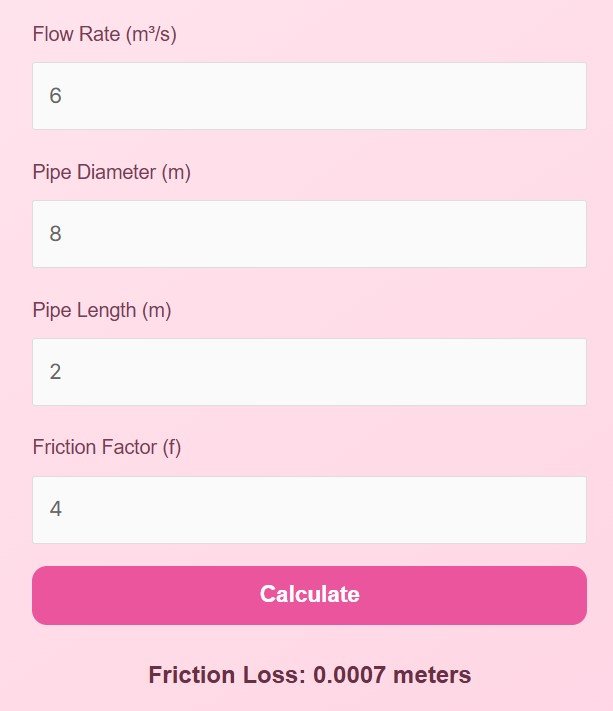
- Input the flow rate of the fluid (usually in cubic meters per second or GPM depending on your setup)
- Provide Pipe Diameter Add the internal diameter of the pipe. This value significantly affects the velocity and friction loss.
- Input Pipe Length Enter the total length of the pipe through which the fluid flows.
- Add Friction Factor Provide the friction factor (typically between 0.01 and 0.05 depending on pipe material and flow conditions).
- Click Calculate Once all values are entered, click the calculate button to get the friction loss instantly.
The result will show the total head loss (in meters or feet), helping you understand how much pressure your system loses due to friction.
If you know the velocity and the pipe size rather than the flow rate, a Flow Rate Calculator can turn those numbers into the flow rate you need here. Enter the diameter and velocity there, then bring the flow rate back to this tool.
Friction Loss Formula and Worked Example
The calculator uses the Darcy-Weisbach equation. It finds the velocity from the flow rate and the pipe area, then works out the head loss from the velocity, the pipe length, the diameter and the friction factor.
Area (square metres) = 3.1416 x Diameter x Diameter / 4
Velocity (metres per second) = Flow rate / Area
Head loss (metres) = Friction factor x (Length / Diameter) x (Velocity x Velocity / (2 x 9.81))
Here, Q is the flow rate, D is the pipe diameter, L is the pipe length, f is the friction factor and g is 9.81 metres per second squared. The number 2 x 9.81 comes from the pull of gravity on the moving fluid.
Take a flow rate of 0.01 cubic metres per second through a pipe 0.1 metres wide and 100 metres long, with a friction factor of 0.02.
First, work out the pipe area: 3.1416 x 0.1 x 0.1 / 4 is 0.00785 square metres. Then find the velocity: 0.01 divided by 0.00785 is 1.273 metres per second.
Next, work out the velocity head: 1.273 x 1.273 / (2 x 9.81) is 0.0826 metres. Then apply the Darcy-Weisbach equation: 0.02 x (100 / 0.1) x 0.0826 is 1.6525 metres.
Enter 0.01, 0.1, 100 and 0.02 in the calculator above and it shows Friction Loss: 1.6525 meters. This matches the worked example exactly.
Advantages
Using a Friction Loss Calculator offers several benefits:
1. Saves Time
Manual calculations using formulas can be complex and time-consuming. This tool provides instant results with minimal effort.
2. Improves Accuracy
Reduces human error by automating calculations based on proven formulas.
3. User-Friendly
Even beginners can use the calculator without deep technical knowledge.
4. Helps in System Design
Engineers can optimize pipe size, material, and pump requirements efficiently.
5. Versatile Usage
Useful for plumbing systems, irrigation networks, HVAC systems, fire protection systems, and industrial applications.
6. Better Decision Making
By understanding friction loss, you can reduce energy consumption and improve system performance.
Friction Factor: How Pipe Roughness Changes the Answer
The friction factor is the one input most people have to guess. It depends on the pipe material, the age of the pipe, and whether the flow is smooth or rough. A new plastic pipe has a low friction factor, often near 0.01, while an old steel pipe with scale inside can reach 0.05.
Roughness matters more at high velocity. In slow flow, the fluid slides over small bumps with little extra loss. In fast flow, the same bumps disturb the fluid and the loss rises sharply. If the pipe is old or the water is dirty, use a higher factor and check the result again.
When you are not sure, test two values. Work out the loss with a factor of 0.02, then again with 0.03, and see how much the answer moves. If the change is small, your pump choice is safe. If the change is large, measure the pipe or ask the supplier for the roughness value.
The friction factor also depends on the flow pattern. A Reynolds Number Calculator tells you whether the flow is laminar or turbulent, and that pattern changes how friction works in the pipe. Check the flow pattern before you settle on a friction factor.
FAQs
What is friction loss in pipes?
Friction loss is the reduction in pressure or energy as fluid flows through a pipe due to resistance from the pipe walls and fittings.
Why is friction loss important?
It helps in designing efficient piping systems and selecting the right pump size to maintain proper flow.
What is a friction factor?
The friction factor is a value that represents the resistance of the pipe surface and flow conditions. It depends on pipe roughness and Reynolds number. A smooth pipe has a lower factor, while a rough or old pipe has a higher one.
Can I use this calculator for any fluid?
Yes, but results are most accurate for common fluids like water. For other fluids, adjustments may be needed based on viscosity and density. Water is the usual case, so check the viscosity of any other fluid before you trust the result.
What units should I use?
You can use standard SI units (meters, cubic meters per second) or convert values accordingly based on your system requirements.
Is this calculator accurate for real-world applications?
Yes, it provides reliable estimates, but for critical engineering projects, detailed analysis is recommended. Use the calculator for planning, then confirm the final design with the methods your project standard requires.
Disclaimer
This calculator provides estimated results based on standard formulas and inputs.
For critical or professional engineering applications, consult a qualified expert for precise analysis and compliance with industry standards.