
Flow Rate Calculator
Calculate liquid flow easily in minutes
Introduction
How fast is the water moving through that pipe? The answer is the flow rate, and it decides whether a tap fills a bucket in seconds or minutes, whether a pump can keep a tank topped up, and whether an irrigation line waters a whole field evenly. This Flow Rate Calculator gives you that answer in seconds. You enter the volume of liquid in litres and the time it took to flow in seconds, and the tool returns the flow rate in litres per second. Plumbers, engineers, students, farmers, and DIY enthusiasts use it whenever a liquid moves and the rate matters. This guide explains what flow rate is, how the calculator works, and how to read the answer, so you can plan pipes, pumps, and tanks with confidence.
What Is a Flow Rate Calculator?
A Flow Rate Calculator is an easy-to-use online tool that helps you determine the flow of liquid through a pipe or channel over time. By entering the volume of liquid and the time, this calculator instantly provides the flow rate in liters per second (L/s), saving you time and effort in manual calculations.
Flow rate is simply how much liquid passes a point in a given time. A shower that delivers 10 litres in 60 seconds has a higher flow rate than a dripping tap that delivers 1 litre in the same minute, and that single number lets you compare them directly. It matters in plumbing, where pipes must carry enough water, in agriculture, where irrigation must reach every row, and in industry, where pumps and cooling systems depend on a steady flow.
How to Use the Flow Rate Calculator
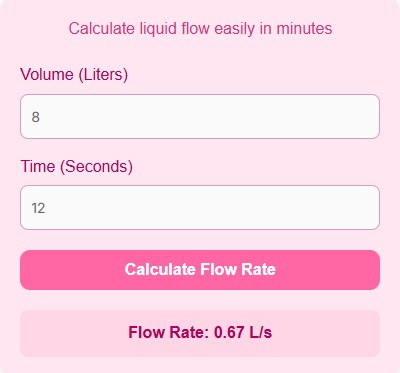
Using the Flow Rate Calculator is simple, and it takes four steps that match the fields you can see above.
Enter the volume of liquid in liters in the Volume (Liters) box, for example 100.
Enter the time it takes in seconds in the Time (Seconds) box, for example 20.
Click the Calculate Flow Rate button.
Read the flow rate, which appears instantly in liters per second (L/s), for example Flow Rate: 5.00 L/s. Measure the volume with a container of known size and time it with a stopwatch, so the two numbers you enter are true measurements, not guesses.
The Formula: Flow Rate Equals Volume Divided by Time
The calculator applies the standard formula: flow rate equals volume divided by time, written as Q equals V divided by t. The unit follows from the inputs: litres divided by seconds gives litres per second. Doubling the volume doubles the flow rate, and doubling the time halves it, so you can sense-check any answer at a glance: if twice as much liquid flows in the same time, the rate must be twice as large.
When the volume is not a simple tank or bucket but a cylinder, you first need its volume, and our Volume of a Cylinder Calculator works that out from radius and height. If instead you know the pipe diameter and the speed of the liquid, rather than a volume and a time, our Volume Flow Calculator finds the flow rate that way. For other unit changes, such as litres to gallons, our Unit Convertor handles volume and more.
Worked Example: 100 Litres in 20 Seconds
Suppose you time a tap filling a container and find that 100 litres flow in 20 seconds, and you want the flow rate. Enter 100 in the Volume (Liters) box, enter 20 in the Time (Seconds) box, and click Calculate Flow Rate. The calculator returns Flow Rate: 5.00 L/s. You can check the answer by hand: 100 divided by 20 equals 5, and the unit is litres per second. At that rate the tap would deliver 300 litres in one minute, because 5 litres per second multiplied by 60 seconds equals 300 litres, which is a useful check when you size a tank or a pump.
When to Use It and Tips for Good Results
The calculator is useful whenever water or another liquid moves through a pipe, a hose, or a channel. Homeowners use it to check whether a tap, a shower, or a garden hose delivers enough water, and to size a water tank for a home. Plumbers use it to choose pipe sizes and to test a system after a repair. Farmers use it to set irrigation flow so every row gets its share. Engineers use it in cooling systems, drainage, and water treatment, where a steady flow keeps equipment safe. Students use it in fluid mechanics coursework, where the same formula appears in nearly every problem set.
A few habits keep your results sound. First, measure the volume and the time together: start the stopwatch when you start filling and stop it at the same moment you stop the flow, so the two numbers describe the same event. Second, use a container large enough that a one second timing error stays small relative to the total, because timing a 3 second fill is far less accurate than timing a 30 second fill. Third, check for leaks or splashes, because lost water makes the volume wrong and the flow rate too low. Fourth, repeat the measurement twice and use the average if the two runs differ. Finally, remember that the flow rate can change with pressure, so a rate measured at one time of day may differ from the rate at another time.
Frequently Asked Questions
What units does the calculator use?
The calculator uses liters for volume and seconds for time, giving flow rate in liters per second (L/s). If your volume is in gallons or millilitres, convert it to liters first.
Can I use it for large-scale industrial applications?
Yes, but for highly specialized industrial systems, consider using professional flow meters alongside this calculator, because a meter accounts for pressure, temperature, and pipe losses that a simple volume and time calculation cannot see.
How do I measure the volume for my calculation?
Use a container with a known capacity, such as a marked bucket, or time how long it takes to fill a tank to a known level. A measuring jug works for small flows, and a large drum works for larger ones.
What if my time is in minutes instead of seconds?
Multiply the minutes by 60 to get seconds before you enter the number. For example, 2 minutes equals 120 seconds, and 100 litres in 120 seconds gives a flow rate of 0.83 L/s.
Does the liquid type change the result?
No, the formula divides volume by time for any liquid, so water, oil, and coolant all work the same way in principle. In practice, thick liquids flow more slowly, and that shows up in your measured volume and time.
Is this calculator free?
Yes, it is completely free, and it works across all devices, so you can use it at the tap, in the field, or at your desk with no sign up.
Disclaimer
Disclaimer: This Flow Rate Calculator is for educational and informational purposes only. The results are estimates based on the volume and time you enter, and they are not a substitute for professional engineering or plumbing advice. Always confirm important results with a qualified professional or suitable measuring equipment before you rely on them for a decision.