
Volume Flow Calculator
Calculate the flow rate using pipe diameter and velocity.
Volume Flow Calculator: Precise Pipe Flow Measurement Tool
The Volume Flow Calculator is a practical tool for engineers, plumbers, and other professionals to measure the flow of liquids in pipes. By inputting the pipe diameter and flow velocity, it provides accurate results in cubic meters per second (m³/s).
It eliminates the need for manual calculations, saving time and minimizing mistakes. A visual bar graph offers a quick understanding of flow behavior. Its clean, responsive interface works seamlessly on any device. Suitable for both learning and practical applications, this tool enhances efficiency and aids in making informed decisions. It simplifies complex calculations and improves workflow reliability.
If you already know the volume and the time it took, our Flow Rate Calculator works out the rate from those two numbers instead.
Volume Flow Formula and Worked Example
The volume flow formula is Q = π × d² / 4 × v. Q is the volume flow rate in cubic metres per second. The letter d is the pipe diameter in metres, and v is the flow velocity in metres per second.
Here is a worked example. Take a pipe with a diameter of 0.2 metres and water moving at 3 metres per second. The area is π × 0.2² / 4, which gives 0.0314 square metres. Multiply by 3, and the flow rate is 0.0942 cubic metres per second.
Try these numbers in the calculator above. Enter 0.2 for the diameter and 3 for the velocity. It gives 0.0942, so the worked example and the calculator agree exactly.
What Is Volume Flow Rate?
Volume flow rate is the amount of fluid that passes a point in a pipe in a given time. It is measured in cubic metres per second, litres per second, or gallons per minute. The unit tells you how much fluid moves, not how fast it moves.
A wide, slow pipe can carry the same flow as a narrow, fast one. The diameter sets the area, and the velocity sets how quickly the fluid crosses it. Both numbers feed the formula, so both must be right.
Diameter, Velocity and Pipe Size
The diameter matters more than it looks. The flow depends on the square of the diameter, so doubling the diameter quadruples the flow at the same velocity. A small change in pipe size changes the result a lot.
Always check your units before you calculate. The calculator expects metres and metres per second. If your pipe is 20 centimetres wide, enter 0.2, not 20. A unit slip of ten times is easy to make.
For a pipe sized in the same way, the Pipe Flow Calculator works out flow and velocity together.
Where Volume Flow Is Used
Plumbers use volume flow to size pipes and pumps for homes and buildings. A shower, a tap, and a washing machine each need a known flow, and the pipes must carry them all at once.
Engineers use it for water supply, irrigation, and drainage. Farmers check that an irrigation line can water a whole field evenly. In factories, it sizes cooling and process lines.
Even a garden hose follows the same maths. A long, narrow hose cuts the flow a tap can supply. Measure the diameter and the velocity, and the calculator shows what the hose can really deliver.
Swimming pools and ponds need the same check. A pump that is too small leaves the water still, and one that is too big wastes power. The flow rate tells you which pump fits.
Common Mistakes to Avoid
The most common mistake is mixing up diameter and radius. The formula uses the full diameter, not the radius. If you enter the radius by mistake, the flow comes out four times too low.
Another mistake is entering the diameter in centimetres while the calculator expects metres. A 20 centimetre pipe is 0.2 metres. Enter 20 and the answer is one hundred times too big.
The last mistake is trusting one reading. Measure the diameter twice and check the velocity again. A second check takes a minute and can save a wrong pipe size.
If you work in gallons instead, the Gallons Per Minute Calculator (GPM) gives the same idea in gallons per minute.
How to Use the Volume Flow Calculator
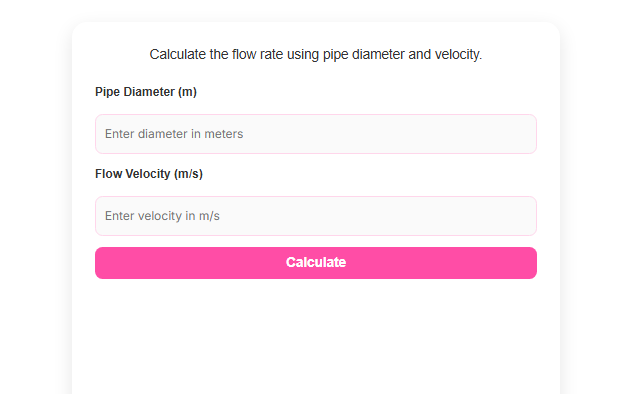
The calculator includes a compact bar graph to visually display flow rates, making it easy to compare readings. Ensure both inputs are positive numbers for accurate results. The graph updates automatically with each calculation, making it ideal for engineers, students, and industry professionals.
Step 1: Enter the pipe diameter (in meters) in the first field.
Example: 0.2 for a 20 cm pipe.
Step 2: Enter the flow velocity (in meters per second) in the second field.
Example: 3 for a velocity of 3 m/s.
Step 3: Click the “Calculate” button.
Step 4: The volume flow rate (m³/s) appears instantly below the button.
Example output: Volume Flow Rate = 0.0942 m³/s
Step 5 (Bonus): A pink bar graph will display the calculated flow visually, fully responsive on all devices.
Benefits of the Volume Flow Calculator
This tool saves time and reduces errors by providing instant flow rate results for any pipe size and velocity. Its visual graph makes data interpretation simple. It supports precise project planning and is useful in industries such as water supply, HVAC, and chemical systems. Its responsive design ensures smooth use on both desktops and mobile devices.
Applications of the Volume Flow Calculator
The Volume Flow Calculator is valuable for designing pipelines, monitoring water systems, and assessing fluid efficiency. Engineers can accurately calculate pump capacities and check flow performance. Students and professionals can better understand and optimize fluid systems using the visual graphs. It is a versatile tool for industrial, educational, and environmental applications.
Tips for Accurate Volume Flow Calculation
Always enter correct pipe diameter and flow velocity for precise results. Verify units and maintain consistent conditions to avoid errors. Use the graph to spot variations and potential issues early. Frequent use can help engineers optimize designs and improve understanding of fluid dynamics.
FAQs
1. What is a volume flow rate?
Volume flow rate is the quantity of fluid passing through a pipe per unit time, measured in cubic meters per second (m³/s).
2. How do I calculate volume flow rate?
Input the pipe diameter and flow velocity into the calculator, which uses the formula Q = (π × d² / 4) × v to compute it automatically.
3. Can I use this calculator for any liquid?
Yes, it works for all incompressible fluids like water, oil, and similar liquids.
4. What if my input values are negative?
Only positive numbers are accepted. Negative or zero inputs will return an error.
5. Is the graph interactive?
The bar graph visually represents the flow rate and updates with each calculation, but it is static rather than interactive.
Disclaimer
This calculator provides estimated results for planning purposes only. Actual flow rates may vary due to system conditions or measurement differences.