
Reynolds Number Calculator
What Is Reynolds Number Calculator?
A Reynolds Number Calculator is an essential online tool used to determine the nature of fluid flow in a system. In fluid mechanics, the Reynolds number is a dimensionless quantity that helps identify whether the fluid flow is laminar, transitional, or turbulent. This concept is widely used in mechanical engineering, civil engineering, chemical engineering, and physics.
Manually calculating the Reynolds number can be time consuming and prone to errors, especially for beginners. This calculator simplifies the process by instantly computing accurate results using standard fluid properties such as velocity, density, characteristic length, and dynamic viscosity. It is ideal for students, educators, researchers, and professionals who need fast and reliable calculations.
Understanding the Reynolds number is crucial when designing pipes, ducts, channels, and fluid systems because it directly affects pressure loss, heat transfer, and overall system efficiency.
How to Use It?
Using the Reynolds Number Calculator is straightforward and requires no technical expertise. Follow these simple steps:
Enter the fluid velocity in meters per second (m/s).
Input the characteristic length or diameter in meters (m).
Provide the fluid density in kilograms per cubic meter (kg/m³).
Add the dynamic viscosity of the fluid in Pascal-seconds (Pa·s).
Click the Calculate button to get instant results.
Once calculated, the tool displays the Reynolds number along with the flow regime classification, making it easy to interpret the behaviour of the fluid. This quick output helps users make informed decisions without performing complex formulas manually.
Reynolds Number Calculation – Step-by-Step Example
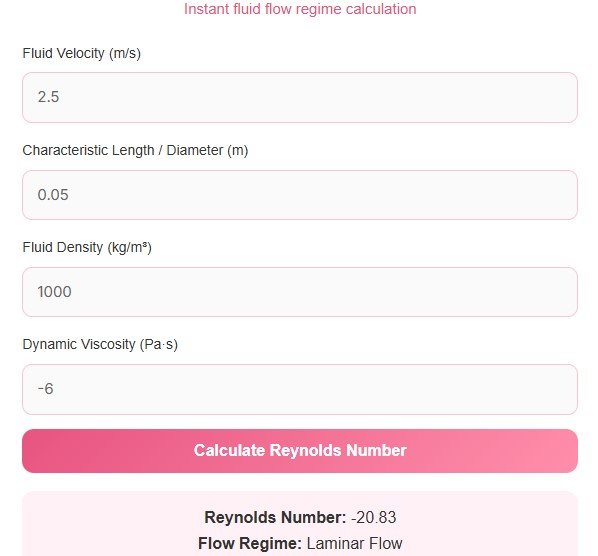
Let’s calculate the Reynolds Number using the same values shown in the calculator.
Given Values
Fluid Velocity (V) = 2.5 m/s
Characteristic Length / Diameter (D) = 0.05 m
Fluid Density (ρ) = 1000 kg/m³
Dynamic Viscosity (μ) = 6 Pa.s
Step 1: Reynolds Number Formula
The standard formula for Reynolds number is:
Re = (ρ × V × D) / μ
Step 2: Substitute the Values
Re = (1000 × 2.5 × 0.05) / 6
Step 3: Calculate the Numerator
1000 × 2.5 = 2500
2500 × 0.05 = 125
→ Numerator = 125
Step 4: Divide by Dynamic Viscosity
Re = 125 ÷ 6
→ Re ≈ 20.83
Step 5: Determine the Flow Regime
Reynolds number classification:
Re < 2000 → Laminar Flow
Re = 2000–4000 → Transitional Flow
Re > 4000 → Turbulent Flow
→ 20.83 < 2000
Flow Regime = Laminar Flow
Final Result
Reynolds Number = 20.83
Flow Type = Laminar Flow
This means the fluid is flowing smoothly in layers with minimal mixing or disturbance.
Why Reynolds Number Is Important?
The Reynolds number plays a vital role in analysing fluid behaviour. It helps engineers and scientists predict how fluids will move in real world applications. For example, laminar flow is preferred in medical and microfluidic applications, while turbulent flow is often desirable in mixing processes and heat exchangers.
By identifying the type of flow, this calculator helps reduce design errors, improve efficiency, and enhance system safety. It is especially useful in educational environments where students are learning the fundamentals of fluid dynamics.
Advantages of Reynolds Number Calculator
This online Reynolds Number Calculator offers several benefits:
-
Eliminates the need for manual calculations
-
Provides quick and accurate results
-
Helps identify laminar, transitional, or turbulent flow
-
User-friendly interface suitable for beginners
-
Works smoothly on mobile, tablet, and desktop devices
-
Saves time in academic and professional work
-
Reduces the risk of calculation errors
Because of its simplicity and reliability, this calculator is a valuable tool for anyone dealing with fluid flow analysis.
FAQs
Q 1:What is the Reynolds number formula?
The Reynolds number is calculated using fluid density, velocity, characteristic length, and dynamic viscosity.
Q 2:What does laminar flow mean?
Laminar flow occurs when fluid moves smoothly in parallel layers with minimal mixing.
Q 3:What is turbulent flow?
Turbulent flow is characterized by chaotic motion, eddies, and increased mixing.
Q 4:Can this calculator be used for pipe flow?
Yes, it is commonly used for pipe and channel flow analysis.
Q 5:Is this calculator accurate?
Yes, it uses standard fluid mechanics equations to deliver reliable results.
Disclaimer
This Reynolds Number Calculator is for educational and informational purposes only. While it uses standard formulas, it should not replace professional engineering judgment or be used for critical design decisions. Always consult a qualified expert for real world applications.