
Salinity Calculator
Enter salt weight and water volume to calculate salinity (ppt)
Salinity Calculator – Accurate Salt-to-Water Ratio in PPT
The Salinity Calculator is a dependable tool created to accurately determine salt concentration in water. It is ideal for use in aquariums, marine studies, laboratories, agriculture, and educational applications.
Users simply enter salt weight and water volume in grams and liters to get instant results in parts per thousand (ppt). The calculator removes the need for manual formulas and minimizes calculation errors. Its user-friendly layout makes it accessible for both beginners and professionals.
The responsive design ensures smooth performance on all devices. Consistent and precise readings help support better water quality decisions. This tool makes salinity measurement quick, clear, and hassle-free.
If you need the strength of a different solution, the Concentration Calculator can work it out for you.
How to Use the Salinity Calculator
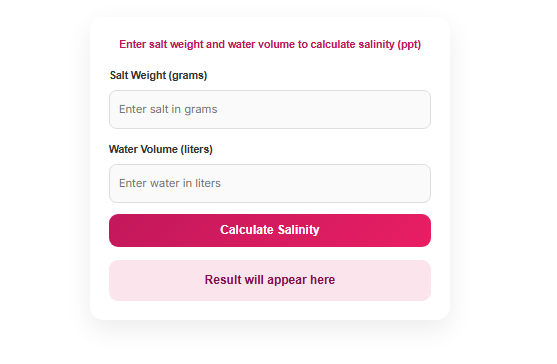
Enter the salt weight in grams into the first input field.
Enter the water volume in liters into the second input field.
Click on the Calculate Salinity button.
Instantly view the salinity result displayed in ppt (parts per thousand).
How the Salinity Calculator Works
The Salinity Calculator works by dividing the amount of salt by the total volume of water. Users input salt in grams and water in liters, and the tool converts the result into parts per thousand (ppt). The calculation runs automatically, removing the need for manual formulas. Instant results make the process fast, accurate, and easy to use.
The Salinity Formula Explained
The formula behind the calculator is simple. Salinity in parts per thousand equals the mass of salt in grams divided by the volume of water in litres. Write it as Salinity (ppt) = salt (g) / water (L). One gram of salt in one litre of water gives a salinity of 1 ppt.
To get the result in milligrams per litre, multiply the ppt value by 1000. A reading of 35 ppt is the same as 35,000 mg per litre, because 1 ppt equals 1000 mg per litre. Both units describe the same mix, so use the one that suits your work.
The formula also works in reverse. If you know the salinity you want and the volume of water, multiply them to find the salt you need. A tank that holds 10 litres at 35 ppt needs 350 grams of salt. Check the units before you mix, because grams and litres must match the formula.
Worked Example: 35 Grams of Salt in 1 Litre of Water
Take 35 grams of table salt and dissolve it in 1 litre of water. Divide 35 by 1 to get 35 ppt. Multiply 35 by 1000 to get 35,000 mg per litre. That is the average salinity of seawater, so this mix matches the ocean.
Try the same check with the calculator. Enter 35 in the salt field and 1 in the water field, then press Calculate Salinity. The result should read 35 ppt. If you double the water to 2 litres with the same 35 grams, the answer drops to 17.5 ppt, which shows how the ratio changes. To see the same mix as a molar strength, the Molarity Calculator can work it out from moles and volume.
Benefits of Using an Online Salinity Calculator
An online Salinity Calculator helps users get quick and accurate results without manual effort. It reduces the risk of errors and does not require advanced technical skills. The tool works smoothly on all devices, allowing easy access anytime and anywhere. Its clean and professional design makes repeated calculations simple and reliable.
Applications of the Salinity Calculator
The Salinity Calculator is commonly used in aquariums, marine research, and fish farming to maintain proper water conditions. Scientists and laboratories depend on it for accurate water analysis and experiments. In agriculture, it supports better irrigation and soil management decisions. Educational and environmental fields also use it for learning, monitoring, and research purposes.
Why Salinity Measurement Is Important
Salinity is vital for healthy aquatic ecosystems and overall water quality. Improper salt levels can harm fish, plants, and microorganisms. Accurate salinity ensures proper growth in aquariums, fish farms, and agricultural settings. It also supports research, environmental monitoring, and sustainable water management.
Common Salinity Levels and What They Mean
Salinity levels vary widely from place to place. Freshwater, such as rivers and lakes, usually sits below 0.5 ppt. Brackish water, found where rivers meet the sea, ranges from 0.5 to 30 ppt. Seawater averages about 35 ppt, while salty lakes and brine pools can pass 50 ppt.
Aquarium keepers use these numbers every day. Tropical freshwater tanks should stay below 0.5 ppt, while reef tanks run best between 32 and 35 ppt. A reading outside the range stresses fish and corals, so regular checks with a salinity calculator help keep the water safe.
Farmers and gardeners face the same issue in soil. Irrigation water over 2 ppt can harm salt-sensitive crops, and a reading above 4 ppt starts to damage soil structure. Knowing the number before you water is the cheapest way to protect a harvest.
How to Check Your Answer by Hand
Do a quick hand check after each result. Divide the salt in grams by the water in litres to get the ppt value. For 35 grams in 1 litre, 35 divided by 1 is 35 ppt. If you double the salt to 70 grams in the same litre, the answer doubles to 70 ppt. Watch the units: grams and litres must pair together, or the answer will be wrong.
Frequently Asked Questions (FAQs)
1. What unit does the Salinity Calculator use?
The calculator measures salinity in parts per thousand (ppt).
2. Can I use this calculator for aquariums?
Yes, it is ideal for both freshwater and saltwater aquariums.
3. Is this calculator accurate for professional use?
It provides reliable estimates based on standard calculations.
4. Do I need technical knowledge to use it?
No, the calculator is designed for beginners and professionals.
5. Can I use it on mobile devices?
Yes, the calculator is fully responsive and mobile-friendly.
6. How much salt do I need for 10 litres of seawater-strength water?
Multiply 35 ppt by 10 litres to get 350 grams of salt. Dissolve the salt fully in the water and stir until it clears. Check the mix with the calculator before you add any fish.
For help mixing a salt solution at the right strength, the Dilution Ratio Calculator works out the correct ratio of concentrate to water.
Disclaimer: This Salinity Calculator is for learning and general use only. Check important results by hand or with a qualified teacher before you use them in labs, aquariums, farming, or safety decisions.