
Dilution Ratio Calculator
What is Dilution Ratio Calculator?
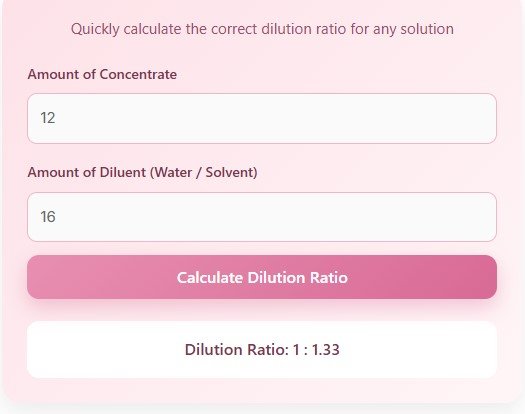
A Dilution Ratio Calculator is an online tool that helps users determine the correct proportion between a concentrated substance and a diluent such as water or another solvent. It calculates how much diluent is required to safely and accurately dilute a concentrate, presenting the result in an easy to understand ratio format like 1 : X. This makes it simple to prepare solutions with the right strength without doing complex manual calculations.
This calculator is widely used in industries such as cleaning and sanitation, laboratories, agriculture, healthcare, and chemical processing. It is especially helpful for beginners who may struggle with dilution formulas, as well as professionals who need quick and precise results. By using a dilution ratio calculator, users can ensure consistency, reduce errors, and maintain safety while mixing solutions for any purpose. If you need the strength of the finished solution, the Molarity Calculator works out concentration from moles and volume.
How to Use the Dilution Ratio Calculator?
Using the dilution ratio calculator is very simple and does not require any technical knowledge. Follow these easy steps:
Enter the amount of concentrate in the first input field. This could be in milliliters, liters, ounces, or any other unit, as long as you use the same unit throughout.
Enter the amount of diluent, such as water or solvent, in the second input field.
Click on the Calculate Dilution Ratio button.
The calculator will instantly display the dilution ratio in the format 1 : X.
There is no need to worry about device compatibility. The calculator is fully responsive and works smoothly on mobile phones, tablets, laptops, and desktop computers. This makes it convenient to use both in professional environments and at home.
The Dilution Ratio Formula Explained
A dilution ratio compares two volumes: the concentrate and the diluent. It is written as 1 : X, where X is the number of parts of diluent for every 1 part of concentrate. A ratio of 1 : 4 means 1 part concentrate and 4 parts diluent.
The total volume is the two parts added together. For a ratio of 1 : 4, the total is 5 parts, so the concentrate is one fifth of the mix and the diluent is four fifths.
Diluting a solution lowers its strength, and the Concentration Calculator can check the new strength once you know the volumes. If a stock solution is 10 percent and you dilute it 1 : 4, the final strength is 10 divided by 5, which is 2 percent.
Worked Example: 150 mL of Stock in 600 mL of Water
Take 150 mL of cleaning stock and add 600 mL of water. Divide both numbers by 150 and the ratio is 1 : 4, because 150 divided by 150 is 1 and 600 divided by 150 is 4. The total volume is 150 plus 600, which is 750 mL.
Common Dilution Ratios and What They Mean
Most bottles print a ratio, and the number after the colon tells you how many parts of diluent to add. A ratio of 1 : 10 needs 10 parts of water for each part of concentrate, while 1 : 50 needs 50 parts. The bigger the second number, the weaker the final mix.
A ratio of 1 : 4 suits strong cleaning jobs, 1 : 10 works for everyday surface sprays, and 1 : 100 is common for a light rinse or a plant feed. Always read the label, because the same product can suggest different ratios for different jobs.
Ratios are not percentages, so do not swap them. A 1 : 4 ratio gives a mix that is 20 percent concentrate, because 1 divided by 5 is 0.20. A 1 : 9 ratio gives 10 percent, and a 1 : 99 ratio gives 1 percent.
Dilution Ratios in Everyday Cleaning
Cleaning is where most people meet dilution ratios. A floor cleaner might ask for 1 : 20, which means a single capful in a bucket of water. Guessing the amount wastes product, while measuring it keeps floors clean without a sticky film.
The same idea applies in the garden. A plant feed at 1 : 100 needs only a small dose in a full watering can, and a stronger mix can burn leaves. Using the calculator takes the guesswork out of both jobs.
Even a car wash uses ratios. Shampoo at 1 : 50 in a bucket gives a gentle foam, and a pressure washer bottle often works at 1 : 10. A quick check before you pour saves product and protects the paint.
How to Check Your Answer by Hand
Add the two volumes and check your ratio. For 150 mL of stock and 600 mL of water, the total is 750 mL. Divide 750 by 150 and you get 5, so the mix has 5 parts in total and the ratio is 1 : 4.
Advantages of Dilution Ratio Calculator
Using a dilution ratio calculator offers several benefits:
Saves time by providing instant results
Eliminates calculation errors caused by manual formulas
Beginner friendly and easy to understand
Helps maintain accurate and consistent mixtures
Useful for cleaning solutions, chemicals, labs, and agriculture
Works on all devices, including mobile and desktop
Improves safety by ensuring proper dilution levels
Whether you are a professional or a beginner, this calculator helps you achieve precise dilution every time.
FAQs
Q 1: What is a dilution ratio?
A dilution ratio represents the relationship between the amount of concentrate and the amount of diluent. For example, a ratio of 1:10 means one part concentrate mixed with ten parts diluent.
Q 2: Who should use a dilution ratio calculator?
This calculator is useful for cleaners, laboratory technicians, students, farmers, industrial workers, and anyone who needs accurate solution mixing.
Q 3: Is this dilution ratio calculator free to use?
Yes, this calculator is completely free and can be used as many times as needed without any limitations.
Q 4: Do I need to install any software to use it?
No installation is required. The calculator works directly in your browser.
Q 5: Can I use this calculator on my mobile phone?
Yes, the calculator is fully responsive and works perfectly on smartphones, tablets, and desktops.
Q 6: Can I mix any two liquids with this calculator?
Yes, as long as you know the volumes of both. The calculator works with any concentrate and diluent pair, but always check that the two liquids are safe to mix before you start.
For a deeper look at the chemistry behind the mix, the Mole Calculator converts mass into moles first.
Disclaimer: This Dilution Ratio Calculator is for learning and general use only. Check important results by hand or with a qualified teacher before you use them in labs, cleaning work, or safety decisions.