
Mole Calculator
What Is a Mole Calculator?
A Mole Calculator is a simple yet powerful online chemistry tool used to calculate the number of moles of a substance when its mass and molar mass are known. In chemistry, the mole is a fundamental unit that helps scientists and students understand the relationship between the mass of a substance and the number of particles (atoms, molecules, or ions) it contains.
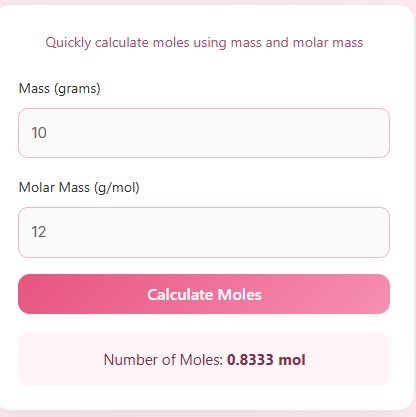
Manually calculating moles can sometimes be confusing, especially for beginners, because it involves formulas and unit conversions. A Mole Calculator removes this complexity by performing the calculation instantly and accurately. You only need to enter two values: the mass of the substance in grams and its molar mass in grams per mole (g/mol). The calculator then applies the standard mole formula and displays the result clearly.
This tool is especially useful for chemistry students, teachers, laboratory professionals, and anyone dealing with chemical calculations. Whether you are solving homework problems, preparing for exams, or working in a lab, a Mole Calculator saves time and reduces the chances of calculation errors.
Once you know the moles, the Molarity Calculator can turn that amount into a solution strength.
How to Use the Mole Calculator?
Using a Mole Calculator is very easy and does not require advanced chemistry knowledge. Follow these simple steps:
First, enter the mass of the substance in grams. This is the weight of the material you are working with.
Next, input the molar mass of the substance in grams per mole (g/mol). You can find molar mass from the periodic table or chemical formula.
Click on the calculate button.
The calculator will instantly display the number of moles.
The formula used by the calculator is:
Moles = Mass ÷ Molar Mass
This automated process makes calculations faster and ensures accuracy, making it ideal for both beginners and experienced users.
The Mole Formula Explained
The mole formula is short, and it does one job well. It turns a mass you can weigh into a count of particles you cannot see. Moles equal mass divided by molar mass. Mass is measured in grams, and molar mass is measured in grams per mole, so the grams cancel and leave moles as the answer.
Molar mass is the key number in this formula. It is the mass of one mole of a substance, and you find it by adding the atomic masses of all the atoms in its formula. Water is a clear example, because its molar mass is about 18.015 grams per mole. That number comes from two hydrogen atoms and one oxygen atom, and it stays the same for every pure sample of water.
Always check your units before you trust an answer. If your mass is in kilograms, change it to grams first, because the formula needs grams and grams per mole. A quick unit check takes seconds, and it stops the most common mole error before it happens.
Worked Example: How Many Moles Are in 36 Grams of Water?
Take 36 grams of pure water and work out how many moles it holds. The molar mass of water is 18.015 grams per mole. Put the numbers into the formula, and the sum is 36 divided by 18.015, which gives 1.9986 moles. That rounds to 2.00 moles, so 36 grams of water is almost exactly two moles.
The same steps work for any other substance. Find the mass in grams, find the molar mass in grams per mole, and divide the first by the second. Use the same units every time, round your answer to match the accuracy of your inputs, and write the unit mol after the number so the result is clear. If you later dilute this water, the Dilution Ratio Calculator can work out the volumes you need.
Moles in Everyday Chemistry
Moles are not only for exam questions. Farmers, cooks, and water treatment workers all balance amounts, even when they never say the word mole. A farmer who buys fertiliser by the kilogram, a pool worker who adds chlorine by weight, and a baker who scales a recipe all work with amounts in the same way a chemist balances an equation.
In a lab, moles keep reactions safe and exact. Chemists weigh a solid, turn grams into moles, and then work out how much of a second substance is needed. That stops waste, keeps costs down, and keeps reactions under control. Without moles, every recipe would be guesswork, and a small error could spoil a full batch.
Students who learn moles early find later topics easier. Titrations, gas volumes, and solution strength all build on the same idea, so time spent here pays off again and again. A strong start with moles makes the harder parts of chemistry feel far less hard.
How to Find Molar Mass Quickly
You cannot use the mole formula without molar mass, so finding it fast is a useful skill. Look up each element in the periodic table, note its atomic mass, and multiply it by the number of atoms in the formula. Add the results together, and the total is the molar mass in grams per mole.
Table salt is a good test. Sodium has an atomic mass near 22.99, and chlorine is near 35.45, so sodium chloride has a molar mass near 58.44 grams per mole. With 12 grams of table salt, the sum is 12 divided by 58.44, which gives 0.205 moles. Try the same steps with the calculator above, and check that you get the same answer.
Advantages of Using a Mole Calculator
There are many benefits of using an online Mole Calculator instead of calculating manually:
Saves time by providing instant results
Accurate calculations with reduced human error
Beginner friendly interface with simple input fields
No need to memorize formulas
Useful for students, teachers, and lab professionals
Works on all devices, including mobile phones, tablets, and desktops
Because it is web-based, you can use the calculator anytime and anywhere without installing any software. Its responsive design ensures smooth performance across all screen sizes.
FAQs
Q 1: What is a mole in chemistry?
A mole is a unit used in chemistry to measure the amount of a substance. One mole contains approximately 6.022 × 10^23 particles.
Q 2: Which formula does the Mole Calculator use?
The calculator uses the standard formula:
Moles = Mass ÷ Molar Mass
Q 3: Is this Mole Calculator suitable for students?
Yes, it is perfect for school, college, and university level chemistry students.
Q 4: Can I use this calculator on my mobile phone?
Yes, the Mole Calculator is fully responsive and works on all devices.
Q 5: Is this tool free to use?
Yes, it is completely free and does not require registration.
Q 6: How do I find the molar mass of a substance?
Look up each element in the periodic table, multiply its atomic mass by the number of atoms in the formula, and add the results together. For water, that gives 18.015 grams per mole, and for table salt it gives 58.44 grams per mole.
If you start with grams and want moles in one step, the Grams to Moles Calculator does the same sum for you.
Disclaimer: This Mole Calculator is for learning and general use only. Check important results by hand or with a qualified teacher before you use them in exams, lab work, or safety decisions.