
Momentum Calculator
Introduction
A heavy lorry rolling slowly and a cricket ball flying fast can both be hard to stop, and momentum is the quantity that explains why. It combines how much mass an object has with how fast it moves, and this Momentum Calculator works it out for you in seconds. You enter the mass in kilograms and the velocity in metres per second, and the tool returns the momentum in kilogram metres per second. Students use it for physics homework and exam practice, teachers use it to check worked answers, and engineers use it to size up collisions, impacts, and moving machinery. This guide explains what momentum is, how the calculator works, and how to read the answer, so the number makes sense in your own problem.
What Is a Momentum Calculator?
A Momentum Calculator is a simple online tool that helps you calculate the momentum of an object using its mass and velocity. Momentum is a fundamental concept in physics, representing the quantity of motion an object has. The more mass an object carries, and the faster it moves, the more momentum it has, and the harder it is to stop.
Momentum is a vector quantity, which means it has both size and direction. The tool gives its size along the direction of motion, which is enough for most school and college problems that travel in a straight line. A force changes momentum over time, so if you need to work out the force behind a change in motion, our Force Calculator pairs with this tool, and the two together cover the most common mechanics questions.
How to Use the Momentum Calculator
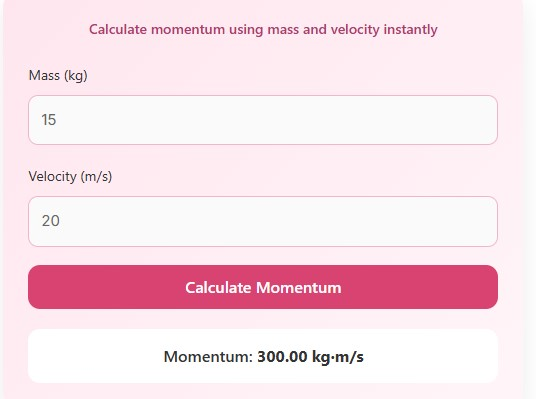
Using the calculator takes four short steps, and each one matches a field you can see above.
Enter the mass of the object in kilograms (kg) in the Mass (kg) box.
Enter the velocity of the object in metres per second (m/s) in the Velocity (m/s) box. Use the speed in the direction of travel.
Click the Calculate Momentum button.
Read the result, which appears instantly in kilogram metres per second (kg m/s), for example Momentum: 50.00 kg m/s. If your mass is in grams or your speed is in kilometres per hour, convert them to kilograms and metres per second first, because the tool works in those units only.
The Formula: Momentum Equals Mass Times Velocity
The calculator applies the standard physics formula: momentum equals mass multiplied by velocity, written as p equals m times v. The unit follows from the inputs: kilograms multiplied by metres per second gives kilogram metres per second. Because the formula is a multiplication, doubling either the mass or the velocity doubles the momentum, and halving one halves the result. That simple scaling is why a light object moving very fast can carry as much momentum as a heavy object moving slowly.
The same mass and velocity also fix the kinetic energy of the object, which grows with the square of the velocity rather than in direct proportion. To find that energy, our Kinetic Energy Calculator takes the same two inputs and returns the energy in joules.
Worked Example: A 5 Kilogram Ball at 10 Metres Per Second
Suppose a ball with a mass of 5 kilograms rolls along the ground at 10 metres per second, and you want its momentum. Enter 5 in the Mass (kg) box, enter 10 in the Velocity (m/s) box, and click Calculate Momentum. The calculator returns Momentum: 50.00 kg m/s. You can check the answer by hand: 5 multiplied by 10 equals 50, and the unit is kilogram metres per second. If the same ball slowed to 5 metres per second, its momentum would fall to 25.00 kg m/s, exactly half, because the mass stayed the same and the velocity halved. That is the whole method: enter the two numbers, read the momentum, and compare it with the values in your problem.
When to Use It and Tips for Good Results
The calculator is useful whenever motion and impact matter. Students reach for it during physics coursework, exam revision, and lab reports that ask for momentum before and after a collision. Teachers use it to check answers quickly. Engineers and sports analysts use it to compare impacts: a cricket ball and a football can carry similar momentum at very different speeds, and the number shows which one is harder to stop. Momentum is also conserved in a closed system, so the total before a collision equals the total after it, which makes this calculator a handy starting point for collision problems.
A few habits keep your results sound. First, keep your units consistent: kilograms for mass and metres per second for velocity, because the tool does not convert other units. Second, keep the direction in mind: momentum in opposite directions cancels in a total, so give velocities a sign when two objects move toward each other. Third, write the unit with every answer, because a bare number of 50 means nothing without kg m/s. Fourth, if you move from straight line motion to rotation, the matching quantity is angular momentum, and the turning effect of a force is torque, which our Torque Calculator can work out for you. Finally, round only at the end of a calculation, so small rounding errors do not build up through a multi-step problem.
Frequently Asked Questions
What is the formula used for momentum?
Momentum is calculated as momentum equals mass multiplied by velocity, written as p equals m times v. Enter the mass in kilograms and the velocity in metres per second, and the answer comes out in kilogram metres per second.
What is the SI unit of momentum?
The SI unit of momentum is the kilogram metre per second, written as kg m/s. It comes from multiplying the unit of mass, the kilogram, by the unit of velocity, metres per second.
Can I use different units?
This calculator works with kg for mass and m/s for velocity. Other units must be converted first. To convert grams to kilograms, divide by 1000, and to convert kilometres per hour to metres per second, divide by 3.6.
Is momentum a vector or a scalar?
Momentum is a vector, so it has direction as well as size. In straight line problems, the sign of the velocity gives the direction, and the calculator returns the size along that line.
Can it be used for homework or projects?
Yes, it is perfect for students, teachers, and physics enthusiasts. It works on desktop, tablet, and mobile, and it is free with no login.
Is this calculator free?
Yes, it is completely free to use, and you can run as many calculations as you like.
Disclaimer
Disclaimer: This Momentum Calculator is for educational and informational purposes only. The results are estimates based on the values you enter and the standard formula for momentum, and they are not a substitute for professional advice. Always confirm important results with your course materials, a qualified teacher, or suitable physics software before you rely on them for a decision.