
Molality Calculator
Calculate solution molality using moles of solute and solvent mass in kilograms.
Molality Calculator – Accurate Chemistry Solution Calculator
The Molality Calculator is a reliable online chemistry tool designed to help students, teachers, and professionals accurately calculate the molality of a solution. Molality is an important concentration unit that measures the amount of solute present in a given mass of solvent.
Unlike molarity, molality is not affected by temperature changes, which makes it especially useful in scientific experiments and laboratory work. This calculator simplifies complex manual calculations by using a precise and standard chemical formula.
By entering basic values, users can instantly determine molality without errors. It is ideal for academic learning, exam preparation, and practical chemistry applications. The tool is fast, user-friendly, and suitable for all devices.
The Molality Formula Explained
Molality tells you how much solute is dissolved in a fixed mass of solvent. It is measured in moles per kilogram, written as mol/kg. The formula is simple: molality equals moles of solute divided by kilograms of solvent. In symbols, m = n / W, where m is molality, n is the amount of solute in moles, and W is the mass of the solvent in kilograms.
The units tell you most of what you need to know. The top of the fraction counts particles, in moles, while the bottom counts solvent, in kilograms. Because both parts are masses or amounts, and neither is a volume, the result does not change when the solution warms up and expands. That is the main reason chemists choose molality for work that spans a range of temperatures.
Watch the units before you divide. Grams of solvent must become kilograms, so divide by 1,000. If you are given grams of solute instead of moles, divide the mass by the molar mass first. If your concentration is given per litre of solution instead, work it out with the Molarity Calculator.
Worked Example: 2 mol of Salt in 0.5 kg of Water
Take a simple laboratory example. You dissolve 2 mol of sodium chloride in 0.5 kg of water. The solvent mass is already in kilograms, so no conversion is needed. Put the figures into the formula: molality equals 2 divided by 0.5.
Two divided by 0.5 is 4, so the solution has a molality of 4 mol/kg. The answer is a plain number with the unit mol/kg, not a percentage. If the solvent mass had been 250 g instead of 0.5 kg, you would first change it to 0.25 kg, and the same 2 mol would give 8 mol/kg.
Try it in the calculator above. Enter Moles of Solute 2 and Mass of Solvent 0.5, then press Calculate Molality. It should show Molality = 4.0000 mol/kg, which matches the hand calculation exactly.
Molality vs Molarity: What Is the Difference?
Molality and molarity look alike, but they count different things. Molality uses kilograms of solvent, while molarity uses litres of solution. One is built on mass, which stays the same when the temperature changes, and the other is built on volume, which does not. For a dilute water solution at room temperature the two numbers are close, often within a few per cent, so it is easy to mix them up.
The difference matters most in two cases: when the solution is heated or cooled, and when the concentration is high. Heating expands a liquid, so a litre of hot solution holds less solute than a litre of the same cold solution, and the molarity falls even though nothing was added or removed. Molality stays put, because the kilograms of solvent and the moles of solute do not change.
Choose molality for boiling point, freezing point and osmotic pressure work, and for any experiment where the temperature moves. Choose molarity when you measure out a volume for a reaction, as in a titration. For a wider look at concentration units, including normality and dilution, use the Concentration Calculator.
Common Mistakes to Avoid
The most common mistake is entering the solvent mass in grams instead of kilograms. A gram value is a thousand times too large, so the answer comes out a thousand times too small. Always check that the solvent is in kilograms before you press Calculate Molality.
Another mistake is using the mass of the whole solution as the solvent mass. Molality needs the solvent alone, so subtract the solute mass first. If you dissolve 10 g of salt in 500 g of water, the solvent is 500 g, or 0.5 kg, not 510 g.
A third mistake is typing a value as a whole number when the real figure is a decimal, or the other way round. One mole of solute in 0.25 kg of solvent is 4 mol/kg, but one mole in 2.5 kg is only 0.4 mol/kg. If you are unsure how many moles you have, count them first with the Mole Calculator.
How to Use the Molality Calculator
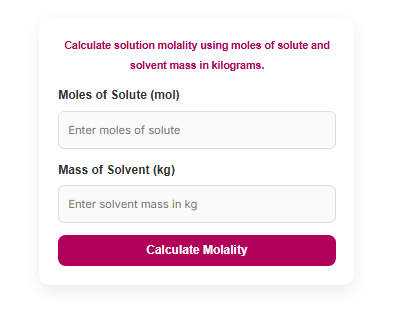
Enter Moles of Solute: Input the number of moles of the solute in the provided field.
Enter Mass of Solvent: Input the mass of the solvent in kilograms in the corresponding field.
Check Values: Ensure all entered values are correct and positive.
Click Calculate: Press the Calculate button to get the result instantly.
View Result: The calculator will display the molality in mol/kg. If invalid values are entered, an error message will appear to ensure accuracy.
Why Molality Is Important for Accurate Calculations
Molality is important in physical chemistry as it remains unaffected by volume changes, making it essential for temperature-sensitive experiments. Accurate values help determine properties like vapor pressure and osmotic pressure. The Molality Calculator ensures precision and consistency, preventing common unit conversion errors. It supports better scientific analysis and understanding.
Benefits of Using the Molality Calculator
Using an online Molality Calculator minimizes errors and saves time. It helps students understand solution chemistry and allows professionals to quickly verify results. The calculator eliminates manual conversions and repetitive calculations, offering smooth use on mobile, tablet, and desktop. Overall, it enhances both productivity and learning efficiency.
How the Molality Calculator Works
The Molality Calculator uses the standard chemistry formula, dividing moles of solute by the mass of solvent in kilograms. Users enter their values, and the calculator instantly provides accurate results. Built with JavaScript, it ensures real-time calculations with input validation to prevent errors. Lightweight, fast, and fully compatible with WordPress and Elementor.
FAQs
What is the formula used in the Molality Calculator?
The calculator uses the formula molality equals moles of solute divided by kilograms of solvent.
Is this Molality Calculator accurate for academic use?
Yes, it follows the standard chemistry formula and provides precise results suitable for academic and laboratory use.
Can I use this calculator on mobile devices?
Yes, the calculator is fully responsive and works smoothly on all screen sizes.
What units should I use for input values?
Moles should be entered in mol, and solvent mass should be entered in kilograms.
Is molality affected by temperature changes?
No, molality is independent of temperature, which makes it more reliable than molarity.
Disclaimer
This Molality Calculator is intended for educational and informational purposes only. Always verify results for critical laboratory or industrial applications.