

To calculate profit margin, subtract your costs from your revenue to find the profit, then divide that profit by the revenue and multiply by 100. In short: Profit Margin = (Revenue − Costs) ÷ Revenue × 100. The detail that matters is which costs you subtract, because that choice gives you gross, operating, or net margin. This guide runs one business example through all three levels, then clears up the margin versus markup mix up that quietly underprices products every day.
The Basic Calculation on a Single Product

Start with one product. You sell an item for $100, and it cost you $60 to buy or make.
Step 1: profit = $100 − $60 = $40.
Step 2: divide by revenue: $40 ÷ $100 = 0.40.
Step 3: multiply by 100: 40 percent profit margin.
Read that result plainly: of every dollar this sale brings in, 40 cents is gross profit and 60 cents went on the product itself. Margin is always a share of the selling price. That single fact separates it from markup, as the later section shows.
The Three Levels of Margin, on One Business
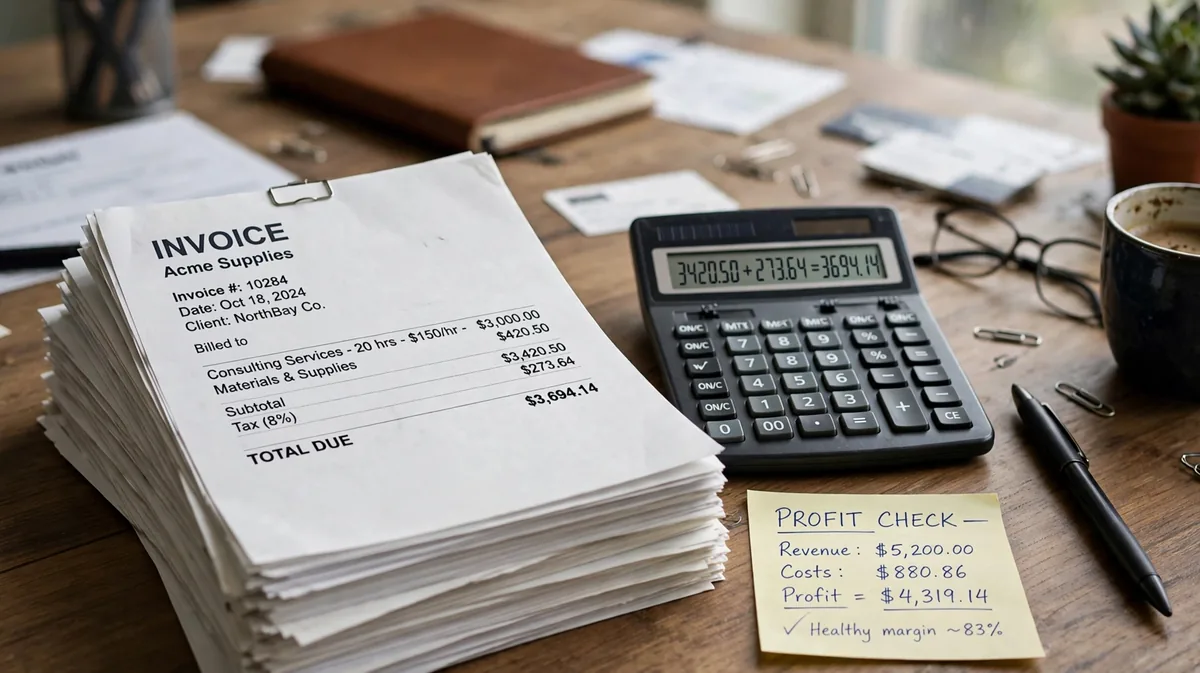
Real businesses subtract costs in layers, and each layer answers a different question. Take a small business with $200,000 of revenue in a year. Its direct costs of goods sold are $120,000. Its rent, wages, marketing, and other operating expenses come to $45,000. It also pays $3,000 of interest and $7,000 of tax.
| Level | Calculation | Result | What it tells you |
|---|---|---|---|
| Gross margin | ($200,000 − $120,000) ÷ $200,000 | 40 percent | Whether pricing covers the direct cost of what you sell |
| Operating margin | ($80,000 − $45,000) ÷ $200,000 | 17.5 percent | Whether the core business runs profitably day to day |
| Net margin | ($35,000 − $3,000 − $7,000) ÷ $200,000 | 12.5 percent | What share of revenue survives as final profit |
Watch how the same business is honestly described by three different numbers. A 40 percent gross margin sounds comfortable. A 12.5 percent net margin is the stricter truth about what the owner actually keeps. Neither is wrong; they measure different layers, which is why any margin figure means little until you know which level it is.
One technical note: use revenue after discounts and returns in these formulas, not the headline sales figure, or every margin you compute will flatter the business slightly.
For your own figures, enter revenue and costs once and read all the levels instantly.
Margin Versus Markup: Same Profit, Different Percentage

This is the most expensive confusion in small business pricing. Margin divides profit by the selling price. Markup divides the same profit by the cost. Since the selling price is the bigger number, margin always comes out smaller.
Back to the product example: profit $40, price $100, cost $60.
- Margin: $40 ÷ $100 = 40 percent
- Markup: $40 ÷ $60 = 66.7 percent
Both describe the same forty dollars. If a supplier quotes you a markup and your accounts track margin, convert before you compare: margin = markup ÷ (1 + markup), and markup = margin ÷ (1 − margin). Check the first one: 0.667 ÷ 1.667 = 0.40, the 40 percent margin we started with.
The Pricing Trap, Priced in Dollars
Suppose your product costs $60 and you want a 40 percent margin. The correct price comes from reversing the margin formula: price = cost ÷ (1 − margin) = $60 ÷ 0.60 = $100. At $100, your profit is $40 and your margin is exactly 40 percent.
Now suppose you mistakenly apply a 40 percent markup instead. Price = $60 × 1.40 = $84. Profit is $24. Real margin = $24 ÷ $84 = 28.6 percent. You aimed for 40 and landed at 28.6, giving away more than a quarter of your intended profit on every single sale, and the spreadsheet still looks tidy while it happens.
This is also where margin meets survival: if your price and costs leave too thin a margin, volume has to work miracles to cover fixed costs. Our break even calculator shows how many units you must sell at a given margin before the business covers its costs at all.
What Counts as a Good Profit Margin?
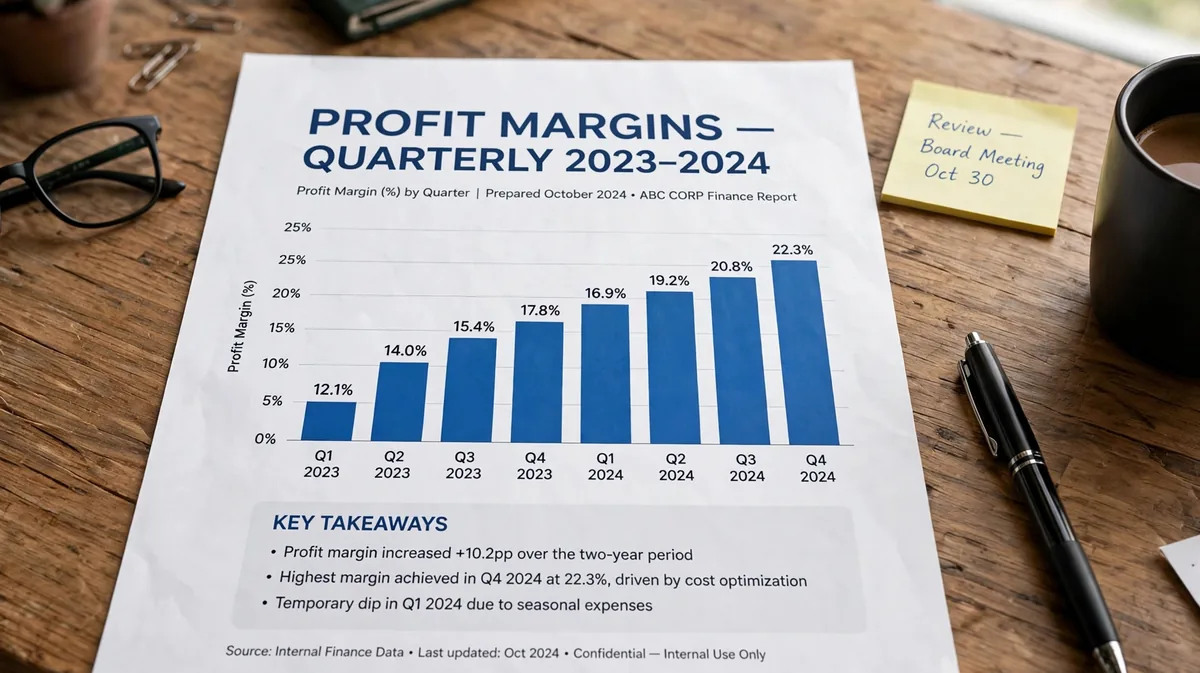
There is no single good number, and any source that gives you one without naming an industry is guessing. Margins follow the structure of the business: a grocery store moves huge volume on very thin margins per item, while a software business carries low direct costs and can post very high gross margins. What you can judge without any benchmark:
- Your trend. A margin shrinking quarter after quarter is a warning whatever the level, because costs are outrunning prices.
- Your level consistency. Gross margin steady while net margin falls points at operating expenses, not pricing.
- Your cushion. Net margin is the shock absorber. A business keeping 12.5 percent can survive a bad season that kills a business keeping 2 percent.
Compare your margin mainly with your own past and with direct competitors selling similar products, and always compare the same level: your net margin against their gross margin is a rigged comparison.
Frequently Asked Questions
How do you calculate profit margin from revenue and cost?
Subtract the cost from the revenue to find the profit, divide the profit by the revenue, and multiply by 100. Revenue of $200,000 with $120,000 of direct costs gives $80,000 of gross profit, and $80,000 ÷ $200,000 = a 40 percent gross margin. For net margin, subtract every cost including interest and tax before the same division.
What is the difference between gross margin and net margin?
Gross margin subtracts only the direct cost of the goods or services sold. Net margin subtracts everything: direct costs, operating expenses, interest, and taxes. In the worked example in this article, the gap between the two is the honest story of the business: 40 percent gross becomes 12.5 percent net once the running costs of the business are paid.
Is a higher markup the same as a higher margin?
They move together but they are never the same number. Markup divides profit by cost, margin divides profit by selling price, so markup always reads higher on the same sale: 66.7 percent markup and 40 percent margin describe one identical $40 profit. When you set a target, be certain whether the target is a margin or a markup before you price anything.
Can profit margin be over 100 percent?
Gross and net margin cannot pass 100 percent, because profit cannot exceed the revenue it is divided by. The only way margin reaches 100 percent is a cost of zero. Markup is different: it divides by the smaller cost figure, so markups above 100 percent are common, such as a $40 cost sold at $100, which is a 150 percent markup and a 60 percent margin.
Conclusion
Calculate profit margin by dividing profit by revenue, and be precise about which costs you subtracted: direct costs only for gross margin, everything for net margin. Keep margin and markup in their separate lanes, price from the margin formula
rather than a markup guess, and judge your number against your own trend and your true competitors. Do that, and this one percentage becomes the most honest health check your business has.

Taha Rasheed is a content researcher and editor at UnlimitedCalculators.com. He is passionate about making everyday calculations easier and more accessible through simple, practical, and easy-to-understand online tools.
He focuses on researching calculation methods, creating helpful content, and improving the clarity and usability of calculator resources across different topics, including mathematics, finance, education, health, and everyday calculations.
At UnlimitedCalculators.com, Taha aims to provide useful, informative, and user-friendly resources that help visitors understand calculations and make everyday tasks simpler.