
Gravitational Force Calculator
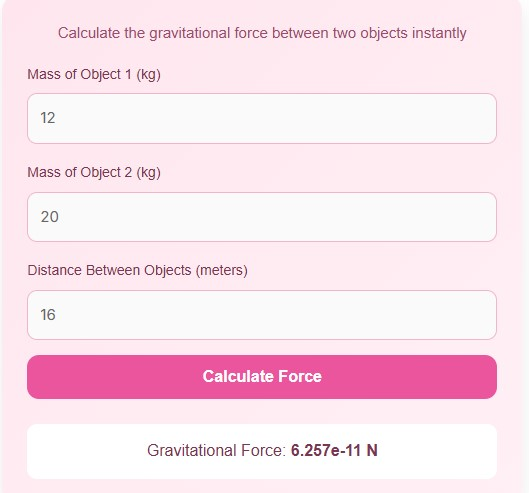
Calculate the gravitational force between two objects instantly
Introduction
Every object in the universe pulls on every other object. The Earth pulls you down, the Moon pulls the oceans into tides, and the Sun holds the planets in their orbits, all through gravity. The force is usually far too small to feel between everyday objects, which is exactly why it is hard to picture. This Gravitational Force Calculator turns Newton’s law of universal gravitation into a number you can see, so you can explore how mass and distance shape the pull between two objects.
It is built for physics students, teachers and anyone curious about how gravity works. You enter two masses and the distance between them, and the calculator gives the gravitational force in newtons. It is a quick way to check homework, test a what if question, or build a feel for a force that governs everything from falling apples to orbiting satellites.
What is Gravitational Force?
Gravitational force is the attractive force between two objects that have mass. It was described by Isaac Newton in 1687: every mass attracts every other mass, and the strength of the pull depends on the two masses and on how far apart they are. The force acts along the line joining the two objects, and it pulls them toward each other. It never pushes them apart.
The force grows when either mass grows. Double one mass and the force doubles. Double both masses and the force is four times as strong. The force falls quickly as distance grows, following an inverse square relationship, so doubling the distance makes the force one quarter as strong, and tripling the distance makes it one ninth as strong.
Gravity is the weakest of the fundamental forces, which is why the pull between two people, or between a person and a book, is far too small to notice. It only becomes large when at least one mass is enormous, such as a planet or a star. That is also why gravity rules the large scale world of planets, stars and galaxies, even though it is negligible in everyday collisions and pushes.
How to Use the Gravitational Force Calculator
Follow these steps to work out the force between any two objects:
- Enter the Mass of Object 1 (kg), for example 10.
- Enter the Mass of Object 2 (kg), for example 20.
- Enter the Distance Between Objects (meters), measured from the centre of one object to the centre of the other, for example 5.
- Click Calculate Force to see the gravitational force in newtons (N).
Always use kilograms for mass and metres for distance. The distance is centre to centre, which matters for spheres such as planets: use the distance between their centres, not the gap between their surfaces. If your values are in other units, convert them first. The Unit Converter can help you change grams to kilograms or kilometres to metres before you enter them.
The Gravitational Force Formula
The calculator uses Newton’s law of universal gravitation:
F = G x (m1 x m2) / r squared
Here F is the gravitational force in newtons, m1 and m2 are the two masses in kilograms, r is the distance between their centres in metres, and G is the gravitational constant, 6.674 x 10 to the power of minus 11 N m squared per kg squared.
Because G is so small, the force between ordinary objects is tiny. For the numbers in the example below, the answer is less than a billionth of a newton. For the Earth, with a mass of about 5.97 x 10 to the power of 24 kg, the same formula gives the familiar pull of about 9.81 newtons on every kilogram at the surface.
Worked Example
Take two masses of 10 kg and 20 kg, with 5 metres between their centres.
Multiply the masses: 10 x 20 = 200. Multiply by the gravitational constant: 6.674 x 10 to the power of minus 11 x 200 = 1.3348 x 10 to the power of minus 8. Divide by the distance squared: 5 squared is 25, so 1.3348 x 10 to the power of minus 8 divided by 25 = 5.339 x 10 to the power of minus 10.
So the gravitational force is 5.339e-10 N, which is exactly what the calculator shows for these inputs. That is about 0.0000000005339 newtons, far too small to feel, which is why we never notice the pull of everyday objects.
When to Use It and Tips
Use this calculator for physics homework and revision, for comparing the pull of different pairs of objects, and for exploring how the inverse square law works in practice. It is also handy when you are studying orbits, tides or the motion of planets, where gravity is the force that matters.
- Keep the units consistent: kilograms and metres, so the answer comes out in newtons.
- Remember the centre to centre rule for distance, especially for large spheres.
- Try doubling the distance to see the force fall to one quarter, a quick check that the inverse square law is working.
- Do not expect large answers for small masses. A tiny result is correct, not a mistake.
If you want to explore how mass is balanced around a point, the Centroid Calculator finds the centre of a shape, which is the natural starting point for centre to centre distances in a real object.
FAQs
Q1: What formula does this calculator use?
It uses Newton’s law of universal gravitation: F = G x (m1 x m2) / r squared, where G is the gravitational constant, 6.674 x 10 to the power of minus 11 N m squared per kg squared. Enter the two masses in kilograms and the distance in metres, and the calculator applies the formula for you.
Q2: Why is the force so small for everyday objects?
Because the gravitational constant G is extremely small. Two people standing a metre apart pull on each other with a force far below anything you could feel. Only very large masses, such as the Earth, produce a force large enough to notice.
Q3: Is the distance measured between the surfaces or the centres?
Between the centres. Newton’s law uses the distance between the centres of mass of the two objects. For spheres, such as planets, that means centre to centre, not the gap between their surfaces.
Q4: Can I use different units, such as grams or kilometres?
The calculator expects kilograms for mass and metres for distance. Convert your values first: divide grams by 1,000 to get kilograms, and multiply kilometres by 1,000 to get metres. Using the wrong units will give a wrong answer.
Q5: Does the force work in both directions?
Yes. The pull is equal and opposite, as Newton’s third law requires. The Earth pulls you down with the same force that you pull the Earth up, but the Earth is so massive that its movement is far too small to see.
Q6: Can I use this for planets and satellites?
Yes, as long as you know the masses and the centre to centre distance. For example, you can use the mass of the Earth and the distance from its centre to a satellite. For very precise orbital work you would also need to allow for the shapes of the bodies and other forces, but this calculator gives a sound first estimate.
Disclaimer
Disclaimer: This calculator is for educational and informational purposes only. It applies Newton’s law of universal gravitation to the values you enter and does not allow for relativity, the shapes of real bodies, or other forces. Results are estimates for learning and general use, not for engineering, navigation or scientific research.