
Fragrance Calculator
🌸 Find how much fragrance oil and alcohol you need for your perfume blend.
How much oil and alcohol do you need?
For a 100 ml bottle at 20%, the strength of eau de parfum, you need 20 ml of fragrance oil and 80 ml of alcohol. That is the worked example this calculator gives, and the same sum works at any size. Oil is the bottle size times the percentage, and alcohol is what is left.
A smaller bottle works the same way. For 50 ml at 15%, the strength of eau de toilette, you need 7.5 ml of fragrance oil and 42.5 ml of alcohol. Put the total volume and the strength into the calculator above, and it works out both amounts for you.
When a blend needs thinning rather than building from scratch, the Dilution Ratio Calculator can work out the extra carrier to add.
Perfume strengths, from light to strong

Body mist and eau de cologne
These are the lightest strengths, at 5% and 10%. In a 100 ml bottle that means 5 ml or 10 ml of fragrance oil, with 95 ml or 90 ml of alcohol. They feel fresh and light, and they suit hot days and close wear.
Eau de toilette
Eau de toilette is 15%. In a 100 ml bottle that means 15 ml of fragrance oil and 85 ml of alcohol. It is the usual choice for daytime wear, as it is noticeable without being heavy.
Eau de parfum
Eau de parfum is 20%. In a 100 ml bottle that means 20 ml of fragrance oil and 80 ml of alcohol. It is stronger and lasts longer, so it suits evenings and cold weather. The calculator on this page covers these four strengths, from 5% to 20%.
How to mix your blend

Start with the oil, not the alcohol. Measure the oil first, with a syringe or a pipette, in millilitres. Drops are hard to count and easy to get wrong, so a marked syringe is worth using even for a small bottle.
Add the alcohol next, then stir or shake the bottle gently until the two liquids are fully mixed. A good blend has top, middle and base notes in balance, so no single note takes over the scent.
Leave the blend to rest in a cool, dark place before you test it. A day or two helps the notes settle, and a week is better for a strong blend. Test it on paper first, then on skin, and give it time to dry down before you judge it.
Scaling a recipe up or down
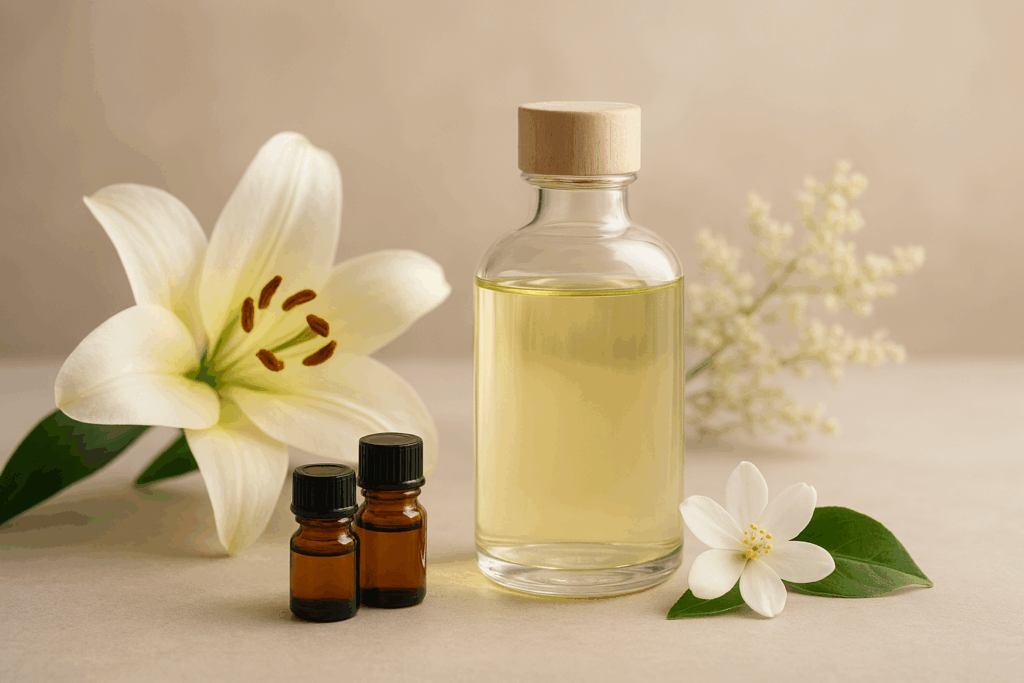
Make a small trial first, then scale it up once the scent is right. A 30 ml trial at 15% needs 4.5 ml of fragrance oil and 25.5 ml of alcohol. The same strength in a 100 ml bottle needs 15 ml of oil and 85 ml of alcohol.
Keep the percentage the same when you scale, and work in millilitres throughout. That way the scent stays the same from the trial bottle to the full bottle. For any other proportion, the Ratio Calculator can keep the oil and alcohol in the same balance as you scale up.
Choosing a strength for the occasion
For everyday wear
For daily wear, choose 10% or 15%. A 10% eau de cologne or a 15% eau de toilette is fresh and easy to wear, and it will not fill a room. It suits school, the office and time outdoors.
For work
For work, keep it light and close to the skin. A 10% blend is a safe choice, with one or two sprays on the wrists and neck. If you want it to last through the day, step up to 15% rather than adding more sprays.
For evenings and events
For evenings, choose 20% eau de parfum. It is richer, it lasts longer, and a small amount goes a long way. One or two sprays are enough, and the scent will still be there hours later.
How concentration changes a scent

A higher percentage does two things. It makes the scent stronger, and it makes it last longer on skin and clothes. That is why the same oil can smell light at 10% and rich at 20%.
How long it lasts
A 5% or 10% blend may last an hour or two, while a 20% blend can last six hours or more on skin. Clothes hold scent longer than skin, so spray lightly and let it dry before you judge it.
How strong it smells
Strength is about the share of oil, not the amount you spray. A 20% blend smells stronger from the first spray, so use less of it. If a scent feels too strong, drop the percentage rather than just spraying less. The Concentration Calculator can work out the same kind of share for other mixtures.
How to use the calculator
- Enter the total volume of your bottle in millilitres, for example 100.
- Choose the strength you want, from 5% body mist to 20% eau de parfum.
- Click Calculate, then read the two amounts: fragrance oil and alcohol.
For the worked example, 100 ml at 20% gives 20 ml of oil and 80 ml of alcohol. If you want to check the share by hand, the Percentage Calculator can do the same sum.
Let it rest, test it and store it

A fresh blend needs time. Leave it in a cool, dark place for at least a day, and a week if you can. The notes soften and join together, and the alcohol smell fades.
Test it on paper first, then on one wrist. Give it time to dry down, and do not test more than two or three scents at once. Store the finished bottle in a dark glass bottle, away from light and heat, with the cap on tight.
Mistakes that spoil a blend

The most common mistake is measuring by drops. Drops vary in size, so a recipe counted in drops will not come out the same twice. Measure in millilitres with a syringe or pipette, and write the amounts down.
The next mistake is judging a scent too soon. A fresh blend smells of alcohol at first, and the top notes fade fast. Let it rest, test it on paper, and only then decide if it needs more oil, less oil, or a different note.
Top, middle and base notes

Top notes are what you smell first. Citrus and light herbs lift off fast, often within an hour. They make a scent feel fresh, but they do not last.
Middle notes form the heart of the scent. Floral and spice notes last a few hours. Base notes, like vanilla, musk and wood, last longest and hold the scent together. A good blend has all three, so the scent changes slowly instead of fading at once.
What affects how a perfume turns out

Good ingredients make a better scent. Pure oils and clean alcohol give a clearer smell, while cheap or old oils can smell flat or harsh. Buy small amounts from a supplier you trust, and check the scent before you mix a large batch.
Storage matters just as much. Light, heat and air break a perfume down over time. Keep finished bottles in a cool, dark place, with the cap on tight, and use dark glass when you can.
Questions people ask
What is a fragrance calculator?
It works out how much fragrance oil and alcohol you need for a bottle, from the total volume and the strength you choose. It takes the guesswork out of mixing.
Which perfume types does it cover?
It covers the four strengths in the calculator: body mist at 5%, eau de cologne at 10%, eau de toilette at 15% and eau de parfum at 20%. It does not cover parfum above 20%, as that strength is not in the list.
How do I measure the ingredients?
Use a syringe or pipette marked in millilitres. Enter the total volume and the strength, read the two amounts, then measure the oil first and add the alcohol.
Can I make smaller or larger batches?
Yes. The calculator works for any total volume, from a small trial to a large bottle, as long as you keep the same percentage.
Is it safe to put essential oils on skin without diluting them?
No. Always dilute essential oils in alcohol or another carrier, as the calculator works out. Undiluted oils can irritate skin, so do a patch test before you use a new blend.
Final Words
Making your own perfume is a small project with a clear payoff: a scent that is yours, made at a strength you chose, for a bottle size you need. Start with the worked example, try a small batch, and let it rest before you judge it.
For more tools, see the All Calculators page, which lists every calculator on this site in one place.
Disclaimer
The Fragrance Calculator is for personal and educational use only. Always handle essential and fragrance oils with care, as some may cause skin irritation or allergic reactions. Do a patch test before you use a new blend.