
CPM Calculator
Instantly calculate your cost per 1,000 ad impressions
What Is a CPM Calculator?
A CPM Calculator helps advertisers, publishers, marketers, and businesses accurately calculate the cost per 1,000 impressions for digital advertising campaigns. This calculator simplifies media planning by allowing users to understand ad pricing, budget efficiency, and campaign performance in seconds.
It is especially useful for comparing advertising platforms, estimating ad spend, and improving ROI. By using a CPM calculator, you can make smarter marketing decisions based on real numbers. It works perfectly for display ads, social media campaigns, and programmatic advertising.
Whether you are a beginner or a professional, this tool saves time and reduces calculation errors. A reliable CPM calculator ensures transparency in advertising costs and helps optimize campaign strategies effectively.
CPM stands for cost per mille, which means the cost of 1,000 ad impressions. An impression is recorded each time an ad appears on a screen, whether or not anyone clicks it. To measure the clicks those views produce, use the CTR Calculator.
How to Use the CPM Calculator
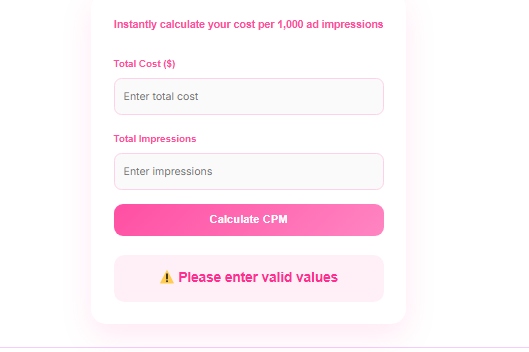
Using the CPM Calculator takes less than a minute. Follow these steps:
- Enter your total cost. Type the full amount you spent on the ad campaign into the Total Cost box.
- Enter your total impressions. Type how many times the ad was shown, using the number from your ad platform report.
- Click Calculate CPM. The calculator divides your cost by your impressions and multiplies by 1,000.
- Read your CPM. The result is the price of 1,000 views, shown in dollars.
- Compare campaigns. Run the same check for each platform or ad set to find the cheapest reach.
Use the same currency and the same date range for every campaign you compare, so the results stay fair. If your platform reports impressions in thousands, multiply that number by 1,000 before you enter it.
Why CPM Is Important in Digital Advertising
CPM is important because it focuses on brand visibility and reach. It allows advertisers to measure the cost of getting their message in front of a large audience. That is particularly useful for brand awareness campaigns, where clicks are not the main goal.
CPM also makes media planning simple. Most ad platforms sell display, video, and social inventory by the thousand impressions, so CPM is the price you actually pay. Comparing CPM across channels shows which placement gives you the most attention for your budget before you commit more money.
Benefits of Using a CPM Calculator
A CPM Calculator saves time and reduces human errors. It gives instant and accurate results for both small and large campaigns, so you do not need to work out the maths by hand.
It is easy to use for beginners and professionals alike, and it works for every type of digital ad, including social media, display, and video. Because the result is a single standard number, you can compare any two campaigns side by side, even when they ran on different platforms or in different months. That makes budgeting, forecasting, and performance reviews faster and fairer.
CPM vs Other Advertising Metrics
CPM focuses on impressions, not clicks or conversions. Unlike CPC, it measures visibility rather than engagement. It is best suited for awareness-based campaigns. Using CPM alongside other metrics gives a complete performance overview.
How to Calculate CPM: Formula and Worked Example
The CPM formula is simple: divide your total cost by your total impressions, then multiply the result by 1,000.
CPM = (Total Cost ÷ Total Impressions) × 1,000
Here is a worked example using the calculator on this page. A business spends $500 on a display campaign and the ad is shown 100,000 times. Divide 500 by 100,000 to get 0.005, then multiply by 1,000. The CPM is $5.00, so the business paid five dollars for every 1,000 views.
Try a second example. A business spends $1,200 and gets 300,000 impressions. The CPM is $4.00, so this campaign reached 1,000 people for one dollar less than the first one. If your CPM rises from one month to the next, you can measure that change with the Percentage Increase Calculator.
What Is a Good CPM?
There is no single good CPM. Display ads often cost only a few dollars per 1,000 impressions, while video ads and premium placements can cost twenty dollars or more. Social media CPMs vary widely by audience, season, and country. Compare your CPM with the average for your channel and audience. A CPM far above that average means you should check your targeting and creative before you keep spending.
When to Use a CPM Calculator
Use a CPM Calculator whenever you plan, compare, or review an advertising campaign. It helps you set a budget before launch, because you can work out how many impressions your money will buy. It helps you compare platforms side by side, for example Google Display against Facebook or Instagram, using one fair number. And it helps you review a finished campaign, because a rising CPM can warn you that an audience is saturated.
Limitations of CPM
CPM has limits. It measures views, not results, so a cheap CPM does not guarantee sales. An ad can be shown without being seen, for example when it loads below the fold. Bots and repeat views can inflate impressions. Always read CPM together with clicks, conversions, and profit. A low CPM only helps if each sale is profitable, so check the margin behind the sale with the Contribution Margin Calculator.
FAQs – CPM Calculator
1. What does CPM mean?
CPM stands for cost per mille, which means the cost of 1,000 ad impressions. It shows how much you pay each time your ad is shown 1,000 times. Advertisers use it to compare the price of reach across platforms and campaigns.
2. Is CPM good for brand awareness?
Yes. CPM is ideal for brand awareness campaigns, because you pay for views, not clicks. If your goal is to get a product launch, event, or message in front of as many people as possible, CPM is usually the right model.
3. Can CPM be used for social media ads?
Yes. CPM is commonly used for Facebook, Instagram, and display ads, as well as video and programmatic advertising. Most social platforms let you choose between CPM and other pricing models.
4. Does a higher CPM mean better ads?
Not always. A higher CPM may mean premium placements, a valuable audience, or strong competition for the same viewers. It does not guarantee better results, so always judge a campaign by its reach, clicks, and conversions together.
5. Is this CPM Calculator free to use?
Yes. This CPM Calculator is completely free to use, with no sign-up needed. Enter your total cost and total impressions, click Calculate CPM, and you get your result straight away.
Conclusion
A CPM Calculator turns two simple numbers into the price of reaching 1,000 people. Use it before you launch to plan your budget, during a campaign to compare platforms, and after it ends to judge value. Watch your CPM over time, and read it together with clicks, conversions, and profit.
Key Points to Remember
CPM is the cost of 1,000 ad impressions. It suits brand awareness and reach, not direct sales. A good CPM depends on your channel and audience. And CPM alone never tells the full story, so pair it with clicks, conversions, and margin before you change your budget.
Disclaimer
This CPM Calculator provides estimated results for informational purposes only. Actual advertising costs may vary depending on platform, targeting, and market conditions.
Always review the terms, reports, and billing details of your advertising platform before making budget decisions. The results here are a planning aid, not financial advice, and they do not guarantee future campaign performance.