
Compression Ratio Calculator
What Is a Compression Ratio Calculator?
A Compression Ratio Calculator is an online tool that works out the compression ratio of an internal combustion engine. The compression ratio compares the total cylinder volume when the piston is at the bottom, called bottom dead centre (BDC), with the clearance volume when the piston is at the top, called top dead centre (TDC). It is one number that says a lot about how an engine will behave.
It plays a very important role in engine performance, fuel efficiency, and power output. A higher compression ratio usually means better thermal efficiency and more engine power, but it also asks for higher octane fuel to stop the engine knocking. Our free online Compression Ratio Calculator helps mechanics, automotive students, and engine builders work it out in seconds, with no manual maths. Gearing works with compression to shape how a car feels on the road, so try the Gear Ratio Calculator when you plan a drivetrain change.
This guide explains the formula, shows a worked example with real numbers, and answers the questions people ask most about engine compression.
How to Use It
Using this Compression Ratio Calculator is very easy. Follow these steps and the result appears at once.
- Enter the Swept Volume (cc): the volume the piston displaces during one stroke.
- Enter the Clearance Volume (cc): the volume left in the cylinder when the piston is at top dead centre.
- Click Calculate Compression Ratio.
- Read the result, shown as a ratio such as 10.00:1.
Enter whole numbers in cubic centimetres, and make sure the clearance volume is not zero, because dividing by zero gives no result.
The Compression Ratio Formula
The formula used is simple. Divide the total cylinder volume by the clearance volume. The total cylinder volume is the swept volume plus the clearance volume, so the formula is: Compression Ratio = (Swept Volume + Clearance Volume) / Clearance Volume. Both volumes must use the same unit, usually cubic centimetres, and the unit cancels out, so the ratio has no unit.
Look at the parts of the formula. The swept volume is the space the piston sweeps as it moves from bottom dead centre to top dead centre. The clearance volume is the small space left above the piston at top dead centre, made up of the combustion chamber, the head gasket space, and the piston dish or dome. Torque is the twisting force an engine makes, and it rises with compression, so try the Torque Calculator to see how force and distance turn into torque.
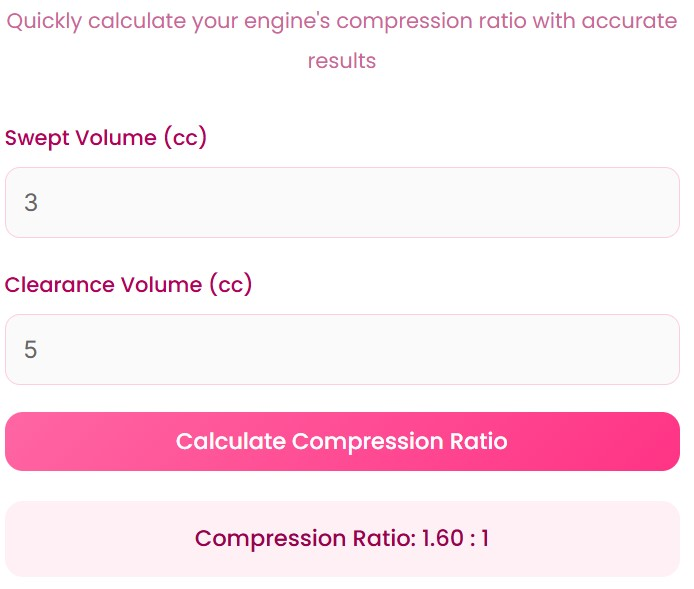
Worked Example: A 10:1 Engine
Take a four cylinder petrol engine with a swept volume of 450 cc and a clearance volume of 50 cc in one cylinder. These are realistic figures for a small car engine, where the swept volume of one cylinder is a few hundred cc and the clearance volume is far smaller. Enter 450 and 50 in the calculator above.
First add the two volumes: 450 + 50 = 500 cc. That is the total cylinder volume at bottom dead centre. Then divide by the clearance volume: 500 / 50 = 10. The compression ratio is 10:1, which the calculator shows as 10.00:1. A ratio of 10:1 is a normal figure for a modern petrol engine and sits inside the usual 8:1 to 12:1 range.
Advantages
Using this online Compression Ratio Calculator provides several benefits:
- Quick and accurate calculations: the ratio appears in seconds, with no hand maths and no rounding slips.
- Eliminates manual calculation errors: one wrong division can hide a problem, and the calculator checks the maths for you.
- Saves time for mechanics and engineers: it does in a moment what a manual calculation takes minutes to do.
- Useful for engine tuning and modifications: change the clearance volume and see at once how the ratio moves.
- Works on mobile, tablet, and desktop devices: use it in the garage or at your desk, on any screen.
It is especially helpful when designing performance engines or checking compatibility with specific fuel, because the ratio decides how much octane the engine needs.
How Compression Ratio Affects Performance
A higher compression ratio squeezes the air and fuel mixture more, so the engine extracts more work from each drop of fuel. That is why performance engines often run ratios of 12:1 or more. The trade off is heat and pressure: squeeze too hard and the mixture can ignite before the spark plug fires, which causes knocking and can damage the engine. Fuel octane limits how high the ratio can go, which is why tuned engines need premium fuel.
Diesel engines have no spark plug, so they rely on compression alone to ignite the fuel, and their ratios reach 14:1 to 25:1. Engine speed also changes how a ratio feels on the road, because the same ratio behaves differently at low and high revs, so check the RPM Calculator when you think about how fast an engine spins.
Typical Compression Ratios
The table shows the ratios you will usually see. Always check your own engine’s figures with the calculator above.
| Engine type | Typical ratio |
|---|---|
| Petrol, standard | 8:1 to 12:1 |
| Petrol, performance | 12:1 to 14:1 |
| Diesel | 14:1 to 25:1 |
Common Compression Ratio Mistakes
- Mixing swept volume and total volume, which gives a ratio that is too low by one.
- Using different units for swept and clearance volume.
- Forgetting the head gasket and piston dish in the clearance volume.
- Raising the ratio without checking the fuel octane the engine needs.
FAQs
1. What is a good compression ratio for petrol engines?
Most petrol engines typically have a compression ratio between 8:1 and 12:1, depending on performance and fuel type. Performance engines often run 12:1 or higher, while older or low performance engines sit near the lower end.
2. What happens if compression ratio is too high?
A very high compression ratio can cause engine knocking and may require high-octane fuel. In the worst case, knocking damages pistons and bearings, so stay within the range your engine and fuel can support.
3. Can I use this calculator for diesel engines?
Yes. Diesel engines usually have higher compression ratios of 14:1 to 25:1, and this calculator works for any engine, because it only needs the swept and clearance volumes.
4. Is this Compression Ratio Calculator free?
Yes, this tool is completely free and easy to use online. There is no sign up, and you can use it as often as you like.
5. Can I raise my engine’s compression ratio?
Yes, but only with care. A thinner head gasket, a skimmed cylinder head, or high compression pistons all raise the ratio. Check the fuel octane and the risk of knocking first, and ask a qualified mechanic if you are unsure.