
Contribution Margin Calculator
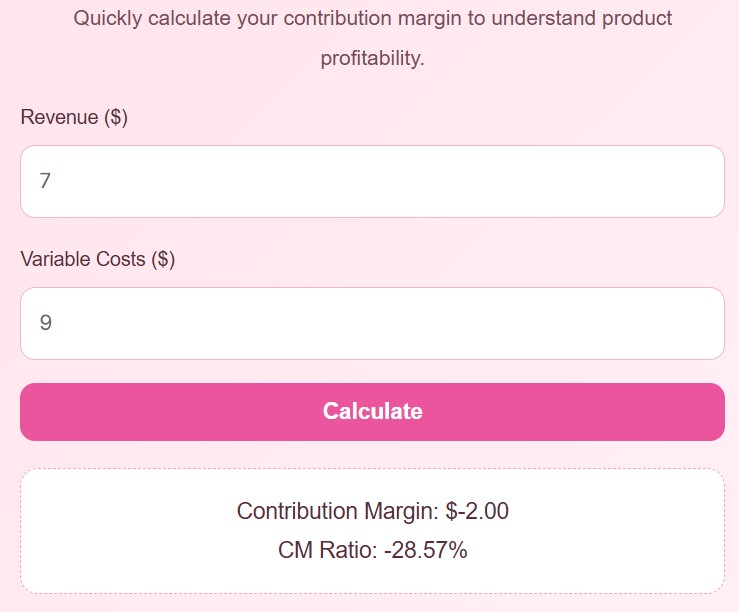
Quickly calculate your contribution margin to understand product profitability.
What is Contribution Margin Calculator?
A Contribution Margin Calculator is a powerful financial tool used to measure how much revenue from sales contributes toward covering fixed costs and generating profit after variable costs are deducted. In simple terms, it helps businesses understand how profitable their products or services truly are after accounting for direct costs like materials, production, packaging, and shipping.
The contribution margin is one of the most important concepts in managerial accounting and financial analysis. It shows how much money is left from sales revenue after subtracting variable expenses. This remaining amount is used to cover fixed costs such as rent, salaries, utilities, and eventually contributes to net profit.
In modern business environments, especially in e-commerce, startups, SaaS companies, and manufacturing industries, understanding contribution margin is essential for pricing strategy, cost control, and profitability planning. A Contribution Margin Calculator simplifies this process by instantly computing results without manual formulas or complex spreadsheets.
With just a few inputs like total revenue and variable costs, the calculator quickly shows:
- Contribution Margin value
- Contribution Margin Ratio (%)
- Profitability insights
This makes it an essential tool for business owners, students, accountants, and financial analysts.
How to Use Contribution Margin Calculator
Using a Contribution Margin Calculator is extremely simple and does not require advanced accounting knowledge. It is designed for beginners as well as professionals.
Follow these easy steps:
Step 1: Enter Total Revenue
Start by entering your total sales revenue. This is the total amount earned from selling products or services before subtracting any costs.
Step 2: Enter Variable Costs
Next, input all variable costs. These are costs that change depending on production or sales volume. Examples include raw materials, packaging, shipping charges, and direct labor costs.
Step 3: Click Calculate Button
Once both values are entered, click on the calculate button. The tool will instantly process your data.
Step 4: View Results
The calculator will display:
- Contribution Margin (Revenue − Variable Costs)
- Contribution Margin Ratio (%)
Step 5: Analyze Your Profitability
Use the results to understand how much money is left to cover fixed costs and generate profit.
A higher contribution margin indicates better profitability, while a lower margin suggests high variable costs or pricing issues.
Advantages of Contribution Margin Calculator
A Contribution Margin Calculator offers several benefits for businesses and individuals who want to improve financial decision-making.
1. Quick and Accurate Results
Manual calculations can be time-consuming and prone to errors. The calculator provides instant and accurate results within seconds.
2. Better Pricing Decisions
By understanding contribution margin, businesses can set better pricing strategies that ensure profitability while staying competitive in the market.
3. Helps in Cost Control
It clearly shows how much of the revenue is consumed by variable costs, helping businesses identify areas where costs can be reduced.
4. Improves Profit Planning
The tool helps in forecasting profits by showing how much each sale contributes toward fixed costs and net income.
5. Easy to Use for Beginners
No accounting background is required. Anyone can use it easily with just two inputs.
6. Useful for All Business Types
Whether you run a small business, e-commerce store, or large manufacturing company, this calculator is useful for analyzing financial performance.
7. Supports Decision Making
It helps in making important decisions like:
- Should I increase prices?
- Should I reduce costs?
- Is this product profitable enough?
8. Time-Saving Tool
Instead of using complex spreadsheets or formulas, users can get instant results in one click.
FAQs
1. What is contribution margin in simple words?
Contribution margin is the amount of money left from sales after subtracting variable costs. It shows how much contributes to fixed costs and profit.
2. Why is contribution margin important?
It helps businesses understand profitability, control costs, and make better pricing decisions.
3. What is contribution margin ratio?
It is the percentage of revenue that remains after variable costs are deducted. It shows efficiency in generating profit.
4. Can small businesses use this calculator?
Yes, it is designed for all types of businesses including small startups and large enterprises.
5. What are examples of variable costs?
Examples include raw materials, packaging, shipping, sales commissions, and direct labor.
6. Is contribution margin same as profit?
No, contribution margin is not final profit. It only shows revenue left after variable costs. Fixed costs still need to be deducted.
7. Do I need accounting knowledge to use it?
No, the calculator is beginner-friendly and requires no technical or accounting knowledge.
Conclusion
A Contribution Margin Calculator is an essential financial tool for understanding business profitability in a simple and effective way. It helps you evaluate how much money your business retains after covering variable costs and how much is available to cover fixed expenses and generate profit.
Whether you are a student learning accounting, a business owner managing finances, or a freelancer tracking income, this tool provides fast and reliable insights into financial performance.
By regularly using a contribution margin calculator, you can improve pricing strategies, reduce unnecessary costs, and make smarter business decisions that lead to long-term success.
Disclaimer
This calculator provides estimated financial results for informational purposes only and should not be considered professional financial advice.
Always consult a qualified accountant or financial advisor before making major business or investment decisions.