
Every expecting parent asks the same question while imagining tiny fingers and first smiles: what will my baby’s eye color be? Whether you picture bright blue eyes inherited from grandma or deep brown ones mirroring dad, the answer is woven into your DNA and it is far more fascinating (and unpredictable) than most people realize.
Why Predicting Babys Eye Color Is Not Simple
Eye color is controlled by up to 16 genes, not one. The old textbook rule of brown beats blue was a starting point, not the full picture.
Two genes carry the most weight: OCA2 and HERC2 on chromosome 15. Together they regulate melanin, the pigment that darkens the iris. High melanin gives brown or hazel eyes and low melanin produces blue, green, or grey.
Because these genes interact in combinations, two brown eyed parents can raise a blue eyed child. T his is polygenic inheritance and it is exactly why predictions come as percentages, not certainties.
The Role of Melanin: Why Newborns Often Have Blue or Grey Eyes
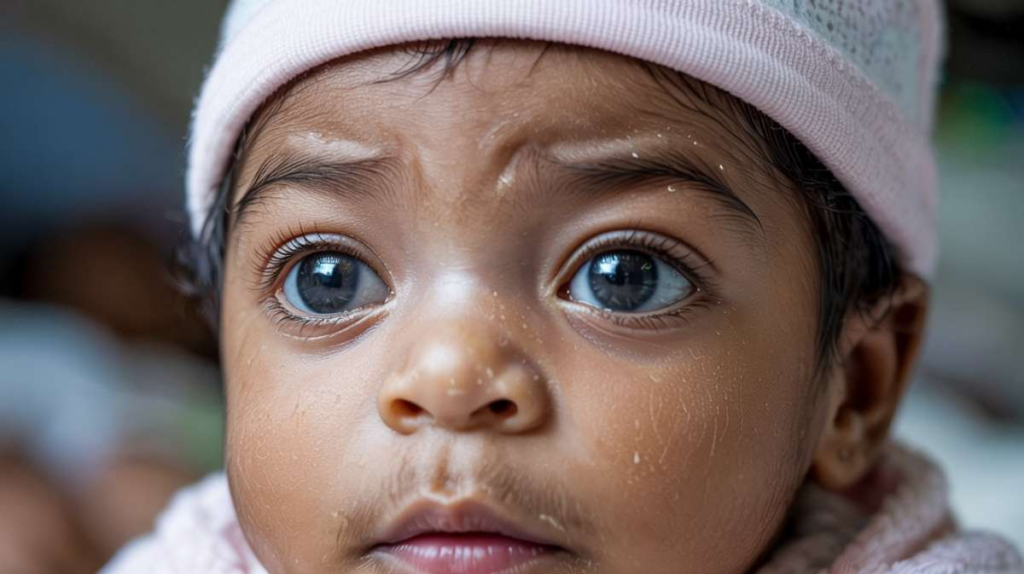
Here is something that surprises many new parents: most babies, regardless of their ethnic background, are born with lower melanin levels in their irises.
Why? Melanocytes (the cells that produce melanin) are present at birth but have not yet been fully activated by light exposure. After nine months in a dark womb, newborns simply have not had the stimulus needed to ramp up melanin production.
As a result:
- Babies of European descent are frequently born with blue or slate grey eyes
- Babies of African, Hispanic, and Asian descent are more likely born with grey or dark brown eyes because their baseline melanin levels are genetically higher
Over the first 6 to 12 months, melanocytes respond to light and produce more melanin, which gradually deepens the eye color. Some childrens eye color continues shifting subtly until age 3.
Baby Eye Color Genetics: The Probability Chart Explained
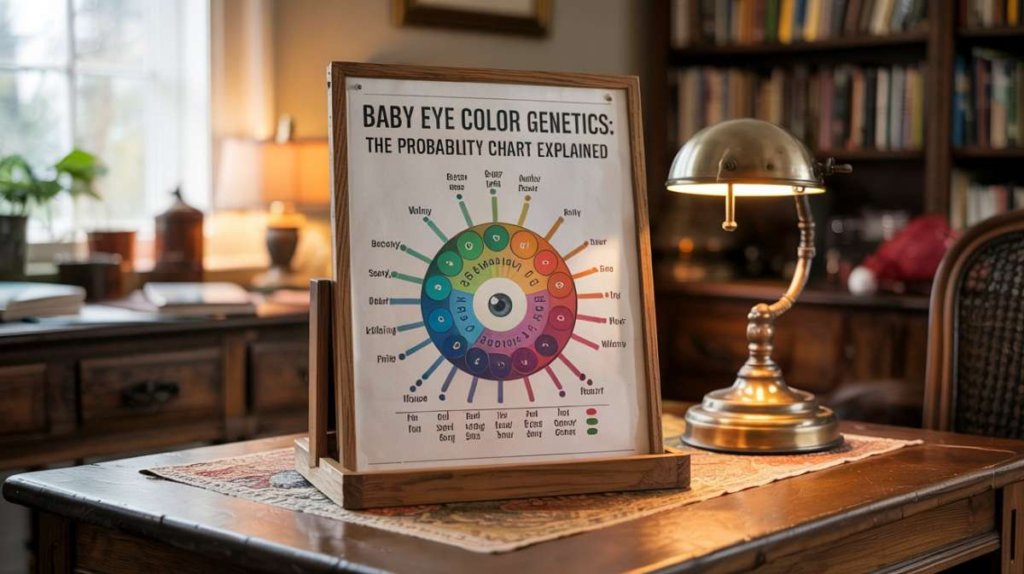
A baby eye color predictor uses Mendelian inheritance principles combined with updated polygenic models to calculate probabilities. Here is a simplified breakdown of the most common parent combinations:
Both Parents Have Brown Eyes
- ~75% chance: Baby has brown eyes
- ~18 to 19% chance: Baby has green or hazel eyes
- ~6 to 7% chance: Baby has blue eyes (if both parents carry a recessive blue allele)
One Parent Brown, One Parent Blue
- ~50% chance: Brown eyes
- ~37% chance: Green or hazel
- ~13% chance: Blue
Both Parents Have Blue Eyes
- ~99% chance: Blue eyes
- ~1% chance: Green or hazel (due to rare polygenic variation)
- Note: Two blue eyed parents having a brown eyed child is extremely rare but genetically possible
Both Parents Have Green Eyes
- ~75% chance: Green eyes
- ~25% chance: Blue eyes
- ~trace % chance: Brown
One Parent Green, One Parent Blue
- ~50% chance: Blue
- ~50% chance: Green
- Very low chance of brown
These are approximations. Individual results depend on the specific alleles each parent carries, many of which are invisible from their eye color alone.
Can Grandparents Predict My Babys Eye Color?
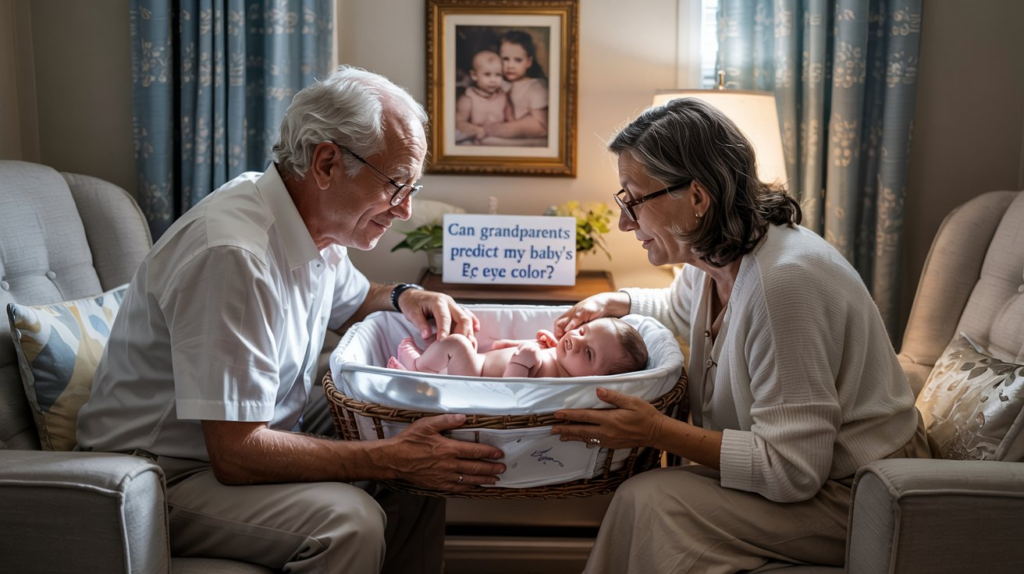
Absolutely, and this is one of the most underused inputs in eye color prediction.
Recessive genes skip generations. Two brown eyed parents may both carry a hidden blue allele inherited from a blue eyed grandparent. That recessive gene can resurface in their child. Including grandparent eye colors in a predictor tool increases accuracy by revealing these hidden genetic possibilities.
Practical tip: If any of the four grandparents has blue or green eyes, the probability of your baby inheriting lighter eyes increases meaningfully, even if both parents have brown eyes.
When Does Baby Eye Color Change? A Timeline
| Age | What Is Happening |
|---|---|
| Birth | Melanin production is minimal and most babies show blue, grey, or dark brown |
| 1 to 3 months | Light exposure begins activating melanocytes |
| 3 to 6 months | Noticeable color shifts may begin in lighter eyed babies |
| 6 to 9 months | Most significant changes occur during this window |
| 12 to 18 months | Eye color is largely stabilized for the majority of children |
| Up to 3 years | Subtle deepening or shifting can still occur |
The Rare Eye Colors: Hazel, Amber, Grey, and Heterochromia
Beyond the classic brown, blue, and green spectrum, some babies inherit genuinely rare eye colors:
Hazel: A dynamic blend of brown, green, and gold. Hazel eyes appear to shift color in different lighting and this is not an illusion but a real variation in how light scatters across the iris. Hazel is particularly difficult to predict because it results from moderate melanin combined with light scattering patterns.
Amber: A golden or coppery tone caused by high concentrations of lipochrome pigment with minimal melanin. Amber eyes are more common in certain ethnic populations and are often mistaken for hazel or light brown.
Grey: A distinct steel toned color, separate from blue. Grey eyes typically contain minimal melanin but have a different microstructure in the iris stroma that scatters light differently than blue eyes.
Heterochromia: When each eye is a different color or one iris contains two colors. This rare condition usually has a benign genetic cause (sectoral heterochromia is particularly striking) but can occasionally be associated with conditions like Waardenburg syndrome. If noticed at birth, mention it to your pediatrician.
What a Baby Eye Color Predictor Actually Calculates
A quality baby eye color predictor does more than run a simple dominant/recessive lookup table. The best tools:
- Accept both parent AND grandparent inputs to surface hidden recessive alleles
- Apply expanded dominance hierarchies with brown over green over blue, but with probabilistic weighting rather than absolute rules
- Account for polygenic contributions by modelling the interaction of OCA2, HERC2, and other loci
- Output probability percentages for every possible color including hazel, amber, grey, and heterochromia
No calculator can guarantee your babys eye color. Eye color inheritance is too genetically complex for a 100% accurate prediction. What a good predictor offers is a scientifically informed probability range, which is genuinely useful for satisfying that very human curiosity about what your child will look like.
Common Myths About Baby Eye Color Debunked
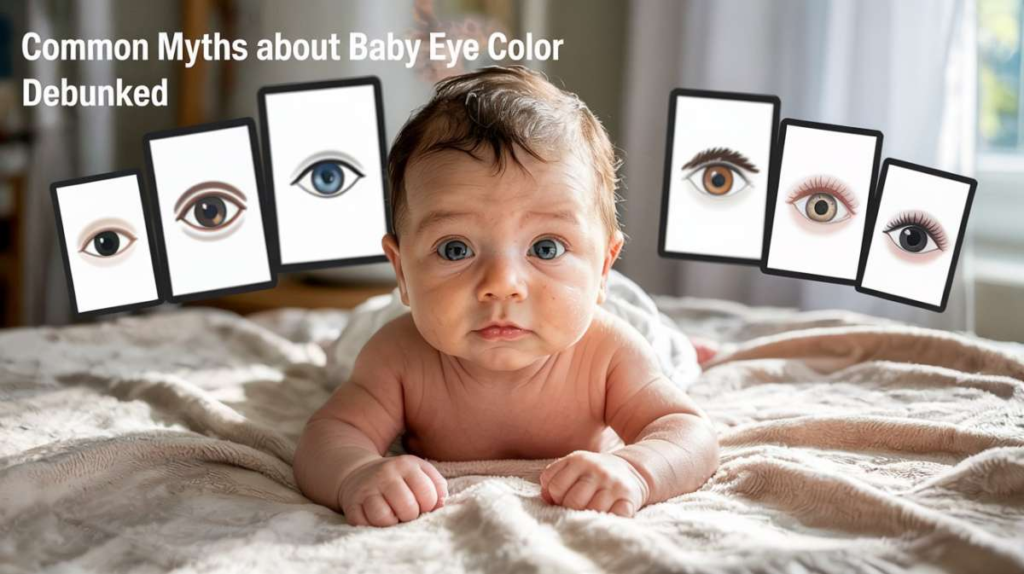
Myth 1: All babies are born with blue eyes. False. Babies of African, Asian, Hispanic, and Middle Eastern descent are frequently born with grey or brown eyes. Blue at birth is a characteristic of lighter skinned, lower melanin newborns and not a universal rule.
Myth 2: Two blue eyed parents always have a blue eyed baby. Almost always true but not always. Because eye color is polygenic, rare genetic combinations can occasionally produce a non blue result even in blue eyed families.
Myth 3: Brown always dominates blue. Generally true, but incomplete. Brown is dominant in the classic sense, yet multiple gene variants can produce green, hazel, or even blue in children of brown eyed parents who carry recessive alleles.
Myth 4: Eye color is set at birth. Completely false. Eye color is one of the most dynamic physical traits in early childhood, often shifting substantially in the first year.
Factors That Influence Final Eye Color
Beyond genetics, a few additional elements can influence how eye color develops:
- Melanin exposure to sunlight: More light exposure accelerates melanin production, which can deepen eye color in the first year
- Ethnic ancestry: Populations with historically higher sun exposure have genetically encoded higher melanin production
- Rare medical conditions: Conditions like ocular albinism, Horner syndrome, or Fuchs heterochromic iridocyclitis can affect iris pigmentation
- Certain medications: In rare cases, some topical eye medications (like latanoprost) can permanently darken iris color
The Science Is Fascinating But the Wait Is Part of the Joy
There is something genuinely wonderful about not knowing exactly what color eyes your child will have. A baby eye color predictor can narrow the odds and give you science backed probabilities, but the moment you look into your newborns eyes for the first time, whatever color they are, will be entirely its own.
What genetics tells us is clear: eye color is a complex, beautiful interplay of inherited information from both parents and all four grandparents, activated by light and time, shaped by melanin and molecular biology. Understanding the science does not diminish the wonder. If anything, it deepens it.
Frequently Asked Questions
Q: Can I trust a baby eye color predictor? A good predictor is a useful probability estimator and not a guarantee. It uses real genetic science to give you the most likely outcomes, but eye color inheritance involves too many variables for certainty.
Q: My parents both have brown eyes, but I have blue. How? Both of your parents carried a hidden recessive blue allele. When both copies of the recessive gene were passed to you, blue eyes resulted. This is exactly why including grandparent data improves predictions.
Q: When is the best time to use a baby eye color predictor? Before or during pregnancy for fun and genetic curiosity. Or after birth, once you know the babys initial eye color, to estimate whether it is likely to change.
Q: Do boy and girl babies have different eye color probabilities? No. Eye color genetics is not sex linked, so there is no difference in probability based on the babys sex.
Q: Can a baby have different colored eyes? Yes, this is called heterochromia and is usually genetic. It can also be caused by injury, inflammation, or rare syndromes. Benign genetic heterochromia requires no treatment.