
Critical Value Calculator
Introduction
A critical value is the line that separates an ordinary result from a result that is surprising enough to act on. In hypothesis testing, that line is a number on the standard normal curve, and this Critical Value Calculator finds it for you in seconds. You type in a confidence level, choose a test type, and the tool returns the Z value that marks the edge of the rejection region. There is no Z table to search, no formula to solve by hand, and no sign up needed. Students use it for coursework and exam revision, researchers use it when they plan a study, and data analysts use it when they check a test result before they write up a conclusion. Because the tool asks for only two inputs, it is fast enough to use while you work through a problem, and clear enough to use the first time you meet hypothesis testing. This guide explains what a critical value is, how the calculator works, and how to read the answer it gives, so you can use the number with confidence in your own work.
What Is a Critical Value Calculator?
A Critical Value Calculator is an online tool that finds the critical Z value for a chosen confidence level. The critical value is the point on a normal distribution beyond which a test statistic counts as unusual. If your test statistic falls beyond that point, you reject the null hypothesis. If it falls short of that point, you do not have enough evidence to reject it. The calculator works with the standard normal distribution, so it returns Z values. That makes it the right tool for Z tests, for large samples, and for questions where the population standard deviation is known.
The confidence level you enter sets how strict the test is. A 95 percent confidence level leaves 5 percent in the tails of the distribution, and the calculator splits that 5 percent according to the test type you choose. In a two-tailed test, half goes to each tail, because you are checking for a difference in either direction. In a one-tailed test, all of it goes to one tail, because you are checking for a difference in one stated direction only. Once you have the critical value, the next step in your test is often the p-value, and our P Value Calculator can help you work that out from a Z score.
How to Use the Critical Value Calculator
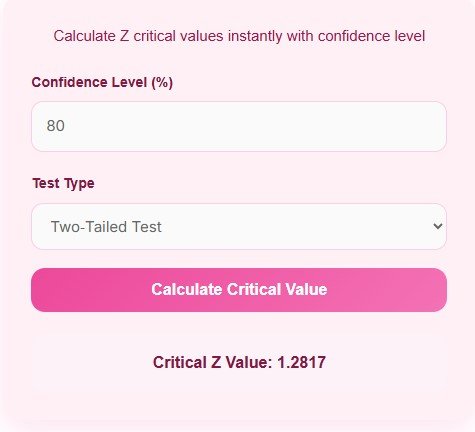
Using the calculator takes four short steps, and each one matches a field you can see above.
Enter your confidence level as a percentage, for example 90, 95, or 99, in the Confidence Level (%) box. A confidence level is a percentage, so enter a number between 0 and 100.
Open the Test Type menu and choose Two-Tailed Test if your hypothesis allows a difference in either direction, or One-Tailed Test if it points one way only.
Click the Calculate Critical Value button.
Read the result, which shows the critical Z value to four decimal places, for example Critical Z Value: 1.9590. Use the same number whenever you repeat the test with the same confidence level and test type, and run the calculator again if either choice changes.
How It Works: The Formula Behind the Z Value
The calculator starts from the confidence level you enter and works out the significance level, alpha, which is 1 minus the confidence level written as a decimal. For a 95 percent confidence level, alpha is 0.05. For a two-tailed test, the calculator finds the Z value that leaves alpha divided by 2 in each tail of the normal distribution. For a one-tailed test, it finds the Z value that leaves all of alpha in one tail. You can think of it as asking the normal distribution a simple question: how far from the centre do I need to go before only alpha of the area is left beyond that point? The answer is the critical value.
The list below shows the two-tailed values this calculator returns for the three confidence levels used most often:
90 percent confidence gives a critical Z value of 1.6447.
95 percent confidence gives a critical Z value of 1.9590.
99 percent confidence gives a critical Z value of 2.5725.
As the confidence level rises, the critical value grows, because a stricter test needs stronger evidence before it rejects the null hypothesis. This calculator returns Z values from the normal distribution. It does not return t values, so for a small sample t test, check your degrees of freedom with our Degrees of Freedom Calculator and use a t table for that test instead.
Worked Example: 95 Percent, Two-Tailed
Suppose you are testing whether a new teaching method changes exam scores, and you choose a 95 percent confidence level with a two-tailed test, because scores could rise or fall. Enter 95 in the Confidence Level box, choose Two-Tailed Test, and click Calculate Critical Value. The calculator returns Critical Z Value: 1.9590. That means a test statistic larger than 1.9590, or smaller than negative 1.9590, falls in the rejection region, and you would reject the null hypothesis.
A test statistic of 2.10, for example, lies beyond the critical value, so the result is significant at the 5 percent level. A test statistic of 1.20 lies inside the range, so the result is not significant and the null hypothesis stands. The same steps work for any other confidence level: change the number, keep the test type, and compare your statistic with the new critical value.
When to Use It and Tips for Good Results
The calculator is useful whenever a decision depends on a test statistic and a stated confidence level. Students reach for it during statistics coursework, exam revision, and assignments that ask for a rejection region. Researchers use it when they plan a study and need the critical value before they collect data. Analysts use it in quality control, in A and B testing, and when they check whether a survey result is strong enough to report. If your test involves counting outcomes, for example the number of ways to choose a sample, our Binomial Coefficient Calculator can help with the counting step.
A few habits keep your results sound. First, pick the test type before you look at your data, because a one-tailed test is only valid when your hypothesis pointed one way from the start. Second, keep the same confidence level through a whole analysis, so your results stay comparable. Third, never switch from a two-tailed test to a one-tailed test after seeing a borderline result, because that changes what the test means. Fourth, write down the critical value and the test statistic together, so anyone reading your work can see how the decision was made. Finally, remember that a critical value is a threshold, not a measure of how large or important an effect is, so report the effect size alongside it.
Frequently Asked Questions
What is a critical value in statistics?
A critical value is the threshold on a distribution that separates the rejection region from the rest of the distribution. In this calculator, it is a Z value on the standard normal curve. If your test statistic goes beyond the critical value, the result is significant at your chosen confidence level.
What is the difference between a one-tailed and a two-tailed test?
A two-tailed test checks for a difference in either direction, so the significance level is split between both tails. A one-tailed test checks for a difference in one stated direction only, so all of the significance level sits in one tail. The same confidence level gives a smaller critical value for a one-tailed test than for a two-tailed test.
What critical value do I use for 95 percent confidence?
For a 95 percent confidence level, this calculator returns a critical Z value of 1.9590 for a two-tailed test. To get the one-tailed value, choose One-Tailed Test in the Test Type menu and run the calculator again.
Can I use this calculator for a t test?
No. This calculator returns Z values from the standard normal distribution, which suit large samples and tests where the population standard deviation is known. A small sample t test needs a t value, which depends on the degrees of freedom of your sample.
Do I still need a Z table?
No, the calculator replaces the Z table for this job. It finds the value for any confidence level you enter, including levels a printed table does not list. Keep a t table handy only if you work with t tests as well.
Is this calculator free to use?
Yes, it is completely free, and it works online on a computer, a tablet, or a phone. There is no sign up, and you can run as many calculations as you like.
Disclaimer
Disclaimer: This Critical Value Calculator is for educational and informational purposes only. The results are estimates based on the standard normal distribution, and they are not a substitute for professional statistical advice. Always confirm important results with your course materials, a qualified statistician, or suitable statistical software before you rely on them for a decision.