
Binomial Coefficient Calculator
Calculate Binomial Coefficient (n Choose k)
Introduction
How many different teams of 3 can you pick from 10 players? How many ways can 5 cards come from a deck of 52? Questions like these are counting questions, and the binomial coefficient is the answer. This Binomial Coefficient Calculator finds it in seconds: you enter n, the size of the whole set, and k, the size of the group you want to choose, and the tool returns the number of possible groups. Students use it for combinatorics and probability coursework, teachers use it to check answers, and analysts use it for lotteries, sampling, and experiment design. This guide explains what a binomial coefficient is, how the calculator works, and how to read the answer, so you can count with confidence instead of multiplying factorials by hand.
What Is a Binomial Coefficient Calculator?
A Binomial Coefficient Calculator is an online tool designed to quickly compute the binomial coefficient, often written as C(n, k) and read as n choose k. This mathematical value represents the number of ways to choose k elements from a set of n elements without considering the order. It is widely used in combinatorics, probability, and statistics.
The order does not matter here, and that is the whole point. Choosing players A, B, and C for a team is the same team as choosing C, B, and A, so the coefficient counts each distinct group once. If the order did matter, the count would be far larger, and you would need a permutations calculation instead. Counting sits at the heart of probability: once you know how many groups are possible, you can work out the chance of any one of them, and our P Value Calculator can help with the next step of testing a result against chance.
How to Use the Binomial Coefficient Calculator
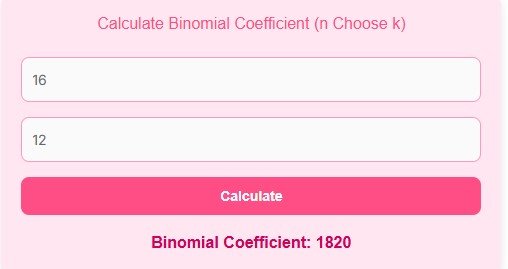
Using the calculator is simple, and it takes three steps that match the fields you can see above.
Enter a non-negative integer n in the first input field. This is the total number of items to choose from, for example 10 players.
Enter a non-negative integer k in the second input field, where k is less than or equal to n. This is the size of the group you want to choose, for example 3 players.
Click the Calculate button to instantly see the result. The tool automatically checks for invalid inputs and displays an error message if needed, for example if k is larger than n.
The Formula: n Choose k
The calculator applies the standard formula: C(n, k) equals n factorial divided by the product of k factorial and n minus k factorial. Written out, C(n, k) = n! / (k! x (n – k)!), where the exclamation mark means factorial, the product of all whole numbers from 1 up to that number. For example, 5! equals 5 x 4 x 3 x 2 x 1, which is 120. The division removes the order from the count: n! counts every arrangement, and dividing by k! and by (n – k)! leaves only the distinct groups. Two facts fall out of the formula at once: choosing 0 items always gives 1, because there is exactly one empty group, and C(n, k) equals C(n, n – k), because choosing the group is the same as choosing who is left out. The critical value that a probability test compares against can be found with our Critical Value Calculator, which pairs well with counting work in statistics.
Worked Example: 10 Choose 3
Suppose a coach has 10 players and needs to pick a team of 3, and the order of picking does not matter. Enter 10 in the n field, enter 3 in the k field, and click Calculate. The calculator returns Binomial Coefficient: 120. You can check the answer by hand: 10! is 3,628,800, 3! is 6, and 7! is 5,040, so 3,628,800 divided by (6 x 5,040) equals 120. There are exactly 120 different teams of 3 that can be picked from 10 players. If the coach instead needed a team of 7, the answer would still be 120, because choosing 7 to play is the same as choosing 3 to leave out.
When to Use It and Tips for Good Results
The calculator is useful whenever you count possibilities without caring about order. Students reach for it in combinatorics and probability coursework, where binomial coefficients appear in nearly every problem set. Teachers use it to check answers and to build examples quickly. Lottery players use it to count how many tickets cover all the combinations, and analysts use it in sampling, quality control, and experiment design, where the number of possible samples decides how much a result can be trusted. It also underpins the binomial distribution, which models how many successes appear in a fixed number of trials, such as heads in a set of coin tosses.
A few habits keep your results sound. First, always check that k is not larger than n, because you cannot choose more items than the set contains, and the calculator will show an error if you try. Second, remember that order does not matter here: if the order of picking does matter, you need a permutations count instead, which is always at least as large. Third, use the symmetry of the formula: C(n, k) equals C(n, n – k), so if k is the larger number, work with n minus k to keep the factorials smaller. Fourth, for probabilities, turn the count into a chance by dividing the favourable groups by the total groups, and our Percentage Calculator can turn that chance into a percentage. Finally, treat very large answers with care: factorials grow fast, and a coefficient in the millions is easy to misread, so write it out in full.
Frequently Asked Questions
What is the binomial coefficient used for?
It counts the number of ways to choose k items from n items when order does not matter. It is the key number in combinatorics and in probability problems that ask how many groups are possible.
What is the formula for C(n, k)?
C(n, k) equals n! divided by (k! x (n – k)!). The exclamation mark means factorial, the product of all whole numbers from 1 up to that number, so 5! equals 120.
What happens if k is larger than n?
The calculator will show an error, because binomial coefficients are only defined for k less than or equal to n. You cannot choose more items than the set contains.
Can I use this calculator for large numbers?
Yes, but extremely large numbers may take a few seconds to compute due to factorial calculations. For most school and college problems, the answer appears instantly.
What is the difference between a combination and a permutation?
A combination counts groups where order does not matter, while a permutation counts arrangements where order does matter. Choosing 3 players for a team is a combination, and choosing them in a batting order is a permutation.
Is this calculator free to use?
Yes, it is completely free, and it works on desktops, tablets, and mobile devices with no sign up.
Disclaimer
Disclaimer: This Binomial Coefficient Calculator is for educational and informational purposes only. The results are estimates based on the values you enter and the standard formula for n choose k, and they are not a substitute for professional advice. Always confirm important results with your course materials, a qualified teacher, or suitable mathematical software before you rely on them for a decision.