
Yield to Maturity Calculator
Calculate the Yield to Maturity (YTM) of a bond easily
Introduction
A bond can look like a simple investment. You lend money, you receive interest each year, and you get your money back when the bond matures. The return you actually earn is rarely as simple as the coupon rate printed on the bond, because the price you pay for the bond changes everything. A bond bought below its face value earns more than its coupon rate, and a bond bought above its face value earns less. This Yield to Maturity Calculator works out that full return in seconds, so you can compare bonds fairly before you invest.
It is useful for anyone comparing bonds, checking whether a bond is fairly priced, or moving from a simple interest rate to a true annual return. Students learning about fixed income, savers weighing bonds against deposits, and investors comparing bonds with different prices and maturities can all use it. You only need four numbers, and the calculator shows the approximate yield to maturity as a percentage.
What is Yield to Maturity?
Yield to maturity, often shortened to YTM, is the total annual return you would earn if you bought a bond at its current price, held it until it matures, received every coupon payment on time, and received the face value back at maturity. It brings together the coupon payments, the price you pay, and the gain or loss when the bond is repaid into one annual rate.
When a bond trades at its face value, its yield to maturity equals its coupon rate. When it trades below face value, at a discount, the yield is higher than the coupon rate, because you also gain when the bond is repaid at full face value. When it trades above face value, at a premium, the yield is lower than the coupon rate, because you lose part of the price you paid. That is why two bonds with the same coupon can offer very different returns.
Yield to maturity is an annualised rate, so it lets you compare bonds with different maturities, coupons and prices on the same basis. It assumes the issuer makes every payment on time and that you hold the bond to maturity. If you sell early, or if the issuer defaults, your actual return will differ.
How to Use the Yield to Maturity Calculator
Using the calculator takes less than a minute. Follow these steps:
- Enter the Face Value ($). This is the amount the bond will repay at maturity, for example 1000.
- Enter the Current Price ($). This is the amount you would pay for the bond today, for example 950.
- Enter the Annual Coupon ($). This is the interest the bond pays each year, for example 50.
- Enter the Years to Maturity. This is the number of years left until the bond is repaid, for example 5.
- Click Calculate YTM to see the approximate yield as a percentage.
Use the same currency for the face value, price and coupon, and enter the coupon as the annual amount in dollars, not as a percentage. If a bond pays coupons twice a year, add the two half-year payments together to get the annual coupon.
The Yield to Maturity Formula
The calculator uses the standard approximation for yield to maturity:
Approximate YTM = (Annual Coupon + (Face Value – Current Price) / Years to Maturity) / ((Face Value + Current Price) / 2)
In words, the yearly return has two parts: the coupon you receive each year, and the gain or loss on the price spread over the years left. That total is divided by the average of the face value and the current price, which is a fair middle value for the money tied up in the bond. The exact yield to maturity needs an iterative calculation, because the price is the present value of all future payments, but this approximation is close enough for comparing bonds and for ordinary investment decisions.
Worked Example
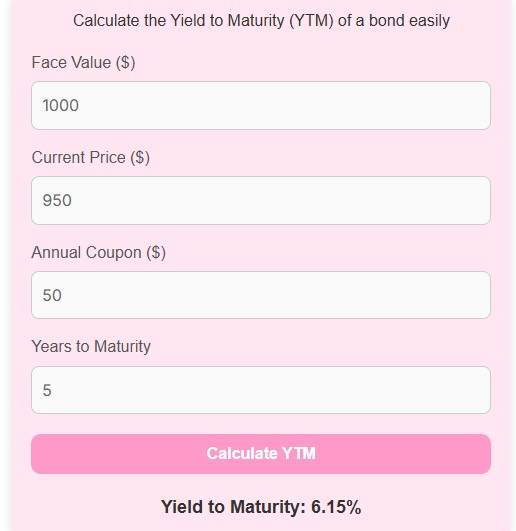
Take a bond with a face value of $1,000, a current price of $950, an annual coupon of $50 and 5 years to maturity.
First, the price gain is $1,000 minus $950, which is $50, spread over 5 years, giving $10 per year. Add the annual coupon of $50 to get $60 per year. Next, the average of the face value and the price is ($1,000 plus $950) divided by 2, which is $975. Finally, $60 divided by $975 is 0.0615, or 6.15%.
So the yield to maturity is 6.15%, which is exactly what the calculator shows for these inputs. The coupon rate alone is 5%, but because the bond is bought at a discount, the true return is higher.
When to Use It and Tips
Use this calculator when you are choosing between two or more bonds, when a bond is offered at a price different from its face value, or when you want to check whether a bond beats a savings account or a term deposit on an annual basis. It is also helpful when interest rates have moved and you want to see what a bond bought today would actually return.
- Compare bonds of the same maturity and credit quality, so the comparison is fair.
- Remember that a higher yield often means higher risk, so check the issuer before you buy.
- Do not confuse yield to maturity with the coupon rate, especially for bonds bought at a discount or premium.
- Recalculate the yield whenever the price changes, because the yield moves in the opposite direction to the price.
To see how long an investment takes to double at a given return, try the Rule of 72 Calculator. If you are weighing a bond against borrowing costs instead, the Loan Calculator can help you compare the cost of a loan with the return on an investment.
FAQs
Q1: Is this yield to maturity calculator accurate?
It gives a close approximation of yield to maturity using the standard formula shown above. The exact yield needs an iterative calculation, but the approximation is accurate enough for comparing bonds and for ordinary investment decisions. For a trade involving a large amount of money, confirm the figure with your broker or a professional pricing tool.
Q2: Why is the yield to maturity different from the coupon rate?
Because the price you pay matters as well as the coupon. A bond bought below face value returns the full face value at maturity, so you gain on the price as well as the coupon, and the yield is higher than the coupon rate. A bond bought above face value loses part of its price, so the yield is lower than the coupon rate.
Q3: Can I use this calculator for any type of bond?
It works for most fixed rate bonds with regular annual coupons and a known face value, price and maturity. It is not suitable for zero coupon bonds, floating rate bonds, or bonds with embedded options such as a call or put feature, because their cash flows are different.
Q4: What happens to yield to maturity when interest rates rise?
Bond prices fall when interest rates rise, and a lower price means a higher yield to maturity for a new buyer. Prices and yields always move in opposite directions. That is why the same bond can show a different yield from one week to the next.
Q5: Does yield to maturity include taxes or fees?
No. It is a gross return before tax, brokerage fees and inflation. Your after tax return depends on your tax rate and on how the coupon and any capital gain are taxed where you live, so use the result as a comparison figure rather than a promise of profit.
Q6: Is yield to maturity the same as the return I will actually earn?
Only if you hold the bond to maturity, receive every coupon on time, and are repaid in full. If you sell early, the price you receive decides your actual return. If the issuer defaults, you may receive less than expected.
Disclaimer
Disclaimer: This calculator is for educational and informational purposes only and is not investment advice. Bond prices and yields change with market conditions, and past yields do not guarantee future returns. Always check the details of a bond with your broker or a qualified financial adviser before investing, and never invest money you cannot afford to lose.