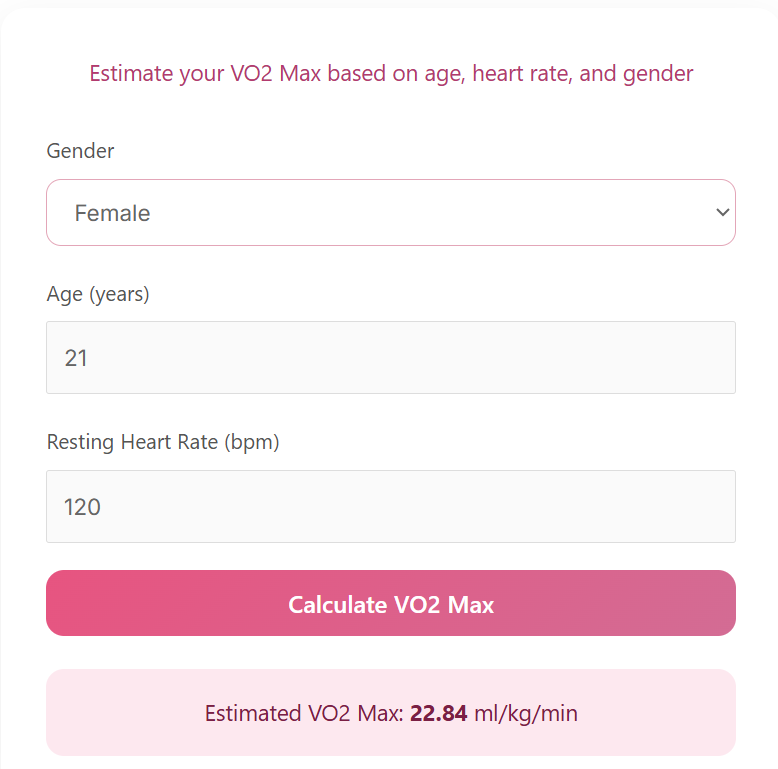
VO2 Max Calculator
VO2 max is the most common single number used to describe aerobic fitness. It measures the maximum amount of oxygen your body can use during intense exercise, and it is reported in millilitres of oxygen per kilogram of body weight per minute. The higher the number, the more oxygen your body can take in and use, which usually means better endurance. This VO2 Max Calculator estimates that number from three simple inputs: your gender, your age and your resting heart rate. It is free, instant and works on any device.
Measuring VO2 max properly takes a laboratory test on a treadmill or an exercise bike, with a mask and a gas analyser, which is expensive and not practical for most people. This calculator uses a well-known estimation formula instead, so it gives a useful figure in seconds from numbers you already know. It is an estimate, not a medical measurement, and the rest of this page explains how it works, what the number means and how to read it.
What Is VO2 Max Calculator?
VO2 max, written as VO2 max, is the maximum rate at which your body can take in oxygen and use it to make energy during hard exercise. When you exercise hard, your heart pumps oxygen-rich blood to your working muscles, and your muscles use the oxygen to produce energy. A fitter body moves and uses more oxygen, so a higher VO2 max usually means better endurance, whether you are running, cycling, swimming or playing sport.
This calculator estimates VO2 max from three inputs because they carry most of the information the formula needs. Resting heart rate matters because a lower resting heart rate usually means a stronger, more efficient heart: it can pump more blood with each beat, so it needs fewer beats to keep you going at rest. Age matters because maximum heart rate falls as we get older: the formula estimates maximum heart rate as 220 minus your age. Gender matters because, on average, women have a lower VO2 max than men of the same age, so the formula applies a factor of 0.9 for women.
How to Use the VO2 Max Calculator
Use it in four steps:
- Select your gender from the dropdown menu.
- Enter your age in years.
- Enter your resting heart rate in beats per minute, measured when you are calm and rested, ideally first thing in the morning.
- Click the “Calculate VO2 Max” button. Your estimated VO2 max appears at once, in ml/kg/min.
Your resting heart rate is the number most worth measuring carefully. Sit or lie quietly for a few minutes, then count your pulse for 60 seconds, or take a reading from a watch or a fitness tracker. A reading taken after climbing stairs or drinking coffee will be too high, and a heart rate that is too high will make the estimate too low.
The Formula
The calculator uses a standard estimation formula, with one version for men and one for women:
For men: VO2 Max = 15.3 x (220 – Age) / Resting Heart Rate
For women: VO2 Max = 15.3 x (220 – Age) x 0.9 / Resting Heart Rate
Here, 220 minus age is the estimate of maximum heart rate. Dividing it by the resting heart rate gives a ratio that reflects how much spare capacity the heart has: a low resting rate gives a larger ratio. Multiplying by 15.3 converts that ratio into millilitres per kilogram per minute. The 0.9 factor for women reflects the average difference in oxygen capacity between men and women, and it is why the same age and resting heart rate give a lower estimate for women than for men.
Worked Example
Take a 30-year-old man with a resting heart rate of 60 beats per minute.
First, the estimated maximum heart rate: 220 minus 30 equals 190 beats per minute. Divide that by the resting heart rate of 60, which gives 3.1667. Multiply by 15.3, which gives 48.45.
So his estimated VO2 max is 48.45 ml/kg/min, and entering Male, 30 and 60 into the tool gives exactly “Estimated VO2 Max: 48.45 ml/kg/min”. For a woman with the same age and resting heart rate, the 0.9 factor applies: 48.45 times 0.9 equals 43.61, and the tool gives 43.61 ml/kg/min. The same heart and the same age, and the formula still gives a lower number for women, because that is how the formula is built.
Reading the Result
The result is in millilitres of oxygen per kilogram of body weight per minute, written as ml/kg/min. A higher number generally means better aerobic fitness. A trained endurance athlete might score above 60, while a typical untrained adult scores in the 30s or 40s. There is no single good number, because a good score depends on your age and your gender, and the tool shows only the number, not a rating or a category. The best use of the figure is to compare it with your own past results, not with anyone else’s.
Because the estimate comes from only three inputs, small changes in the resting heart rate move the result a lot. At the same age of 30, a resting rate of 55 instead of 60 would raise the estimate from 48.45 to about 52.85, since 190 divided by 55 is 3.4545, and 3.4545 times 15.3 is 52.85. Measure the resting heart rate carefully if you plan to track the result over time.
When to Use It
- When you want a quick estimate of your aerobic fitness without a laboratory test.
- When you have been training for some weeks and want to see whether your estimated VO2 max has moved, using the same resting heart rate method each time.
- When you are walking or running regularly and want to relate your effort to fitness. The Steps to Miles Calculator converts your daily steps into miles, so you can see how far you walk while you build fitness.
- When you are keeping an eye on your heart health in general. The BP Map Calculator works out your mean arterial pressure from your blood pressure readings, another useful number for heart health.
- When you want to set heart rate training zones from your resting and maximum heart rate, which the Karvonen Formula Calculator works out.
Tips for a Better Estimate
Measure your resting heart rate first thing in the morning, before coffee and before activity, and use the same method each time. Take the reading after a few minutes of sitting or lying still. Enter your real age, not a rounded figure. If your resting heart rate is unusual for you on a given day, take it again on another day before drawing conclusions. And remember that the calculator estimates, so one number on its own should not change your training or your medical care.
Frequently Asked Questions
1. What does VO2 max mean?
VO2 max is the maximum amount of oxygen your body can use during intense exercise, in ml/kg/min. It is a key indicator of cardiovascular fitness and endurance: higher values generally mean a fitter heart and lungs.
2. How accurate is this calculator?
It is an estimate based on a widely used formula, not a laboratory measurement. It is useful for tracking your own fitness over time, but it is not as precise as a treadmill test with a gas analyser, and it is not a medical measurement.
3. Why does the result differ for men and women?
The formula applies a factor of 0.9 for women, reflecting the average difference in oxygen capacity between men and women. With the same age and resting heart rate, a woman’s estimate is 10 per cent lower than a man’s, for example, 43.61 instead of 48.45.
4. What is a good VO2 max?
That depends on your age and gender, and the tool gives only a number, not a rating. In general, higher is better, and a trained endurance athlete scores above 60 while a typical untrained adult scores in the 30s or 40s. Compare your result with your own past results rather than with a single target.
5. Do I need any special equipment?
No. You only need to know your gender, your age and your resting heart rate. A watch or a fitness tracker can help you measure the resting heart rate, but counting your pulse for a minute works too.
6. Can I use this calculator on my phone?
Yes. The calculator is fully responsive and works smoothly on mobile, tablet and desktop devices.
Disclaimer
Disclaimer: This VO2 Max Calculator is for educational and informational purposes only, and it does not provide medical advice. It gives an estimate based on a standard formula, not a medical measurement. If you have a heart condition, feel unwell during exercise, or are starting a new exercise programme, speak to a qualified healthcare professional first.