
Unit Circle Calculator
Quickly find sine, cosine and tangent values from any angle
What is Unit Circle Calculator?
A Unit Circle Calculator is an online math tool that helps students, teachers, and professionals quickly find the trigonometric values of an angle using the unit circle concept. It calculates important trigonometric functions such as sine (sin), cosine (cos), and tangent (tan) when you enter an angle in degrees or radians.
In mathematics, the unit circle is a circle with a radius of 1 unit centered at the origin of a coordinate plane. It is widely used in trigonometry, geometry, physics, engineering, and computer graphics to understand the relationship between angles and trigonometric functions.
unit circle
The unit circle allows us to determine the coordinates of any angle on the circle. These coordinates correspond to the values of sine and cosine. For example:
The x-coordinate represents cosine (cos θ)
The y-coordinate represents sine (sin θ)
A Unit Circle Calculator automates these calculations and instantly provides accurate results. Instead of manually calculating or memorizing unit circle values, users can simply enter an angle and get the trigonometric results within seconds.
This calculator is especially useful for students learning trigonometry, preparing for exams, solving homework problems, or verifying answers quickly.
How to Use the Unit Circle Calculator
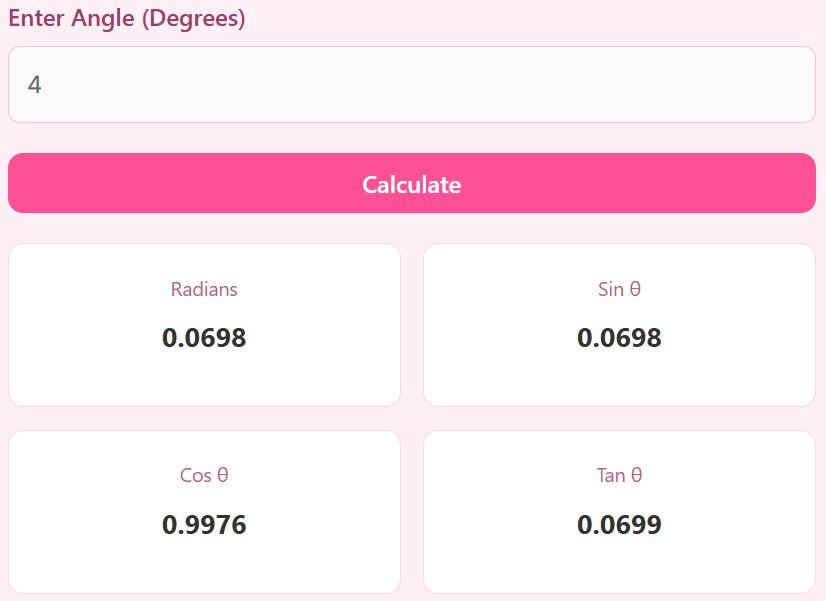
Using a Unit Circle Calculator is very simple and does not require advanced mathematical knowledge. Follow these easy steps:
1. Enter the Angle
First, input the angle you want to calculate. Most calculators allow you to enter the value in degrees.
2. Click the Calculate Button
After entering the angle, click the Calculate button. The calculator will instantly process the input using trigonometric formulas based on the unit circle.
3. View the Results
The calculator will display important trigonometric values such as:
Radians value
Sine (sin θ)
Cosine (cos θ)
Tangent (tan θ)
Some advanced calculators may also show additional functions such as secant, cosecant, and cotangent.
4. Analyze the Output
Once the results appear, you can use them to solve trigonometry problems, verify homework answers, or understand angle relationships in the unit circle.
Because the tool performs calculations automatically, it saves time and reduces the chances of errors.
Advantages of Using a Unit Circle Calculator
A Unit Circle Calculator offers many benefits, especially for students and learners who regularly deal with trigonometric functions.
1. Saves Time
Manual trigonometric calculations can be time-consuming. A calculator instantly provides results within seconds.
2. Improves Accuracy
Human calculations can sometimes lead to mistakes. A calculator reduces calculation errors and provides precise values.
3. Helpful for Learning
Students can better understand the relationship between angles and trigonometric functions by experimenting with different angle inputs.
4. Easy to Use
Most unit circle calculators have a simple and user-friendly interface, making them accessible even for beginners.
5. Useful for Multiple Subjects
The unit circle concept is used in many academic fields, including:
Mathematics
Physics
Engineering
Computer graphics
Signal processing
6. Perfect for Homework and Exam Preparation
Students preparing for exams like SAT, ACT, or college math tests can quickly verify answers and practice problems.
7. Accessible Anytime
Since the calculator works online, you can use it anytime from your computer, tablet, or mobile device.
FAQs
1. What is the unit circle in mathematics?
The unit circle is a circle with a radius of 1 unit centered at the origin (0,0) of the coordinate plane. It is used to define trigonometric functions such as sine and cosine.
2. What values does the Unit Circle Calculator provide?
Most calculators provide the following values:
Angle in radians
Sine (sin θ)
Cosine (cos θ)
Tangent (tan θ)
Some advanced versions also include secant, cosecant, and cotangent.
3. Why is the unit circle important in trigonometry?
The unit circle helps explain how angles relate to trigonometric functions. It is the foundation for many trigonometric identities and formulas.
4. Can I enter angles greater than 360 degrees?
Yes. Many calculators automatically reduce large angles to their equivalent angles within the unit circle and still produce correct results.
5. Is this calculator useful for students?
Yes, it is extremely useful for students studying trigonometry, geometry, and calculus, as it simplifies calculations and improves understanding.
6. Does the calculator support radians?
Some calculators allow you to input angles in radians as well as degrees, depending on the settings.
7. Can this tool replace learning the unit circle?
No. While the calculator is helpful for solving problems quickly, it is still important to understand the concepts of the unit circle and trigonometry for deeper learning.
Disclaimer
This Unit Circle Calculator is designed for educational and informational purposes only. While every effort is made to ensure accurate results, users should verify calculations when solving critical academic or professional problems.