
Times Interest Earned Ratio Calculator
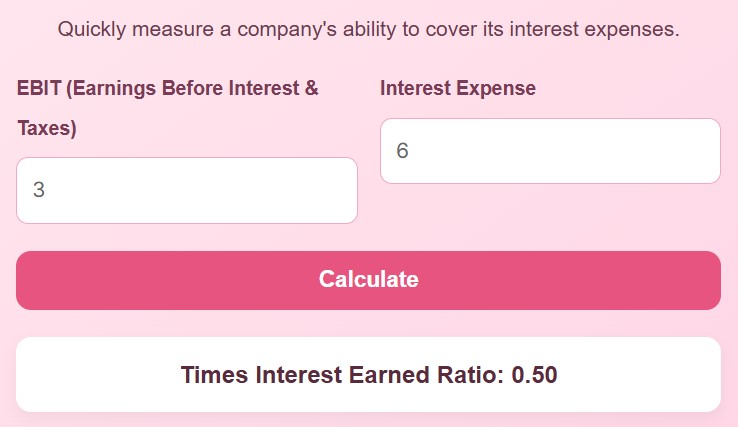
Quickly measure a company's ability to cover its interest expenses.
What is Times Interest Earned Ratio Calculator?
A Times Interest Earned Ratio Calculator is a financial tool that helps determine how easily a company can pay its interest expenses using its operating income. This ratio measures the ability of a business to meet its debt obligations and is commonly used by investors, lenders, and financial analysts to evaluate a company’s financial stability.
The Times Interest Earned (TIE) ratio, also known as the interest coverage ratio, shows how many times a company’s earnings before interest and taxes (EBIT) can cover its interest payments. A higher ratio indicates stronger financial health because the company generates enough income to comfortably pay its interest expenses.
Financial professionals often rely on this ratio when analyzing a company’s creditworthiness or overall financial risk. Companies with a low ratio may struggle to meet their debt payments, while companies with a high ratio generally have a stronger ability to handle financial obligations.
To calculate the ratio, you divide EBIT (Earnings Before Interest and Taxes) by the Interest Expense.
Times Interest Earned Ratio = EBIT / Interest Expense
For example, if a company has an EBIT of $100,000 and an annual interest expense of $20,000, the Times Interest Earned ratio would be 5. This means the company earns five times the amount needed to cover its interest payments.
A Times Interest Earned Ratio Calculator simplifies this process by automatically performing the calculation for you. Instead of manually calculating the ratio, you only need to enter the required values and the calculator instantly provides the result.
This tool is extremely useful for:
Business owners evaluating their financial position
Investors comparing companies before investing
Lenders assessing loan risk
Financial analysts conducting company research
By using this calculator, users can quickly understand how well a company can handle its interest obligations and determine whether its financial structure is sustainable.
How to Use It
Using a Times Interest Earned Ratio Calculator is simple and requires only two key financial values. Follow these steps to calculate the ratio quickly and accurately:
1. Enter EBIT (Earnings Before Interest and Taxes)
First, input the company’s EBIT, which represents the operating profit before deducting interest and taxes. This value is usually available in a company’s income statement.
2. Enter the Interest Expense
Next, enter the interest expense for the same financial period. This is the total amount a company pays in interest on its loans and debts.
3. Click the Calculate Button
After entering the required values, click the calculate button. The calculator will instantly compute the Times Interest Earned ratio.
4. Analyze the Result
The result shows how many times a company can cover its interest obligations using its operating income.
Understanding the Results
Ratio below 1 The company may not generate enough income to pay interest expenses.
Ratio between 1.5 and 3 Moderate ability to cover interest payments.
Ratio above 3 Strong financial stability and good debt coverage.
Using this calculator regularly can help businesses and investors monitor financial performance and make informed decisions.
Advantages of Using a Times Interest Earned Ratio Calculator
Using an online Times Interest Earned Ratio Calculator offers several advantages for businesses, investors, and financial professionals.
1. Quick and Accurate Calculations
Manual calculations can sometimes lead to errors. A calculator provides instant and precise results without complicated formulas.
2. Easy Financial Analysis
The tool helps users quickly understand a company’s ability to handle debt obligations. This makes financial analysis much easier and faster.
3. Helpful for Investment Decisions
Investors often compare companies before investing. This ratio helps determine whether a company is financially stable and capable of managing its debt.
4. Supports Better Business Planning
Business owners can use the ratio to evaluate their financial structure and determine whether they should take additional loans or reduce debt.
5. Useful for Credit Risk Assessment
Lenders and banks analyze this ratio before approving loans. A higher ratio indicates lower credit risk.
6. Saves Time
Instead of calculating the ratio manually every time, the calculator delivers results instantly with minimal effort.
7. Beginner Friendly
Even users with little financial knowledge can easily use the calculator because it requires only two simple inputs.
Because of these benefits, a Times Interest Earned Ratio Calculator is a valuable financial tool for anyone involved in business finance, investment analysis, or financial planning.
FAQs
What is a good Times Interest Earned ratio?
A good ratio typically ranges between 2 and 5 or higher. This indicates that a company generates enough operating income to comfortably cover its interest expenses.
What does a low Times Interest Earned ratio mean?
A low ratio suggests that a company may struggle to pay its interest obligations. This could indicate higher financial risk or excessive debt.
Why is the Times Interest Earned ratio important?
This ratio helps investors, lenders, and analysts understand a company’s financial stability and debt-paying ability. It is widely used when evaluating credit risk.
Can a Times Interest Earned ratio be negative?
Yes. If a company has negative EBIT (operating losses), the ratio may also become negative. This indicates the company cannot cover its interest expenses with its current earnings.
Is Times Interest Earned the same as the interest coverage ratio?
Yes. The Times Interest Earned ratio is another name for the interest coverage ratio, and both terms refer to the same financial metric.
Who should use a Times Interest Earned Ratio Calculator?
This calculator is useful for business owners, investors, financial analysts, accountants, and lenders who want to evaluate a company’s ability to manage debt obligations.
Disclaimer
This calculator provides estimates for educational and informational purposes only. Results should not be considered financial or investment advice.
Always consult a qualified financial professional before making business, investment, or financial decisions based on these calculations.