
Thermal Expansion Calculator
Calculate how materials expand or contract with temperature changes
What is Thermal Expansion Calculator?
A Thermal Expansion Calculator is a physics based online tool used to calculate how much a material expands or contracts when it is exposed to a change in temperature. Most solid materials such as metal, steel, aluminum, glass, and concrete expand when heated and contract when cooled. This change in size is known as thermal expansion.
The calculator uses a standard physics formula:
ΔL = L₀ × α × ΔT
Where:
- ΔL = change in length
- L₀ = original length
- α = coefficient of linear expansion
- ΔT = change in temperature
This tool is widely used in engineering, construction, material science, and physics education to predict structural changes and ensure safety in real-world applications.
How to Use Thermal Expansion Calculator
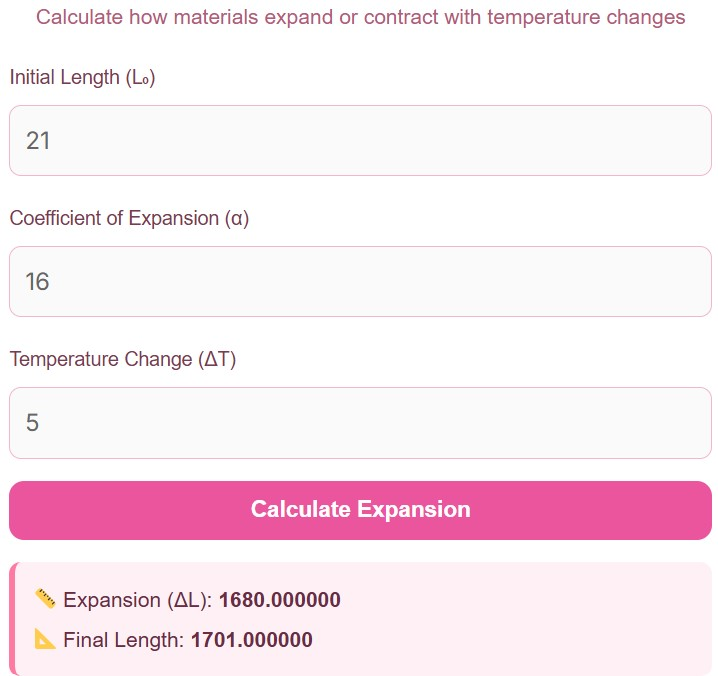
Using a Thermal Expansion Calculator is very simple, even for beginners. You just need to enter a few basic values:
- Enter Initial Length (L₀):
This is the original length of the object before temperature change. - Enter Coefficient of Expansion (α):
This value depends on the material (for example, steel, aluminum, or copper). - Enter Temperature Change (ΔT):
Input how much the temperature increases or decreases. - Click Calculate Button:
The calculator will instantly show:- Expansion or contraction amount (ΔL)
- Final length after temperature change
This saves time compared to manual calculations and reduces human error.
A Worked Example: A Steel Bar Heated by 50 Degrees Celsius
Take a steel bar that is 10 metres long. Steel has a coefficient of linear expansion of 0.000012 per degree Celsius. If the bar is heated so that its temperature rises by 50 degrees Celsius, how much longer does it get?
Put the numbers into the formula. The change in length is 10 multiplied by 0.000012 multiplied by 50, which equals 0.006 metres. That is 6 millimetres, so the bar grows by 6 millimetres.
The final length is the starting length plus the change, which is 10 plus 0.006, or 10.006 metres. Enter the same three numbers into the calculator above and it shows the same answer: Expansion 0.006000 and Final Length 10.006000.
The same steps work for any solid. Measure the starting length, find the coefficient for the material, and enter the temperature change. The density of the material also matters in real design, so the Density Calculator is a useful check when you compare two materials for the same job.
Coefficients of Expansion for Common Materials
The coefficient is the part that changes most between materials. A small coefficient means the material hardly moves when it heats up, while a large one means it grows a lot. Here are the usual values, given per degree Celsius.
Steel is about 0.000012, and concrete is close to it at about 0.000012 as well, which is why the two work well together in reinforced concrete. Copper is about 0.000017, brass is about 0.000019, and glass is about 0.000009.
Aluminium is the outlier at about 0.000023, almost twice the value for steel. That is why aluminium parts need larger gaps and fixings that allow movement. These numbers are typical values at room temperature, and the exact figure can vary a little with the alloy and the temperature range.
When you do not know the coefficient for a material, look it up in a data sheet before you calculate. A small error in the coefficient gives the same percentage error in the answer, so it is the number to get right.
Thermal Expansion in Bridges, Rails and Pipelines
Long structures feel thermal expansion the most. A steel railway line that is several hundred metres long grows by centimetres between a cold morning and a hot afternoon, and a bridge deck does the same across the seasons.
That is why bridges and railway tracks are built with expansion joints. A joint is a deliberate gap that opens and closes as the structure warms and cools, so the deck or rail can move without pushing against its supports.
Without a gap, the material has nowhere to go. The deck presses on its abutments, the rail buckles sideways, and a pipe can bend or crack at its joints. The force that builds up in a fixed bar is large, even for a small temperature change. The Force Calculator gives a feel for how a load becomes a force, and the same idea explains why expansion must be given room to happen.
Pipelines use the same idea in a different shape. Instead of a gap, a long pipe run has loops and bends that flex a little as the pipe lengthens, so the pipe stays sealed while it moves.
Heating, Cooling and Everyday Examples
Expansion is not only about getting longer when things get hot. When a material cools, it shrinks by the same rule, and the temperature change is simply negative. A metal lid on a glass jar is a good example: warming the lid makes it expand a little, so it loosens and turns easily.
Power lines sag more on a hot summer day because the wire is longer, and they pull tighter on a cold night. The same effect is used in a thermostat, where a strip made of two metals bends as it warms because the two sides expand by different amounts.
The heat that causes the change matters too. Warming a larger mass, or a material that holds more heat, takes more energy than warming a small one. The Enthalpy Calculator works out the heat energy in a change like that, which pairs well with the expansion figure from this tool.
For the best result, keep the units the same through the whole calculation. Use metres for the length and degrees Celsius for the temperature change, and the answer is the change in the same length unit.
Advantages of Thermal Expansion Calculator
A Thermal Expansion Calculator offers many practical benefits for students, engineers, and professionals:
1. Fast and Accurate Results
It provides instant and precise calculations without manual effort, reducing the risk of mistakes.
2. Time-Saving Tool
Instead of solving complex formulas step by step, users get results in seconds.
3. Useful for Engineering Projects
Engineers can predict how materials will behave under different temperatures, which is critical in construction and manufacturing.
4. Educational Purpose
Students can easily understand the concept of thermal expansion through real-time calculations.
5. Material Safety Analysis
It helps in designing safe structures by analyzing expansion in bridges, railways, pipelines, and buildings.
6. Easy to Use
No advanced math skills are required, just enter values and get results instantly.
FAQs (Frequently Asked Questions)
1. What is thermal expansion in simple words?
Thermal expansion is the increase in size of a material when it is heated and decrease when it is cooled.
2. Which materials expand the most?
Metals like aluminum and copper generally expand more compared to materials like steel or glass.
3. Why is thermal expansion important in engineering?
It helps engineers design safe structures that can handle temperature changes without damage or deformation.
4. Can this calculator be used for all materials?
Yes, you can use it for any solid material as long as you know its coefficient of expansion.
5. Is thermal expansion dangerous?
It is not dangerous by itself, but if not considered in design, it can cause cracks, bending, or structural failure.
6. What is the formula used in this calculator?
The calculator uses the formula:
ΔL = L₀ × α × ΔT
Disclaimer
The results provided by this Thermal Expansion Calculator are for educational and informational purposes only. While the calculations are based on standard physics formulas, slight variations may occur in real-world conditions due to environmental factors and material properties.
Always consult a qualified engineer or professional for critical construction or industrial applications.