
Serial Dilution Calculator
What is Serial Dilution Calculator?
A Serial Dilution Calculator is a powerful online tool designed to help you quickly and accurately calculate dilution steps used in laboratories, research, microbiology, chemistry, and pharmaceutical work. Serial dilution is a process where a solution is diluted step-by-step in a sequence, reducing the concentration gradually rather than in a single step.
This calculator simplifies complex dilution calculations by using the standard formula:
C1 × V1 = C2 × V2
Instead of manually solving equations or risking errors, users can input initial concentration, final concentration, and desired volume to instantly get precise results. It is especially useful when working with sensitive experiments where accuracy is critical.
Serial dilution is widely used in applications such as bacterial culture preparation, drug formulation, chemical analysis, and sample preparation. By automating the calculation process, this tool saves time, improves accuracy, and enhances productivity.
Whether you are a student, researcher, or lab technician, a Serial Dilution Calculator eliminates guesswork and ensures reliable dilution planning every time.
How to Use It
Using the Serial Dilution Calculator is very simple and requires only a few steps:
Step 1: Enter Initial Concentration (C1)
Input the concentration of your original solution. This is the starting strength before dilution.
Step 2: Enter Final Concentration (C2)
Provide the desired concentration you want to achieve after dilution.
Step 3: Enter Final Volume (V2)
Enter the total volume of the final diluted solution.
Step 4: Click Calculate
Once all values are entered, click the Calculate button to generate results instantly.
Step 5: View Results
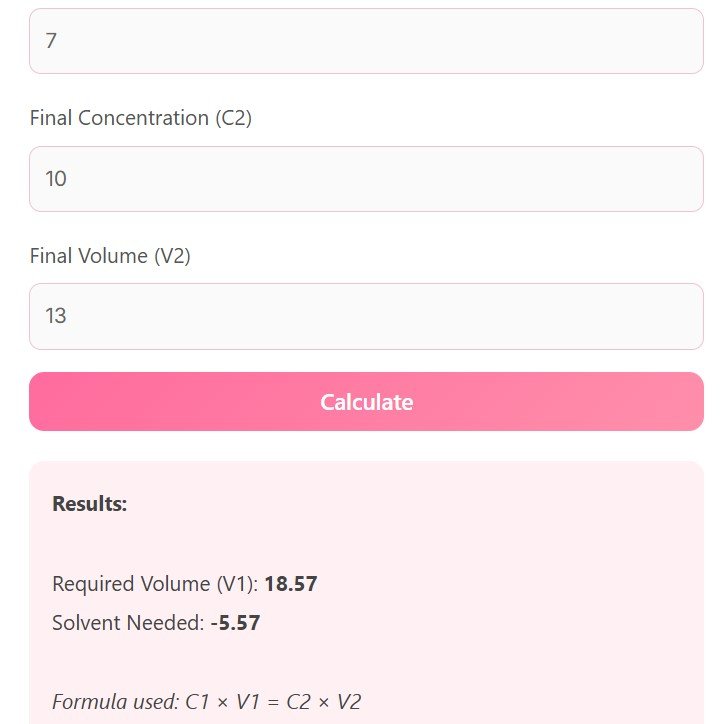
The calculator will display:
- Required volume of the original solution (V1)
- Amount of solvent needed
This allows you to prepare your dilution accurately without manual calculations.
Advantages of Serial Dilution Calculator
Using an online Serial Dilution Calculator offers multiple benefits, especially for beginners and professionals alike:
1. High Accuracy
Manual calculations can lead to errors, especially in complex experiments. This tool ensures precise results every time.
2. Time Saving
Instead of solving equations step-by-step, you get instant results within seconds.
3. Easy to Use
The simple interface makes it accessible for students, researchers, and lab workers without advanced mathematical skills.
4. Reduces Human Error
By automating calculations, it minimizes the risk of mistakes in concentration and volume measurements.
5. Improves Workflow Efficiency
Helps streamline laboratory processes and experiment preparation.
6. Useful for Multiple Fields
Applicable in:
- Microbiology
- Chemistry
- Pharmaceuticals
- Environmental science
- Medical labs
7. No Installation Required
Being web-based, you can use it directly in your browser without downloading any software.
FAQs
1. What is serial dilution?
Serial dilution is a stepwise dilution process where the concentration of a solution is reduced gradually by diluting it multiple times.
2. Why is serial dilution important?
It helps achieve very low concentrations accurately, which is essential in laboratory experiments and analysis.
3. What formula does this calculator use?
It uses the standard dilution formula:
C1 × V1 = C2 × V2
4. Can beginners use this calculator?
Yes, the calculator is designed to be user-friendly and suitable for beginners as well as professionals.
5. Is this calculator accurate?
Yes, it provides highly accurate results based on the values you input.
6. Do I need to install anything?
No, it is a web-based tool that works directly in your browser.
7. Can I use it for lab experiments?
Yes, it is ideal for planning and preparing laboratory dilutions.
8. What units should I use?
You can use any consistent units (ml, L, µL), but make sure all inputs follow the same unit system.
Disclaimer
This calculator is intended for educational and informational purposes only and should not replace professional laboratory practices.
Always verify results and follow proper lab safety guidelines when performing real-world experiments.