
Puppy Growth Calculator
Estimate your puppy’s adult weight easily
Introduction
Every puppy owner asks the same question: how big will my puppy get? The answer matters more than curiosity. It decides the size of the crate and bed you buy, how much food you feed, which collar and harness will fit in six months, and whether your new friend will stay a lap dog or grow into a dog that needs a garden and a strong lead. This Puppy Growth Calculator estimates your puppy’s adult weight from its age, current weight and breed size, so you can plan ahead instead of guessing.
It is made for new puppy owners, families choosing a breed, foster carers and anyone who wants a realistic idea of an adult dog’s size. You only need three facts about your puppy, and the estimate appears at once. It is a guide, not a promise, because every puppy grows at its own pace, but it is a much better guide than breed averages alone.
What is Puppy Growth?
Puppy growth is the rapid increase in weight and size between birth and adulthood. Small breeds grow fast and finish early, often reaching adult size by 9 to 12 months. Medium breeds take a little longer, and large and giant breeds keep growing until 18 to 24 months. A puppy’s growth follows a curve: very fast in the first weeks, then slower as it approaches its adult weight.
Because the shape of that curve differs by breed size, age alone does not tell you much, and weight alone does not either. A 5 kg puppy could be a nearly grown small breed or a young large breed with a long way to go. That is why this calculator asks for breed size alongside age and weight: the combination places your puppy on the right growth curve.
How to Use the Puppy Growth Calculator
Follow these steps to estimate your puppy’s adult weight:
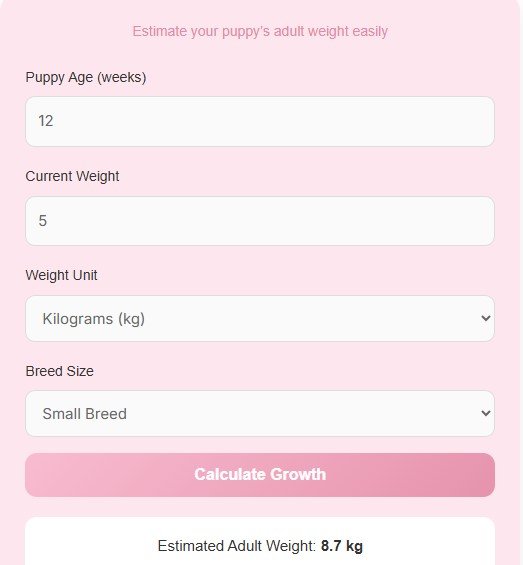
- Enter the Puppy Age (weeks), for example 12.
- Enter the Current Weight, for example 5.
- Select the Weight Unit, kilograms (kg) or pounds (lb), to match how you weighed your puppy.
- Select the Breed Size: Small Breed, Medium Breed or Large Breed.
- Click Calculate Growth to see the estimated adult weight.
Weigh your puppy on the same scales each time, and use its age in weeks rather than months, because a week makes a real difference at this age. If your puppy is a crossbreed, choose the size of the breed it most resembles, or the size you expect it to reach. If your scale gives pounds and you want kilograms, the Unit Converter can convert the weight for you.
How the Estimate is Worked Out
The calculator uses standard growth curves for each breed size. At a given age, a puppy of a given breed size has typically reached a known share of its adult weight. The estimate is:
Estimated Adult Weight = Current Weight divided by the share of adult weight already reached at this age
For example, a small breed puppy has already done most of its growing by 12 weeks, so it has reached a larger share of its adult weight than a large breed puppy of the same age. Dividing the current weight by that share gives the adult weight. The tool does not use a single formula for every dog, because growth is not a straight line, and the share changes with age and breed size.
Worked Example
Take a small breed puppy aged 12 weeks that weighs 5 kg.
Enter 12 weeks, 5 kg and Small Breed, then click Calculate Growth. The calculator estimates an adult weight of 8.7 kg, which is exactly what it shows for these inputs.
In other words, the tool treats a 12 week old small breed puppy as having reached about 57 percent of its adult weight, because 5 divided by 8.7 is 0.57. A large breed puppy of the same age and weight would be given a higher adult weight, because large breeds are much less grown at 12 weeks.
When to Use It and Tips
Use this calculator when you first bring a puppy home, when you are choosing a crate, bed or food amount, and whenever you want to check that your puppy is growing as expected. Repeat the calculation every few weeks and watch the estimate: if it stays roughly steady, your puppy is growing normally.
- Weigh your puppy weekly at first, always on the same scales and at the same time of day.
- Pick the breed size honestly. Choosing a smaller size gives a lower estimate, which is not helpful.
- Remember that food, health and neutering can all affect growth, so treat the result as a guide.
- If your puppy is much heavier or lighter than the breed average for its age, ask your vet rather than relying on a calculator.
Once your puppy is grown, the Dog Size Calculator can place it in a size category from its weight and height, which helps when you choose a bed, a crate or a travel carrier.
FAQs
Q1: Is the puppy growth calculator accurate?
It gives a sound estimate based on standard growth curves for each breed size, and it is usually close for healthy puppies of a known breed size. Actual growth varies with genetics, food and health, so treat the result as a guide rather than an exact prediction. Repeating the calculation as your puppy grows gives a more reliable picture.
Q2: Can I use it for all dog breeds?
Yes, for most breeds, by choosing the breed size that fits your puppy: Small, Medium or Large. For crossbreeds, choose the size of the breed your puppy most resembles, or the size you expect it to reach. Very unusual breeds may grow differently, so check with your vet if you are unsure.
Q3: What age is best for using this calculator?
It is most useful during the early growth stages, from about 8 to 24 weeks, when the growth curve is steepest and the estimate changes most. It still works for older puppies, but the result is closer to the current weight as the puppy nears adult size.
Q4: Does it support both kg and lb?
Yes. You can enter the weight in kilograms or pounds. Just make sure the Weight Unit you select matches the units on your scales, or the result will be wrong.
Q5: Why is my puppy smaller or larger than its littermates?
Puppies in the same litter can grow at different rates because of genetics, birth weight and how much milk and food each one gets. Small differences are normal. If one puppy is much smaller, or is not gaining weight at all, ask your vet to check it.
Q6: Should I feed my puppy based on its adult weight?
Feeding guides are often based on expected adult weight, so the estimate is a useful starting point. Follow the food packet for your puppy’s age and current weight, and ask your vet to adjust the amount for your puppy’s condition and activity.
Disclaimer
Disclaimer: This calculator is for educational and informational purposes only and is not veterinary advice. It estimates adult weight from typical growth patterns and does not replace a vet’s assessment of your puppy’s health, growth or diet. If you are worried about your puppy’s growth, weight or appetite, speak to your vet.