
Price Elasticity of Demand Calculator
Quickly calculate price elasticity using percentage changes
What is Price Elasticity of Demand Calculator?
A Price Elasticity of Demand Calculator is a powerful online tool used to measure how sensitive the quantity demanded of a product is to a change in its price. In simple terms, it helps you understand how much demand will increase or decrease when prices go up or down.
Price elasticity of demand (PED) is an essential concept in economics, especially in business decision-making, pricing strategies, and market analysis. The formula used in this calculation is:
PED = (% Change in Quantity Demanded) / (% Change in Price)
This calculator automates the entire process, saving time and reducing the chances of manual calculation errors. Whether you are a student, business owner, or analyst, this tool can help you quickly determine whether demand for a product is elastic, inelastic, or unitary.
Understanding elasticity is crucial because it directly impacts revenue. For example, if demand is elastic, a small change in price can lead to a large change in demand. On the other hand, if demand is inelastic, price changes have little effect on the quantity demanded.
How to Use It
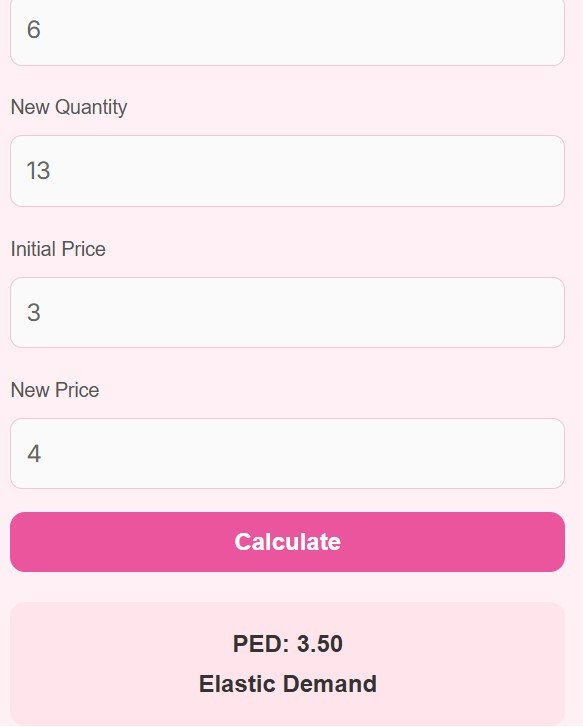
Using a Price Elasticity of Demand Calculator is very simple and requires only a few inputs. Follow these steps:
1. Enter Initial Quantity
Input the original quantity demanded before the price change.
2. Enter New Quantity
Provide the updated quantity demanded after the price has changed.
3. Enter Initial Price
Add the original price of the product or service.
4. Enter New Price
Input the new price after the change.
5. Click Calculate
Once all values are entered, click the calculate button. The tool will instantly display:
- Price Elasticity of Demand (PED value)
- Type of demand:
- Elastic Demand (>1)
- Inelastic Demand (<1)
- Unitary Elastic (=1)
This quick process makes it easy for anyone to analyaze demand behaviour without needing advanced economic knowledge.
Advantages
Using a Price Elasticity of Demand Calculator offers several benefits:
1. Saves Time
Manual calculations can be time-consuming and complex. This calculator provides instant results with just a few inputs.
2. Accurate Results
It eliminates human error and ensures precise calculations every time.
3. Easy to Use
The user-friendly interface makes it suitable for beginners, students, and professionals alike.
4. Helps in Pricing Strategy
Businesses can use this tool to determine the best pricing strategies to maximize revenue and profits.
5. Better Decision Making
Understanding demand elasticity helps companies make informed decisions about pricing, production, and marketing.
6. Useful for Academic Purposes
Students studying economics can use this calculator to quickly solve problems and understand concepts more clearly.
7. Market Analysis
It helps analysts evaluate how consumers react to price changes in different markets.
FAQs
1. What is price elasticity of demand?
Price elasticity of demand measures how responsive the quantity demanded is to a change in price. It shows whether consumers are sensitive or insensitive to price changes.
2. What does an elasticity greater than 1 mean?
If the value is greater than 1, demand is elastic. This means consumers are highly responsive to price changes.
3. What does an elasticity less than 1 mean?
If the value is less than 1, demand is inelastic. This means demand does not change much with price fluctuations.
4. What is unitary elasticity?
Unitary elasticity occurs when the elasticity value is exactly 1, meaning the percentage change in quantity demanded equals the percentage change in price.
5. Who can use this calculator?
Anyone can use it, including students, teachers, business owners, economists, and researchers.
6. Why is elasticity important in business?
It helps businesses understand customer behavior and set optimal pricing to increase revenue and stay competitive.
7. Can elasticity be negative?
Yes, price elasticity of demand is usually negative because price and demand move in opposite directions. However, many calculators show the absolute value for simplicity.
Disclaimer
This calculator provides estimated results for educational and informational purposes only and should not be considered financial or business advice.
Always consult a professional economist or financial expert before making important pricing or business decisions.