
ml to mg Calculator
What is an mL to mg Calculator?
An mL to mg calculator is an essential digital tool designed to bridge the gap between volume and mass. In the world of science, cooking, and DIY projects, we often encounter measurements in milliliters (mL), which measure how much space a liquid takes up. However, many recipes or formulas require the weight in milligrams (mg).
The complexity arises because 1 mL of one substance does not always weigh the same as 1 mL of another. For example, a spoonful of honey is much heavier than a spoonful of rubbing alcohol. This calculator uses the specific density of a substance to provide an accurate conversion, ensuring that your measurements are precise every time. Whether you are a student working on a chemistry project or a hobbyist mixing essential oils, this tool simplifies complex physics into a single click.
How to Use the mL to mg Calculator
We have designed this tool to be intuitive and user-friendly, even for those who aren’t fans of math. Follow these simple steps:
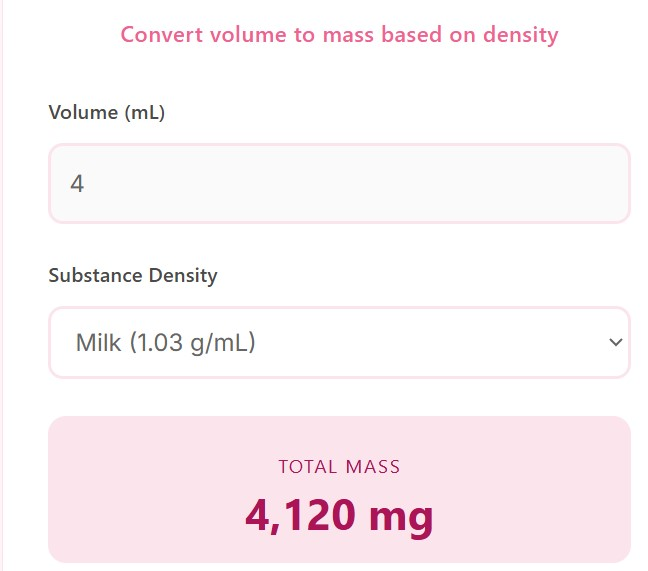
Input the Volume: Start by entering the amount of liquid you have in milliliters (mL) into the designated box.
Select Your Substance: Use the dropdown menu to select common liquids like water, milk, or cooking oil. The calculator automatically applies the scientifically accepted density for these items.
Advanced Custom Density: If you are working with a specific chemical or a unique liquid, select the “Custom” option. You can then manually enter the density (grams per milliliter).
Instant Conversion: The result will appear instantly in the pink result box, showing the total mass in milligrams (mg). There is no “Calculate” button needed; the tool updates in real-time as you type.
The Science: Understanding the Formula
To understand how the conversion works, we look at the fundamental physics equation:
Since 1 gram contains 1,000 milligrams, the specific formula used by our calculator is:
This ensures that even the smallest measurements are accounted for, providing you with a high resolution result that manual rounding might miss.
Advantages of Using This Tool
Eliminate Calculation Errors:
Manual multiplication involving decimals and thousands often leads to “human error.” This tool automates the process for 100% accuracy.Highly Responsive Design: Our “Soft Pink” themed calculator is built with a “mobile-first” approach. It looks beautiful and functions perfectly on iPhones, Androids, tablets, and wide-screen desktops.
Educational Value: By showing the role of density, the tool helps users understand why volume and mass are not the same thing.
No Installation Required: As a web-based tool, you can access it anywhere without downloading heavy apps or software.
Frequently Asked Questions (FAQs)
Why is 1 mL of water equal to 1000 mg?
Water has a density of exactly $1.0 \text{ g/mL}$ (at $4^\circ\text{C}$). Therefore, $1 \text{ mL} \times 1.0 \times 1000 = 1000 \text{ mg}$. This is the baseline for the metric system.
Does temperature affect the conversion?
Yes, liquids tend to expand when heated, which slightly lowers their density. For most household or basic laboratory uses, standard room temperature density is sufficient.
What is density?
Density is how much “stuff” is packed into a specific space. High density liquids (like syrup) will have more milligrams per milliliter than low-density liquids (like gasoline).
Can I convert mg back to mL?
Yes, you simply reverse the math. Divide the milligrams by 1,000, then divide by the density of the substance.
Is this calculator free to use?
Absolutely. This tool is provided as a free resource for our community to ensure accuracy in their measurements and projects.
Disclaimer:
This calculator is intended for educational, culinary, and general hobbyist use only. It should not be used for determining medical dosages, pharmaceutical compounding, or critical industrial chemical reactions.