
MIRR Calculator
MIRR Calculator: Quick, Reliable and Professional Financial Insights
A MIRR Calculator is a free online tool that works out the Modified Internal Rate of Return of an investment. MIRR stands for Modified Internal Rate of Return. It tells you the annual return of a project after allowing for the cost of finance and for the rate at which cash that comes back is reinvested. Investors, analysts, students and business owners use it to compare projects and to decide where money is best placed.
It is more realistic than the older IRR measure, because IRR assumes that cash is reinvested at the same high rate as the project itself, which rarely happens in real life. MIRR uses a finance rate for money borrowed and a separate reinvestment rate for money that comes back, so the result is closer to what an investor can actually achieve. To see the return on a simpler investment first, try our NPV Calculator, which values future cash in today’s money.
The MIRR Formula
The formula is MIRR equals the nth root of the future value of positive cash flows divided by the present value of negative cash flows, minus one. In symbols, MIRR = (FV / PV) to the power of 1 divided by n, minus 1, where FV is the future value of the cash that comes in, PV is the present value of the cash that goes out, and n is the number of periods, usually years.
Worked Example: 10000 Invested, 18000 Back in 5 Years
Take an investment of 10000 that returns a future value of 18000 after 5 years, with a finance rate of 8 percent and a reinvestment rate of 10 percent. First divide the future value by the investment: 18000 divided by 10000 equals 1.8. Next take the fifth root of 1.8, which is 1.1247. Then subtract one: 1.1247 minus 1 equals 0.1247, or 12.47 percent a year.
Try the same numbers in the calculator above. Enter Initial Investment 10000, Future Value of Cash Flows 18000, Finance Rate 8, Reinvestment Rate 10 and Number of Periods 5, then click Calculate MIRR. The tool shows MIRR: 12.47 percent, which matches the hand calculation. A MIRR of 12.47 percent a year means the project grows the money by that rate each year, after allowing for finance and reinvestment.
MIRR vs IRR: Why the Modified Version Is More Realistic
The problem with IRR is simple. It assumes that every pound or dollar of cash that comes back is reinvested at the same high IRR rate, which is often far above what a bank or a safe investment would pay. That makes a project look better than it is. MIRR fixes this by reinvesting at a rate you choose, often a bank rate or a cost of capital, and by charging the finance rate for money borrowed. The result is usually lower than IRR, but it is more honest.
That difference matters most when projects are very different. A short project with high early cash can have a very high IRR, while a longer, steadier project can have a better MIRR. If you are comparing two options, use MIRR to choose, and use the Compound Interest Calculator to see how reinvested returns grow over time. Together they give a clearer picture than a single IRR figure on its own.
How to Use the MIRR Calculator
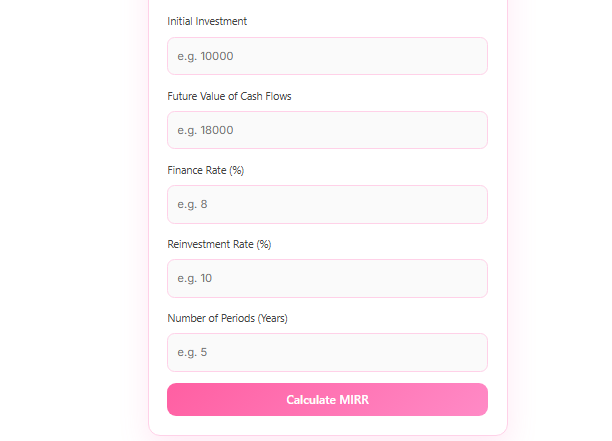
- Enter the initial investment amount in the first field.
- Input the future value of all expected cash flows.
- Add the finance rate and reinvestment rate as percentages.
- Specify the total number of periods or years.
- Click the Calculate MIRR button to see the percentage result instantly.
Understanding the MIRR Concept
Modified Internal Rate of Return (MIRR) improves upon IRR by addressing its reinvestment assumptions. It assumes positive cash flows are reinvested at a reinvestment rate instead of the project’s own return. This makes MIRR more practical for real world financial scenarios. It also considers the finance rate for initial investments, so borrowing costs are part of the picture. As a result, MIRR provides a single, reliable return value.
Key Inputs Required for MIRR Calculation
The calculator requires initial investment, future value of cash flows, finance rate, reinvestment rate, and number of periods. Each input directly affects the final MIRR result. Accurate data ensures reliable output. Finance rate reflects borrowing cost, while reinvestment rate reflects growth assumptions. Periods determine time impact on returns. Understanding these inputs improves financial accuracy.
Benefits of Using an Online MIRR Calculator
The main benefit is the time it saves and the mistakes it avoids. A hand calculation needs the present value, the future value and an nth root, and a small slip in any step changes the answer. The tool does all of that in a second, and it shows the answer as a clear percentage. Use that percentage with other measures too, such as how long it takes to get your money back, which you can check with our Payback Period Calculator. A project with a good MIRR and a short payback is a strong candidate.
Frequently Asked Questions (FAQs)
1. What does MIRR measure?
MIRR measures the realistic annual return of an investment, considering finance and reinvestment rates. It shows how much a project grows your money each year. Use it to compare projects on a fair, like for like basis.
2. How is MIRR different from IRR?
MIRR uses separate reinvestment and finance rates, making it more accurate than IRR. IRR assumes cash is reinvested at the project’s own high rate, while MIRR reinvests it at a rate you choose, such as a bank rate.
3. Who should use a MIRR Calculator?
Investors, financial analysts, students, and business owners can all benefit from it. If you are choosing between projects, checking a business case, or learning how returns work, MIRR gives you a single annual rate that is easy to compare.
4. Can MIRR be negative?
Yes, a negative MIRR indicates that the investment results in a loss. It means the future value of the cash that comes back is less than the money you put in, so the project destroys value instead of creating it.
5. Is MIRR suitable for comparing projects?
Yes, MIRR is ideal for comparing multiple projects with different cash flows. Because it uses one reinvestment rate and one finance rate for every project, the results are on the same basis. Compare the MIRR of each option before you decide.
Disclaimer
Disclaimer: This MIRR Calculator is for informational purposes only and should not be considered financial or investment advice. The result is an estimate based on the numbers you enter. Always check important investment decisions with a qualified financial adviser.