
Glass Weight Calculator
Calculate the weight of your glass easily
Estimate the weight of a glass sheet before you order it
A glass sheet looks light until you try to lift it. A single large pane can weigh tens of kilograms, so guessing its weight is risky for handling, transport and fixing. This Glass Weight Calculator turns three simple measurements into a clear weight in grams and kilograms, so you can plan safely and order with confidence.
Enter the length and width in centimetres and the thickness in millimetres. The calculator uses the standard density of ordinary glass, 2.5 grams per cubic centimetre, and shows the result at once. Glass is made mainly from silica sand, soda ash and limestone, as described in Glass – Wikipedia. It is free, works on any device and needs no sign up.
A glass weight calculator is a simple tool that finds the weight of a flat glass sheet from its size and thickness. It multiplies the sheet volume by the density of the glass. Because glass has a known density, the result is far more reliable than a guess, and it avoids the need for a scale that can hold a large pane.
The tool on this page uses 2.5 grams per cubic centimetre, the accepted density of ordinary soda lime glass. That value is the mass of one cubic centimetre of the material, as explained in Density | Definition, Symbol, Units, Formula, & Facts | Britannica. Thicker glass and larger sheets weigh more in direct proportion, so doubling the thickness doubles the weight if the other sizes stay the same.
If you want to understand how density turns a volume into a weight, the Density Calculator explains the same idea for any material. Use the result to choose fixings, plan two person lifting and check transport limits before you move the sheet.
How to Use the Glass Weight Calculator
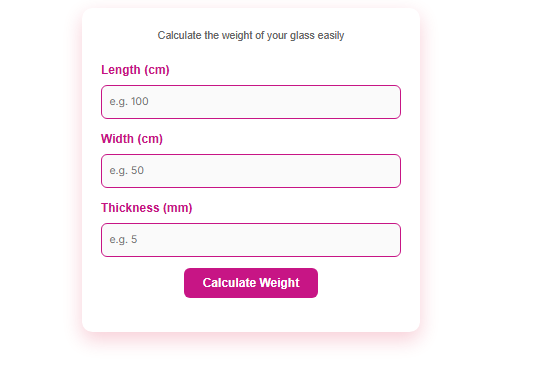
Measure the longest side of the sheet in centimetres, then the shorter side. Measure the thickness in millimetres with a caliper or a glass thickness gauge. Round each measurement to the nearest whole number if the sheet is cut square, and keep the same units the calculator asks for.
Type the three numbers into the calculator and press Calculate Weight. The result shows grams first and kilograms in brackets, so you can use whichever unit suits your order form or lifting plan. If you change one number, press Calculate Weight again to refresh the result.
Check the result against the feel of the sheet when you lift it with a helper. If the number looks far too high or low, recheck the thickness first, because a single millimetre makes a large difference. The calculator uses ordinary glass density, so it is an estimate, not a weighed value.
Benefits of Using the Glass Weight Calculator
Knowing the weight before you order saves time on site and avoids costly mistakes. A pane that is heavier than the frame or the fixings can handle may flex, slip or fail, while a pane that is heavier than expected can be unsafe to lift. This calculator gives you the number you need before the glass arrives, so you can check the frame, the brackets and the lifting plan in advance.
Glaziers use it to price jobs and plan deliveries, and builders use it to check floor loads and transport limits. Homeowners use it before buying a table top, a shower screen or a large window, so they know how many people the job needs. Estate agents and surveyors use it when they describe a feature pane in a property report. In every case, the same three measurements give a quick, repeatable answer.
Types of Glass Supported
Ordinary flat glass, often called soda lime glass, is the most common type in windows, doors and table tops. It has a density of about 2.5 grams per cubic centimetre, which is the value this calculator uses. Most household and office panes fall into this group, so the result will be close to the true weight.
Tempered glass is heat treated to make it stronger, but the treatment does not change its density, so a tempered sheet of the same size weighs the same as an ordinary sheet. Laminated glass is slightly heavier, because it has a plastic layer between two sheets. The difference is usually only a few per cent, so use this calculator as a guide for laminated glass and allow a small margin.
For a double glazed unit, work out each pane separately and add the results, then add the frame. Do not enter the full unit thickness as if it were solid glass, because the gap between panes adds no weight.
Formula and worked example
The weight comes from the volume of the sheet and the density of the glass. First change the thickness from millimetres to centimetres by dividing by 10, because the length and width are in centimetres. Then multiply length by width by thickness in centimetres to get the volume in cubic centimetres.
Weight in grams = Length (cm) x Width (cm) x Thickness (cm) x 2.5
Take a sheet 100 cm long, 50 cm wide and 5 mm thick. The thickness is 0.5 cm, so the volume is 100 x 50 x 0.5 = 2,500 cubic centimetres. Multiply by 2.5 grams per cubic centimetre to get 6,250 grams, which is 6.25 kilograms. Enter the same numbers into the calculator above and you will see Estimated Glass Weight: 6,250.00 g (6.25 kg).
Density is the link between volume and mass, as explained in Density – Wikipedia. If your sheet is larger, the same steps apply. Just keep the units the same, and remember that a 10 mm sheet weighs twice as much as a 5 mm sheet of the same size.
FAQs – Glass Weight Calculator
What is the Glass Weight Calculator used for?
It finds the weight of a flat glass sheet from its length, width and thickness. It uses the standard density of ordinary glass, 2.5 grams per cubic centimetre, and gives the result in grams and kilograms. Use it before ordering, lifting or installing a pane.
Can I use it for tempered or laminated glass?
Yes, with care. Tempered glass has the same density as ordinary glass, so the result applies to it. Laminated glass is slightly heavier because of its plastic layer, so treat the result as a close estimate and allow a small margin.
Does it provide weight in different units?
Enter length and width in centimetres and thickness in millimetres. The result shows grams first, with kilograms in brackets. For example, 6,250 grams is shown as 6.25 kilograms. The calculator does not take inch inputs, so convert inches to centimetres first.
Does the calculator work with any glass thickness?
Yes, for any thickness you can measure in millimetres, from thin 2 mm panes to thick 19 mm sheets. The weight grows in direct proportion to thickness, so a 10 mm sheet weighs twice as much as a 5 mm sheet of the same size. Always measure the thickness with a caliper or gauge.
Can I use it for large construction projects?
Yes, for planning and ordering on both small and large jobs. It gives a reliable estimate for ordinary glass sheets, but it is not a substitute for a weighed value or a structural check. For load limits and safety critical fixings, confirm the weight with the supplier or an engineer.
Disclaimer
Disclaimer: This calculator provides estimated values only and should be used as a reference. Results are based on the standard density of ordinary glass and your measurements, so always verify measurements and weight with the supplier before installation, lifting or transport.