
Elo Calculator
What is Elo Calculator?
An Elo Calculator is a powerful online tool used to calculate rating changes based on the Elo rating system. Originally developed by Arpad Elo, this system is widely used in competitive games like chess, esports, and online gaming. It gives every player a number that shows how strong they are compared with others. When you win, your rating goes up. When you lose, it goes down. The size of the change depends on how strong your opponent was and on what the system expected from you.
Our Elo Calculator is designed for players, coaches and anyone who follows a competitive ladder. It works for chess, for video games and for any ranking system that uses Elo. If you follow a shooter game as well, our KD Calculator is a useful companion, because kill death ratio and Elo rating show different sides of the same performance. The tool is free, works on any device and needs no account.
The Elo Formula
The Elo system starts by working out how likely you were to win. That is called the expected score. If you and your opponent have the same rating, your expected score is 0.5, which means a draw is the expected result. If you are rated higher, your expected score is above 0.5. If you are rated lower, it is below 0.5. The formula for the expected score is 1 divided by 1 plus 10 to the power of the rating gap divided by 400.
After the match, your new rating is your old rating plus the K factor times the difference between your actual score and your expected score. A win is 1 point, a draw is 0.5 and a loss is 0. The K factor sets how fast ratings move. A K of 32 is common for new or casual players, while 16 or 24 is common for stronger or more settled players. For another way to look at results, see our Winning Percentage Calculator, which turns wins and games played into a simple percentage.
Worked Example: Rating 1500 Against 1600
Take a player rated 1500 who plays an opponent rated 1600 and wins, with a K factor of 32. First work out the expected score for the 1500 player. The rating gap is 100, so the expected score is 1 divided by 1 plus 10 to the power of 0.25, which is 0.360. That means the system gave the lower rated player a 36 percent chance of winning, and the higher rated player a 64 percent chance.
Now apply the rating change. The actual score is 1 for a win, the expected score is 0.360, and the difference is 0.640. Multiply 0.640 by the K factor of 32 and you get 20.48. Add that to 1500 and the new rating is 1520.48, which the calculator shows as 1520. Try the same numbers in the calculator above, with Player Rating 1500, Opponent Rating 1600, Match Result Win and K Factor 32, and you will see Expected Score: 0.360 and New Rating: 1520.
How to Use It
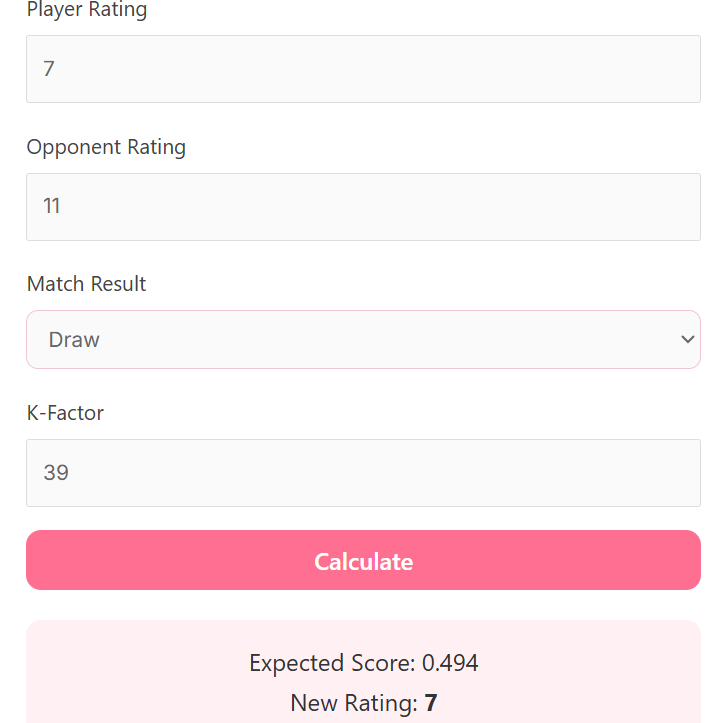
Using an Elo Calculator is very simple and beginner friendly. Follow these steps:
- Enter Player Rating – Input the current rating of the player.
- Enter Opponent Rating – Add the rating of the opponent.
- Select Match Result – Choose whether the player won, lost, or drew the match.
- Set K-Factor – The K-factor determines how much the rating changes. Common values are 16, 24, or 32.
- Click Calculate – Instantly get the expected score and the updated rating.
Advantages of Elo Calculator
An Elo Calculator offers several important benefits. First, it gives fast and accurate results. There is no need for manual calculations, and the tool provides instant and precise rating updates. Second, it is beginner friendly. Even users with no mathematical background can easily use the calculator, because it asks for only a few numbers and does the rest.
Third, it is widely applicable. It works for chess, online gaming, sports rankings and competitive platforms, and it helps players track their progress and improve their strategies over time. A custom K factor gives flexibility for different experience levels, and the whole process takes seconds. For another sports performance measure, see our Batting Average Calculator, which measures hitting in baseball and cricket in a similar, simple way.
What Do Elo Ratings Mean?
Elo ratings are a scale, not a score out of a fixed total. In chess, a new club player is often around 1200, a strong club player is around 1800 to 2000, a master is above 2200, and the best players in the world are above 2700. A gap of 100 points means the stronger player is expected to win about 64 percent of the time, while a gap of 200 points means about 76 percent.
Frequently Asked Questions
What is a good K-factor value?
A K factor of 32 is commonly used for beginners, while experienced players may use lower values like 16 or 24. A higher K moves your rating faster after each match, and a lower K moves it more slowly. Use 32 while you are new, and lower it once your rating has settled.
Can I use this calculator for games other than chess?
Yes, the Elo system is used in many games including esports, online matchmaking systems, and sports rankings. Any contest with two players or teams and a clear win, loss or draw can use it, as long as you know both ratings and the K factor.
What happens if a lower-rated player wins?
The lower-rated player gains more points, while the higher-rated player loses more points. In the worked example above, the 1500 player beat a 1600 player and gained 20.48 points, rising to 1520. If the 1600 player had won, the gain would have been much smaller, because that result was expected.
Is the Elo Calculator accurate?
Yes, it follows the standard Elo formula used worldwide. It uses the same expected score calculation as FIDE and many online platforms, and it shows the result to three decimal places for the expected score. Small differences can come from rounding, and different platforms may use a different K factor.
Do ratings change after every match?
Yes, ratings are updated after each match based on performance and expected outcome. A win, a loss and a draw change the rating in different ways, and the change is larger when the result was unexpected. Over many games, the rating settles near your true playing strength.
Disclaimer
Disclaimer: This calculator provides estimated results based on the standard Elo rating formula and may vary depending on the K factor and the rating system used. It is intended for educational and informational purposes only and should not be used as an official ranking. For official chess or tournament ratings, check with the governing body for your game.