
Cost of Equity Calculator
What is Cost of Equity Calculator?
A Cost of Equity Calculator is a financial tool used to determine the return that investors expect for investing in a company’s equity. It helps businesses, investors, and financial analysts estimate how much return shareholders require to compensate for the risk of investing in a company.
This calculator is commonly based on the Capital Asset Pricing Model (CAPM) formula:
Cost of Equity = Risk-Free Rate + Beta × (Market Return – Risk-Free Rate)
The cost of equity plays a crucial role in financial planning, company valuation, investment analysis, and capital budgeting decisions. Companies use it to calculate their weighted average cost of capital (WACC), while investors use it to evaluate whether a stock investment is worth the risk.
By using an online Cost of Equity Calculator, you can quickly calculate the expected return without performing manual financial calculations.
How to Use It
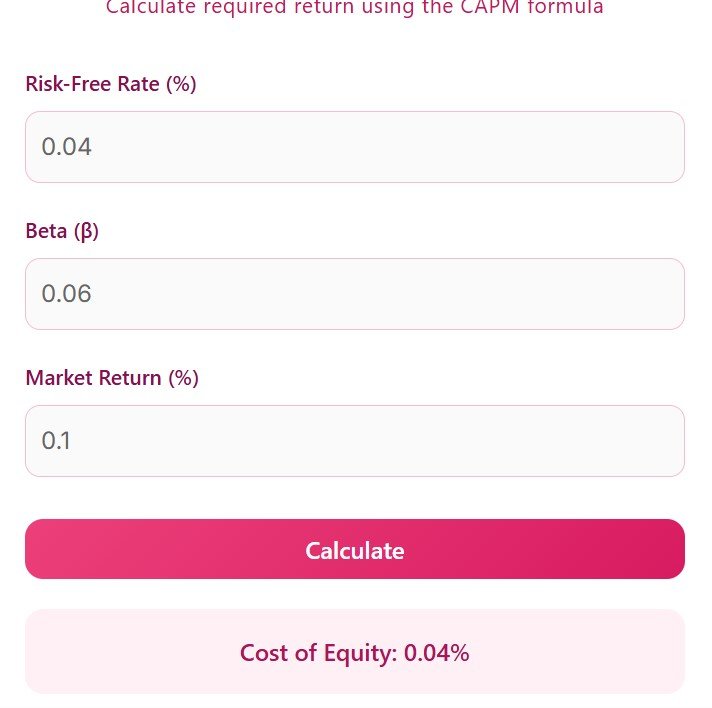
Using the Cost of Equity Calculator is simple and requires only three inputs:
Risk-Free Rate (%) Enter the current risk-free rate, typically based on government bond yields.
Beta (β) Input the company’s beta value, which measures stock volatility compared to the market.
Market Return (%) Enter the expected average market return.
After entering these values, click the Calculate button. The calculator will instantly display the estimated cost of equity in percentage form.
This tool is ideal for finance students, investors, accountants, and business owners who need quick and accurate results.
Cost of Equity (CAPM) Calculation Step by Step Example
Let’s calculate the Cost of Equity using the same values shown in the calculator.
Given Values
Risk-Free Rate (Rf) = 0.04
Beta (β) = 0.06
Market Return (Rm) = 0.10
Step 1: CAPM Formula
The standard Capital Asset Pricing Model (CAPM) formula is:
Cost of Equity=Rf+β(Rm−Rf)\textbf{Cost of Equity} = R_f + \beta (R_m – R_f)Cost of Equity=Rf+β(Rm−Rf)
Where:
RfR_fRf = Risk-Free Rate
β\betaβ = Beta (measure of volatility)
RmR_mRm = Market Return
Step 2: Substitute the Values
Cost of Equity=0.04+0.06(0.10−0.04)\text{Cost of Equity} = 0.04 + 0.06 (0.10 – 0.04)Cost of Equity=0.04+0.06(0.10−0.04)
Step 3: Calculate the Market Risk Premium
First, subtract the Risk-Free Rate from the Market Return:
0.10−0.04=0.060.10 – 0.04 = 0.060.10−0.04=0.06
→ Market Risk Premium = 0.06
Step 4: Multiply by Beta
0.06×0.06=0.00360.06 \times 0.06 = 0.00360.06×0.06=0.0036
Step 5: Add the Risk Free Rate
0.04+0.0036=0.04360.04 + 0.0036 = 0.04360.04+0.0036=0.0436
Step 6: Final Result
Cost of Equity = 0.0436\textbf{Cost of Equity = 0.0436}Cost of Equity = 0.0436
Convert to percentage form:
Cost of Equity = 4.36%\textbf{Cost of Equity = 4.36\%}Cost of Equity = 4.36%
Final Result
Cost of Equity ≈ 4.36%
This means the investor should expect approximately 4.36% required return based on the level of market risk
Advantages
Quick and Accurate Results Eliminates manual calculation errors.
User-Friendly Interface Simple inputs make it easy for beginners.
Financial Planning Support Helps in investment decision-making.
Time-Saving Tool Provides instant results using the CAPM formula.
Useful for Valuation Assists in business valuation and capital budgeting.
Using a reliable Cost of Equity Calculator improves financial accuracy and supports smarter investment decisions.
FAQs
1. What is a good cost of equity percentage?
It depends on the industry and risk level. Higher-risk companies usually have a higher cost of equity.
2. Why is beta important in the calculation?
Beta measures stock volatility. A higher beta means higher risk and higher expected return.
3. Is cost of equity the same as cost of capital?
No. Cost of equity is only the return required by shareholders, while cost of capital includes both equity and debt.
4. Can investors use this calculator?
Yes, investors can use it to evaluate stock returns and compare investment opportunities.
Disclaimer:
This calculator provides estimated results for informational purposes only. It does not constitute financial or investment advice.