
Circumference Calculator
Circumference: 0
Area: 0
What is a Circumference Calculator? (The Ultimate Guide)
In the world of geometry, the circle is one of the most fundamental shapes we encounter. Whether you are calculating the material needed for a circular fire pit, the travel distance of a bicycle wheel, or solving a complex physics problem, knowing the distance around a circle is essential. This is where a Circumference Calculator becomes an indispensable tool.
What is a Circumference Calculator?
A Circumference Calculator is a digital tool designed to compute the linear distance around the outside of a circle. In mathematical terms, while the boundary of a polygon is called a “perimeter,” the boundary of a circle is specifically referred to as the circumference.
The calculator relies on the mathematical constant Pi ($\pi$), which is approximately 3.14159. The relationship between a circle’s size and its boundary is constant, and the calculator uses two primary formulas to deliver instant results:
Based on Radius ($r$): $C = 2\pi r$
Based on Diameter ($d$): $C = \pi d$
By automating these formulas, the tool ensures that you don’t have to worry about the infinite decimals of Pi or manual multiplication errors.
How to Use the Circumference Calculator
Our tool is designed for maximum efficiency. You don’t need to be a math expert to get professional-grade results. Follow these simple steps:
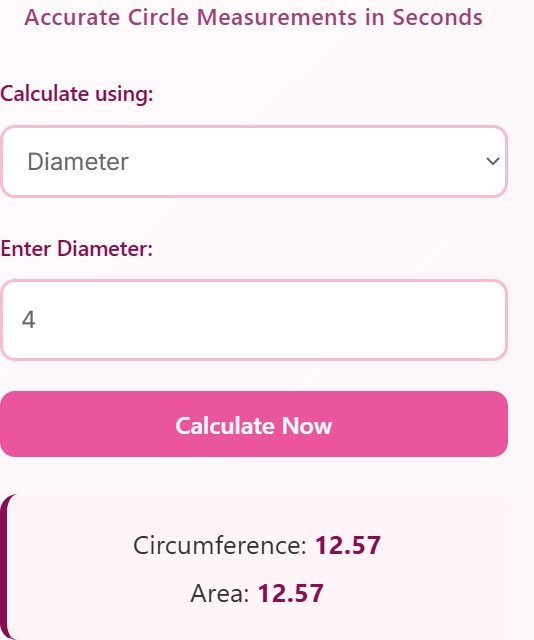
Select Your Input Value: Most calculators allow you to choose between entering the Radius (the distance from the center to the edge) or the Diameter (the total width of the circle through the center).
Enter the Number: Type your measurement into the input field. Our calculator supports various units, including millimeters, centimeters, meters, inches, and feet.
Instant Calculation: As soon as you enter the value, the tool processes the equation.
Review Results: The calculator will display the precise circumference. Many advanced versions will also provide the Area of the Circle as a bonus output, saving you even more time.
Advantages of Using a Circumference Calculator
Why use an online tool instead of a traditional calculator? Here are the primary benefits:
Precision and Accuracy: Manual calculations often involve rounding Pi to 3.14, which can lead to significant errors in large-scale projects. This tool uses high-precision constants for the most accurate output.
Efficiency: For professionals like architects, tailors, or engineers, calculating multiple circles manually is tedious. This tool provides answers in milliseconds.
Educational Support: It serves as an excellent “check” for students learning geometry, helping them verify their homework and understand the relationship between diameter and circumference.
Versatility: Whether you are working on a small craft project or a large construction site, the tool adapts to any unit of measurement, eliminating the need for separate unit conversions.
Zero Margin for Error: Even the best mathematicians can make a typo. An automated calculator ensures that the logic is always flawless.
Frequently Asked Questions (FAQs)
1. What is the difference between Diameter and Circumference?
The diameter is a straight line passing through the center of the circle from one side to the other. The circumference is the curved distance all the way around the edge of the circle.
2. Can I find the circumference if I only know the Area?
Yes. Our calculator can work backward. If you know the Area ($A$), the radius can be found using $r = \sqrt{A/\pi}$, and then the circumference can be calculated.
3. Why is Pi ($\pi$) used in the formula?
Pi is a universal constant. Regardless of how big or small a circle is, if you divide its circumference by its diameter, you will always get Pi.
4. Is the circumference always longer than the diameter?
Yes, the circumference is always approximately 3.14 times longer than the diameter of the same circle.
Disclaimer:
This calculator is provided for informational and educational purposes only. While we strive for absolute precision, these results should be verified by a professional for critical engineering or medical applications.