
Average Atomic Mass Calculator
Quickly compute weighted atomic mass using isotope data
What is Average Atomic Mass Calculator?
Most elements in nature are a mixture of isotopes, atoms of the same element with different numbers of neutrons and so different masses. The average atomic mass is the weighted average of those isotope masses, weighted by how common each isotope is. It is the number printed under each element on the periodic table, and it is usually not a whole number. Atomic mass is explained in detail in Atomic mass – Wikipedia.
Chlorine is the classic example. Natural chlorine is about three quarters chlorine-35 and one quarter chlorine-37, so its average atomic mass sits between 35 and 37, at about 35.45. An average is needed because a sample of chlorine contains billions of atoms of both kinds, and chemistry works with the mixture, not with one atom at a time. The article on isotopes describes how the mix varies from element to element, in Isotope – Wikipedia.
This Average Atomic Mass Calculator does that weighting for you. Enter each isotope mass with its percentage abundance, and it returns the average atomic mass at once. It saves time, removes arithmetic slips, and works on phones, tablets and desktop computers, with no sign-up and nothing to install.
How to Use It
Using the Average Atomic Mass Calculator is very easy and beginner-friendly. Follow these simple steps:
- Enter the mass of each isotope in the given input field. For chlorine, start with 35.
- Input the percentage abundance (%) of each isotope. For chlorine-35, that is 75.76.
- Click on the “Add Isotope” button if you have more isotopes to include. Add a second row for chlorine-37 with an abundance of 24.24.
- Once all values are entered, click the “Calculate” button.
- The calculator will instantly display the average atomic mass result.
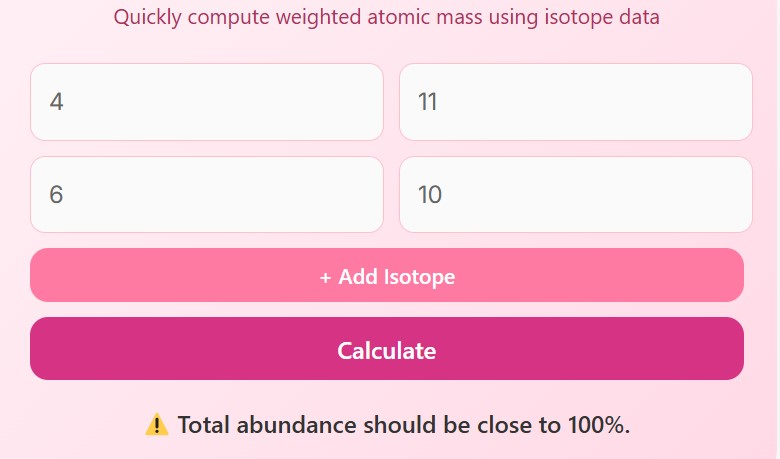
Make sure that the total percentage abundance is close to 100% for accurate results. If the total is far from 100, the calculator warns you that the total should be close to 100%, because the weighting only makes sense for a complete sample.
Formula and worked example
The average atomic mass is a weighted average. Each isotope mass is multiplied by its share of the sample, and the products are added. An isotope that makes up most of the sample pulls the average towards its own mass, while a rare isotope barely moves it. Chlorine is a natural source of data for this, as described in Chlorine – Wikipedia.
Average atomic mass = (mass₁ × abundance₁ + mass₂ × abundance₂ + …) ÷ 100
Abundance is entered as a percentage, so the total of all abundances should be 100
Work through chlorine. Its isotopes are chlorine-35 at 75.76% and chlorine-37 at 24.24%. Multiply the first mass by its share: 35 × 75.76 = 2,651.6. Multiply the second: 37 × 24.24 = 896.88. Add the two products: 2,651.6 + 896.88 = 3,548.48. Divide by 100 to turn the percentages back into a plain average: 3,548.48 ÷ 100 = 35.4848. Enter 35 and 75.76, then add a second row with 37 and 24.24, into the calculator above and it returns: Average Atomic Mass = 35.4848, which matches this working.
The answer 35.4848 is close to the value printed on the periodic table, about 35.45. The small gap comes from the rounded abundances used here: real chlorine is about 75.8% chlorine-35 and 24.2% chlorine-37. You can check the result another way: 35 × 0.7576 = 26.516 and 37 × 0.2424 = 8.9688, and 26.516 + 8.9688 = 35.4848. The calculator does the same thing in one step, so you can trust it for any element once the abundances add up to 100.
The same method works for any element. Boron, for example, is about 80% boron-11 and 20% boron-10, which gives an average near 10.8. Carbon is almost entirely carbon-12, so its average is close to 12.01. Try any element whose isotopes you know, and the calculator gives the same weighted average you would get by hand, without the long multiplication.
Use this calculator when a chemistry question gives you isotope masses and abundances, when you need the molar mass of an element for a stoichiometry problem, or when you want to check a periodic table value by hand. It works for any element with two or more isotopes, as long as you know the masses and the percentages. It cannot find isotope data for you, and it assumes the abundances describe a complete sample, so a total far from 100% gives a misleading answer. For a single isotope, or to find the number of neutrons in an atom, use the Atomic Mass Calculator instead.
The calculator is built for this one job, so there is nothing to set up. You type the numbers you already have from a textbook or a worksheet, and the answer appears at once. It removes the risk of a slip in a long multiplication, it works on any device, and it costs nothing. That makes it useful for homework, revision, and a quick check before a lab session.
FAQs
What is average atomic mass?
Average atomic mass is the weighted average of all isotopes of an element, based on their abundance. A common isotope counts more than a rare one, so the average sits closer to the common isotope’s mass. It is the value printed under the element symbol on the periodic table, and it is usually not a whole number.
Why is abundance important in calculation?
Abundance determines how much each isotope contributes to the final atomic mass. A more abundant isotope has a greater effect on the result, while a rare isotope moves it only slightly. That is why the same element can have different averages in different samples if the isotope mix differs, and why the abundances must add up to about 100%.
Can I use this calculator for any element?
Yes, you can use it for any element as long as you know the isotope masses and their percentage abundances. It does not matter whether the element has two isotopes or ten: add one row per isotope and the calculator weights them all. You only need the data, which you can find in a periodic table or a chemistry textbook.
What happens if the total abundance is not 100%?
The result may be inaccurate. The formula divides the weighted sum by 100, which assumes the abundances describe a complete sample. If the total is far from 100%, the calculator shows a warning that the total should be close to 100%. Check your entries, add any missing isotope, and recalculate.
Is this calculator suitable for students?
Absolutely. It is designed to be simple and helpful for students learning basic and advanced chemistry. The worked example on this page uses chlorine, which appears in many textbooks, so you can follow each step and then try the same method with your own element. Teachers can use it to check classwork in seconds.
Disclaimer
This calculator provides approximate results based on the values entered and is intended for educational purposes. For scientific research or critical calculations, always verify results using standard chemistry references.