
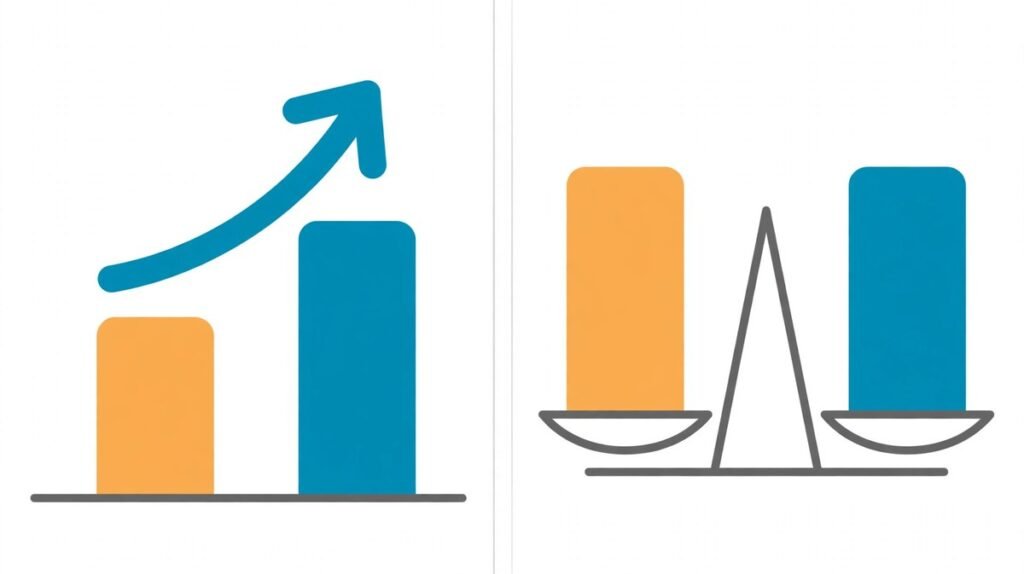
Percent change vs percent difference can seem confusing because both compare two numbers and express the result as a percentage. However, they answer different questions. Percent change measures how much a value has increased or decreased from its starting point. Percent difference compares two values without treating either one as the original.
Understanding which formula to use helps you calculate price changes, business growth, scientific measurements, and everyday comparisons correctly.
What Is Percent Change?

Percent change measures how much a value increases or decreases compared with its original value. It is commonly used when comparing something before and after an event or tracking changes over time.
For example, you might calculate percent change to find out:
- How much a product’s price increased
- How much your monthly expenses decreased
- How much a business’s revenue grew
- How much your weight changed over a period
- How much a website’s traffic increased
The important part is that percent change uses the original value as its reference point.
Percent Change Formula
The standard percent change formula is:
Percent Change = ((New Value − Original Value) ÷ Original Value) × 100
The result can be positive or negative.
- A positive result means an increase.
- A negative result means a decrease.
- A result of 0% means the value did not change.
Example of Percent Change
Suppose your monthly rent increased from $1,000 to $1,100.
- Original value: $1,000
- New value: $1,100
- Difference: $1,100 − $1,000 = $100
- Divide the difference by the original value: $100 ÷ $1,000 = 0.10
- Multiply by 100: 0.10 × 100 = 10%
Answer: Your rent increased by 10%.
Because the new value is greater than the original value, the result is positive.
Example of Percent Decrease
Suppose a laptop originally costs $800 but is now on sale for $600.
Percent change = (($600 − $800) ÷ $800) × 100
= −25%
Answer: The laptop price decreased by 25%.
The negative sign indicates a decrease. You can also describe the result as a 25% decrease.
Try our free Percentage Change Calculator to work out any increase or decrease instantly.
What Is Percent Difference?

Percent difference measures how far apart two values are when neither value is considered the starting point or baseline.
It is useful when comparing two independent measurements, prices, quantities, or results.
For example, you might use percent difference to compare:
- Prices at two different stores
- Measurements from two instruments
- Two independent test results
- The costs of similar products
- Measurements taken from separate samples
Unlike percent change, percent difference uses the average of the two values as its reference point.
Percent Difference Formula
Percent Difference = (|Value 1 − Value 2| ÷ Average of Both Values) × 100
The average is calculated as:
Average = (Value 1 + Value 2) ÷ 2
Combining both steps gives:
Percent Difference = (|A − B| ÷ ((A + B) ÷ 2)) × 100
The absolute value symbol means the difference is treated as positive, regardless of which value is larger.
Example of Percent Difference
Suppose two stores sell the same headphones:
- Store A: $80
- Store B: $100
First, find the difference:
$100 − $80 = $20
Next, calculate the average:
($80 + $100) ÷ 2 = $90
Finally, calculate the percent difference:
($20 ÷ $90) × 100 = 22.22%
Answer: The prices have a percent difference of approximately 22.22%.
This comparison does not assume that either store’s price is the original price.
Percent Change vs Percent Difference: Key Differences
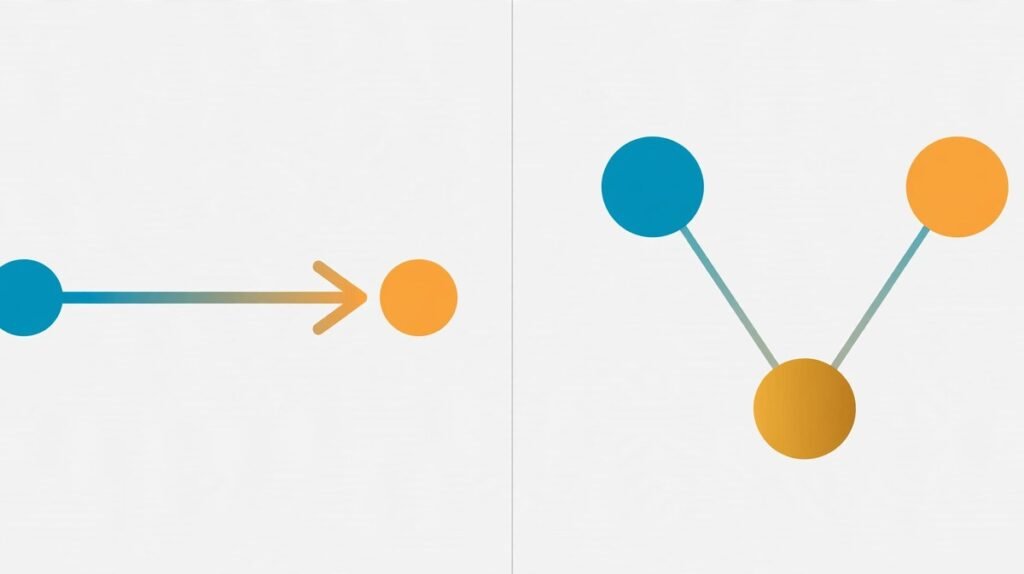
| Feature | Percent Change | Percent Difference |
|---|---|---|
| Purpose | Measures increase or decrease | Compares two independent values |
| Reference point | Original value | Average of both values |
| Formula denominator | Original value | Average of the two values |
| Direction | Positive or negative | Usually nonnegative |
| Order matters | Yes | No |
| Common use | Before and after comparisons | Side by side comparisons |
The main difference is the denominator. Percent change uses the original value, while percent difference uses the average of both values.
When Should You Use Percent Change?
Use percent change when one value clearly comes before the other or when one value is the reference point.
Price Changes Over Time
If a product costs $50 last month and $65 this month, percent change tells you how much its price increased.
Business Growth
Businesses use percent change to measure revenue, sales, customer numbers, website traffic, and expenses across different periods.
Before and After Measurements
Percent change is useful when comparing measurements before and after a treatment, adjustment, workout program, or other process.
Budget and Expense Tracking
If your monthly spending falls from $2,000 to $1,700, percent change shows the percentage decrease from your original spending.
When Should You Use Percent Difference?
Use percent difference when comparing two values that have equal importance and neither is a baseline.
Comparing Prices
If two stores offer the same product at different prices, percent difference measures the gap relative to their average price.
Comparing Scientific Measurements
Researchers may compare measurements from two independent instruments or experimental results when neither value is treated as the accepted standard.
Comparing Products or Services
Percent difference can help compare the prices, dimensions, or performance measurements of two similar products.
Important: If one measurement is a known or accepted standard, percent error may be more appropriate than percent difference.
Percent Change vs Percent Difference: Same Numbers, Different Results
One of the easiest ways to understand the distinction is to use the same two values in both formulas.
Suppose a value changes from 80 to 100.
Using Percent Change
Original value = 80
New value = 100
Percent change:
((100 − 80) ÷ 80) × 100 = 25%
The result is a 25% increase.
Using Percent Difference
Value 1 = 80
Value 2 = 100
Average:
(80 + 100) ÷ 2 = 90
Percent difference:
(20 ÷ 90) × 100 = 22.22%
The result is 22.22%.
Both calculations are mathematically correct, but they answer different questions. Percent change measures growth from 80 to 100, while percent difference compares 80 and 100 equally.
Common Mistakes When Calculating Percentages

Using the Wrong Starting Value
Percent change depends on the original value. Dividing by the new value instead of the original value produces a different result.
Confusing Percent Change With Percent Difference
These formulas are not interchangeable. Choose the calculation based on whether you have a baseline or two independent values.
Ignoring Negative Results
A negative percent change represents a decrease. Do not automatically remove the negative sign unless you are specifically reporting the size of the decrease.
Assuming Equal Percentage Increases and Decreases Cancel Out
A 20% decrease followed by a 20% increase does not return a value to its starting point.
For example:
- Start with $100.
- Decrease by 20% to get $80.
- Increase $80 by 20% to get $96.
The final value is $4 below the starting amount.
Comparing Percentages Without Considering the Original Values
A 50% increase from $10 is a $5 increase. A 10% increase from $1,000 is a $100 increase.
The percentage alone does not tell you the actual amount of change.
Frequently Asked Questions
What is the difference between percent change and percent difference?
Percent change measures how much a value increases or decreases from an original value. Percent difference compares two independent values using their average as the reference point.
How do you calculate percent change?
Subtract the original value from the new value, divide the result by the original value, and multiply by 100.
How do you calculate percent difference?
Find the absolute difference between the two values, divide it by their average, and multiply by 100.
Can percent difference be negative?
Percent difference is normally reported as a nonnegative value because it uses the absolute difference between the two measurements.
Is percent difference the same as percent error?
No. Percent difference compares two values using their average. Percent error compares a measured value with an accepted or true value using the accepted value as the reference.
Can percent change be greater than 100%?
Yes. If a value increases by more than its original amount, its percent change can exceed 100%.
For example, increasing from 20 to 50 represents a 150% increase.
How do you calculate percent difference in Excel?
If your two values are in cells A1 and B1, use:
=ABS(A1-B1)/AVERAGE(A1,B1)*100
This returns the percent difference as a number such as 22.22. If you want Excel to display the result using percentage formatting, omit *100 and format the cell as a percentage.
Choose the Correct Percentage Formula
Percent change and percent difference both help compare values, but the correct formula depends on what you are measuring.
Use percent change when you have an original value and a new value. Use percent difference when comparing two independent values without a clear starting point.
Once you identify the reference point, choosing the right formula becomes much easier.

Taha Rasheed is a content researcher and editor at UnlimitedCalculators.com. He is passionate about making everyday calculations easier and more accessible through simple, practical, and easy-to-understand online tools.
He focuses on researching calculation methods, creating helpful content, and improving the clarity and usability of calculator resources across different topics, including mathematics, finance, education, health, and everyday calculations.
At UnlimitedCalculators.com, Taha aims to provide useful, informative, and user-friendly resources that help visitors understand calculations and make everyday tasks simpler.