
Parallel Resistor Calculator
What is Parallel Resistor Calculator?
A Parallel Resistor Calculator is an online tool that helps you quickly calculate the equivalent resistance of resistors connected in parallel in an electrical circuit. In electronics and electrical engineering, resistors are commonly connected in parallel to control current flow and distribute voltage across different components. Calculating the total resistance manually can take time and may lead to errors, especially when multiple resistors are involved.
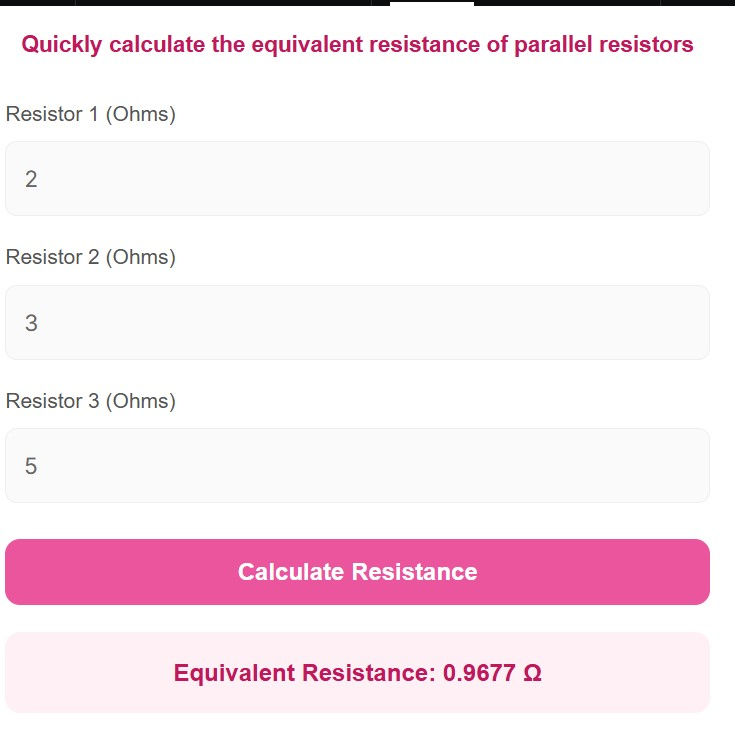
This calculator simplifies the process by instantly computing the total or equivalent resistance when two or more resistors are connected in parallel. All you need to do is enter the resistor values in ohms, and the calculator will automatically apply the correct formula to give you an accurate result.
In a parallel circuit, the total resistance is always lower than the smallest resistor value in the network. This happens because current has multiple paths to flow through, which reduces the overall resistance in the circuit.
The equivalent resistance of resistors connected in parallel is calculated using the following formula:
1/R_total = 1/R1 + 1/R2 + 1/R3 + …
Here:
R_total = Equivalent resistance of the parallel circuit
R1, R2, R3 = Individual resistor values
Instead of solving this equation manually every time, the Parallel Resistor Calculator performs the calculation instantly. This makes it extremely useful for students, electricians, engineers, hobbyists, and anyone working with electronic circuits.
Whether you are designing a circuit, studying electronics, or verifying calculations, this tool can save time and improve accuracy.
How to Use the Parallel Resistor Calculator
Using the calculator is very simple and requires only a few steps. Even beginners who have little experience with electronics can easily use it.
1. Enter Resistor Values
Start by entering the resistance values of the resistors connected in parallel. These values are typically measured in ohms (Ω).
2. Add Multiple Resistors
Most calculators allow you to enter at least two resistor values and sometimes more. Enter each resistor value in its respective field.
3. Click the Calculate Button
Once all resistor values are entered, click the Calculate button. The calculator will instantly process the numbers using the parallel resistor formula.
4. View the Result
The calculator will display the equivalent resistance of the parallel circuit. This result represents the total resistance experienced by the power source.
5. Adjust Values if Needed
If you want to test different resistor combinations, simply change the values and calculate again.
This simple process allows you to perform accurate electrical calculations without needing complex formulas or manual computation.
Advantages of Using a Parallel Resistor Calculator
Using an online calculator for parallel resistance offers many benefits, especially for students and professionals working with electrical circuits.
1. Saves Time
Manual calculations involving multiple resistors can take time and require careful mathematical steps. The calculator gives results instantly.
2. Reduces Human Error
Mistakes can occur when manually solving formulas. The calculator eliminates these errors by performing the calculations automatically.
3. Beginner Friendly
Even users who are new to electronics can easily calculate equivalent resistance without needing advanced knowledge of electrical formulas.
4. Useful for Circuit Design
Engineers and hobbyists often test different resistor combinations while designing circuits. The calculator makes it easy to experiment with different values.
5. Works for Multiple Resistors
Instead of calculating step by step for each resistor pair, the calculator can handle multiple resistors simultaneously.
6. Improves Learning
Students studying electronics or physics can use the calculator to verify their manual calculations and better understand how parallel circuits work.
7. Accessible Anytime
Since the calculator works online, it can be used from any device including desktop computers, tablets, and smartphones.
These advantages make the Parallel Resistor Calculator a valuable tool for both learning and practical applications.
FAQs
1. What is a parallel resistor connection?
A parallel resistor connection is a circuit configuration where multiple resistors are connected across the same two nodes. This allows current to flow through multiple paths simultaneously.
2. Why is total resistance lower in a parallel circuit?
In a parallel circuit, current has multiple paths to flow through. This reduces the overall resistance, making the total resistance lower than the smallest resistor in the circuit.
3. Can I calculate more than two resistors?
Yes. Most parallel resistor calculators allow you to enter two or more resistor values and calculate the equivalent resistance instantly.
4. What unit should I use for resistor values?
Resistor values should typically be entered in ohms (Ω). If you have values in kilo-ohms or mega-ohms, you may need to convert them into ohms first.
5. Is this calculator useful for students?
Yes, it is extremely useful for students studying electronics, physics, or electrical engineering, as it helps verify calculations and understand circuit behavior.
6. Does the order of resistors matter?
No. In a parallel circuit, the order of resistors does not affect the total resistance.
7. Can this calculator be used on mobile devices?
Yes. Most modern calculators are responsive and work smoothly on phones, tablets, and desktop devices.
Disclaimer
This Parallel Resistor Calculator provides results for educational and general informational purposes only and may not replace professional electrical analysis.
Always verify calculations and consult a qualified engineer when working with real electrical systems or high-voltage circuits.