
Theoretical Yield Calculator
What is Theoretical Yield Calculator?
A Theoretical Yield Calculator is an online chemistry tool that helps you calculate the maximum amount of product that can be formed in a chemical reaction. In chemistry, theoretical yield refers to the ideal quantity of product obtained when a limiting reactant completely reacts without any loss.
This calculator uses three main inputs: the moles of the limiting reactant, the molar mass of the desired product, and the stoichiometric ratio from the balanced chemical equation. By applying the standard theoretical yield formula, it quickly provides accurate results in grams.
Whether you are a chemistry student, teacher, lab assistant, or researcher, this tool simplifies complex stoichiometry calculations and saves valuable time.
How to Use It
Using the Theoretical Yield Calculator is simple and beginner-friendly:
Enter the moles of the limiting reactant from your balanced chemical equation.
Input the molar mass of the desired product in grams per mole (g/mol).
Provide the stoichiometric ratio (product coefficient divided by reactant coefficient).
Click the “Calculate Theoretical Yield” button.
Instantly view the result in grams.
Make sure your chemical equation is properly balanced before entering values for accurate results.
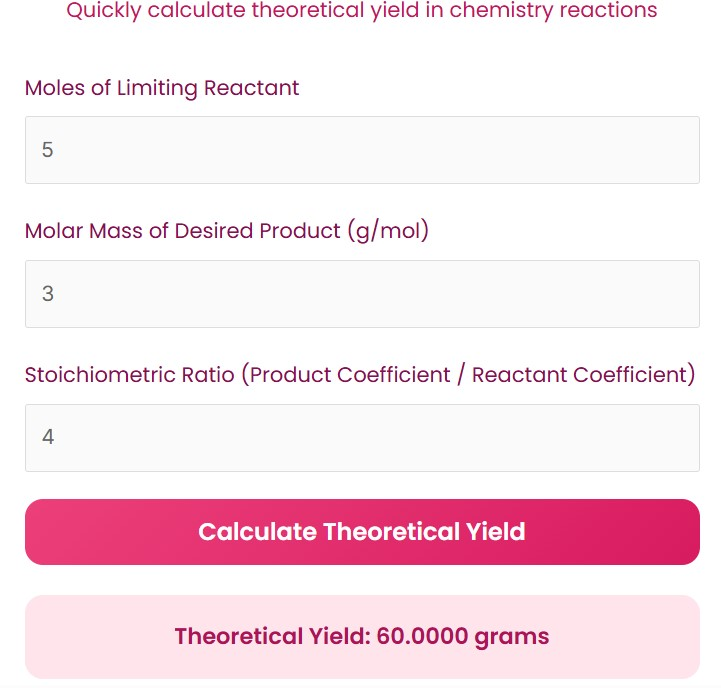
Theoretical Yield Calculation Step by Step Example
Let’s calculate the Theoretical Yield using the same values shown in the calculator.
Given Values
Moles of Limiting Reactant = 5 moles
Molar Mass of Desired Product = 3 g/mol
Stoichiometric Ratio (Product Coefficient / Reactant Coefficient) = 4
Step 1: Theoretical Yield Formula
The standard formula for Theoretical Yield is:
Theoretical Yield=Moles of Limiting Reactant×Stoichiometric Ratio×Molar Mass of Product\textbf{Theoretical Yield} = \text{Moles of Limiting Reactant} \times \text{Stoichiometric Ratio} \times \text{Molar Mass of Product}Theoretical Yield=Moles of Limiting Reactant×Stoichiometric Ratio×Molar Mass of Product
Step 2: Substitute the Values
Theoretical Yield=(5×4×3)\text{Theoretical Yield} = (5 \times 4 \times 3)Theoretical Yield=(5×4×3)
Step 3: Calculate the Product Moles
First multiply limiting reactant moles with stoichiometric ratio:
5×4=205 \times 4 = 205×4=20
→ Product Moles = 20 moles
Step 4: Multiply by Molar Mass
Now multiply product moles with molar mass:
20×3=6020 \times 3 = 6020×3=60
Step 5: Final Result
Theoretical Yield = 60 grams\textbf{Theoretical Yield = 60 grams}Theoretical Yield = 60 grams
Final Result
Theoretical Yield = 60 grams
This means that under ideal conditions (no loss of material), the maximum amount of product that can be formed is 60 grams.
Advantages
Here are some key benefits of using this theoretical yield calculator:
Accurate Results Reduces human error in manual calculations.
Time Saving Instantly calculates theoretical yield in seconds.
Beginner Friendly Simple interface suitable for students.
Educational Tool Helps understand stoichiometry concepts clearly.
Mobile Responsive Works smoothly on desktop, tablet, and mobile devices.
This tool is especially helpful for chemistry assignments, lab reports, exam preparation, and research work.
FAQs
1. What is theoretical yield in chemistry?
Theoretical yield is the maximum amount of product that can be formed from a given amount of limiting reactant under ideal conditions.
2. What is the difference between theoretical yield and actual yield?
Theoretical yield is the predicted maximum amount, while actual yield is the amount actually obtained from an experiment.
3. Why is limiting reactant important?
The limiting reactant determines the maximum amount of product that can be formed because it gets used up first in a reaction.
4. Can this calculator be used for all chemical reactions?
Yes, as long as you know the balanced equation, moles of limiting reactant, molar mass, and stoichiometric ratio.
5. Is this calculator accurate?
Yes, it uses the standard theoretical yield formula. However, accuracy depends on the correctness of the input values.
Disclaimer:
This Theoretical Yield Calculator is for educational and informational purposes only. Results depend on the accuracy of the values entered and a properly balanced chemical equation. Always verify calculations for laboratory, academic, or professional use.