
Average Rate of Change Calculator
Calculate the Average Rate of Change easily
What is Average Rate of Change Calculator?
The Average Rate of Change Calculator is a simple yet powerful tool designed to help users quickly determine how a value changes over a specific interval. In mathematics, physics, and economics, understanding the rate at which one quantity changes in relation to another is essential. Traditionally, calculating the average rate of change required manual computations, which could be time-consuming and prone to error.
With this calculator, you can instantly compute the average rate of change between two points. Whether you are a student trying to solve calculus problems, an engineer analyzing performance metrics, or a professional working on financial trends, this tool provides fast and accurate results. All you need to do is input the initial and final values, and the calculator does the rest.
The formula used by the calculator is:
Average Rate of Change=y2−y1x2−x1\text{Average Rate of Change} = \frac{y_2 – y_1}{x_2 – x_1}Average Rate of Change=x2−x1y2−y1
Here, x1x_1x1 and y1y_1y1 represent the starting point, and x2x_2x2 and y2y_2y2 represent the ending point of the interval.
How to Use It
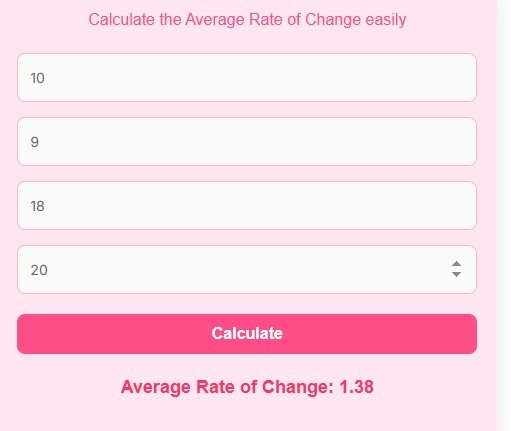
Using the Average Rate of Change Calculator is straightforward and beginner-friendly. Follow these steps:
Enter Initial Values: Input the starting point values x1x_1x1 and y1y_1y1 in their respective fields.
Enter Final Values: Input the ending point values x2x_2x2 and y2y_2y2.
Click Calculate: Press the Calculate button, and the result will display instantly.
View Result: The calculator shows the average rate of change clearly, so you can use it for assignments, projects, or professional calculations.
This simple process eliminates the need for manual calculations, saving time and reducing errors. The calculator is also responsive, making it easy to use on mobile devices, tablets, and desktops.
Advantages
Using the Average Rate of Change Calculator offers several key benefits:
Instant Results: No manual calculations required; get accurate results in seconds.
User-Friendly Interface: The design is intuitive and easy to navigate, even for beginners.
Responsive Design: Works perfectly on all devices, including smartphones, tablets, and desktops.
Error Prevention: The calculator checks for invalid inputs, such as dividing by zero, and provides alerts.
Educational Tool: Ideal for students learning algebra, calculus, or physics concepts.
Professional Use: Engineers, analysts, and finance professionals can save time on repetitive calculations.
By providing precise results quickly, this tool helps users make informed decisions, complete homework, or analyze data efficiently.
FAQs
Q1: What formula does the calculator use?
A: It uses the formula (y2−y1)÷(x2−x1)(y_2 – y_1) ÷ (x_2 – x_1)(y2−y1)÷(x2−x1) to compute the average rate of change between two points.
Q2: Can I use negative numbers?
A: Yes! The calculator works with both positive and negative values, making it versatile for various scenarios.
Q3: What if x₂ equals x₁?
A: Dividing by zero is not possible. The calculator will display an error message to prevent incorrect results.
Q4: Is this calculator suitable for students?
A: Absolutely. It’s perfect for high school, college, or university students learning math, physics, or economics.
Q5: Can I use this tool on mobile devices?
A: Yes, the calculator is fully responsive and works seamlessly on smartphones and tablets.
Conclusion
The Average Rate of Change Calculator is an essential tool for anyone who needs quick, accurate calculations of rate changes. Whether for educational purposes, professional analysis, or personal projects, this calculator simplifies the process and ensures accuracy. Its responsive design, easy interface, and instant results make it a must-have tool for students, professionals, and enthusiasts alike.
Using this calculator eliminates the need for tedious manual calculations, saves time, and enhances productivity. Try it today and make your calculations faster, easier, and more accurate than ever before.