
Marginal Cost Calculator
Introduction
Should you make one more unit? The answer depends on what that extra unit costs, and that figure is the marginal cost. If the next unit costs less than the price you can sell it for, making it adds to your profit. If it costs more, making it loses money. This Marginal Cost Calculator finds that figure in seconds: you enter the change in total cost and the change in quantity, and the tool returns the cost of each extra unit. Business owners use it for pricing and production choices, students use it for economics coursework and exams, and analysts use it to find the point where producing more stops paying off. This guide explains what marginal cost is, how the calculator works, and how to read the answer, so every extra unit you make is a deliberate choice.
What Is a Marginal Cost Calculator?
A Marginal Cost Calculator is a handy online tool designed to help businesses and students calculate the additional cost of producing one more unit of a product. It simplifies complex calculations, allowing you to determine the marginal cost quickly and accurately without manual formulas.
Marginal cost is different from average cost, and the difference matters. Average cost spreads all costs across all units, including rent and salaries that do not change with output. Marginal cost looks only at the extra cost of the next unit, which is the number that guides a go or no-go choice on one more batch. When you know both the marginal cost and the margin each sale leaves, the picture is complete, and our Contribution Margin Calculator works out how much each sale contributes toward fixed costs and profit.
How to Use the Marginal Cost Calculator
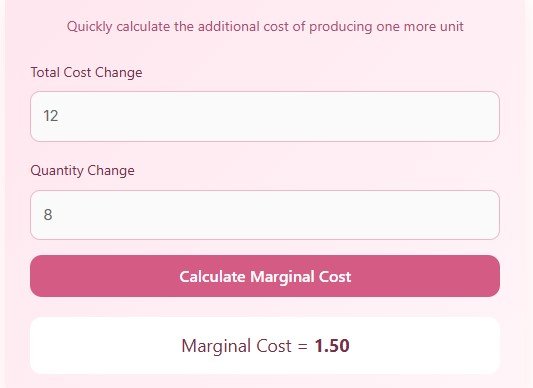
Using the Marginal Cost Calculator is easy, and it takes four steps that match the fields you can see above.
Enter the change in total cost in the Total Cost Change box. This is how much your total cost grew when you raised production, for example 500 dollars.
Enter the change in quantity in the Quantity Change box. This is how many extra units you produced, for example 50 units.
Click the pink Calculate button under the two boxes.
Read the result, which appears instantly as the cost per extra unit, for example Marginal Cost = 10.00. Money figures are not labeled with a currency, so read the answer in the currency of the costs you entered.
The Formula: Marginal Cost Equals Change in Cost Divided by Change in Quantity
The calculator applies the standard economics formula: marginal cost equals the change in total cost divided by the change in quantity, written as MC equals delta TC divided by delta Q. The two input boxes match the two halves of the formula exactly, which is why the tool needs no other information. If your total cost does not change when you add units, the marginal cost is zero, and the extra units cost nothing. If a bigger order forces overtime pay, new materials, or extra shipping, the change in cost rises and so does the marginal cost. To see how a change in cost shows up as a percentage, our Percentage Calculator can work that out from the before and after figures.
Worked Example: 500 Dollars for 50 More Units
Suppose a bakery raises its daily output by 50 loaves and its total daily cost rises by 500 dollars, because of extra flour, yeast, packaging, and oven time. Enter 500 in the Total Cost Change box, enter 50 in the Quantity Change box, and click Calculate Marginal Cost. The calculator returns Marginal Cost = 10.00. That means each extra loaf costs 10 dollars to make. You can check the answer by hand: 500 divided by 50 equals 10. If the bakery sells each loaf for 15 dollars, the extra 50 loaves add 5 dollars of profit each, or 250 dollars in total, before fixed costs. If the selling price were 8 dollars, each extra loaf would lose 2 dollars, and the expansion would not pay.
When to Use It and Tips for Good Results
The calculator is useful whenever a business decides whether to make, buy, or sell more. Small business owners use it to set prices and to decide whether a bigger order is worth taking. Managers use it to find the output level where marginal cost meets the selling price, because beyond that point each extra unit loses money. Students use it in economics coursework, where marginal cost appears in questions about supply, profit, and market equilibrium. It is also the starting point for a break-even check: once you know the marginal cost of the next unit, you can compare it with the price and see whether growth adds profit or burns cash.
A few habits keep your results sound. First, use the change in total cost, not the total cost itself, because fixed costs such as rent do not change with output and belong outside this calculation. Second, measure the two changes over the same output step, so the cost and quantity figures describe the same expansion. Third, remember that marginal cost often falls at first as production gets more efficient, then rises again as overtime and wear set in, so one calculation describes one step, not the whole year. Fourth, if the expansion needs borrowing to fund it, our Bank Loan Calculator can work out the monthly cost of the loan before you commit. Finally, write down the marginal cost beside the selling price for every product line, so the decision is visible at a glance.
Frequently Asked Questions
What is marginal cost?
Marginal cost is the additional cost incurred to produce one extra unit of a product. It is calculated as the change in total cost divided by the change in quantity.
What is the formula for marginal cost?
Marginal cost equals the change in total cost divided by the change in quantity, written as MC = change in TC / change in Q. Enter the two changes, and the calculator divides them for you.
Can I use this calculator for any product?
Yes, it works for all products and services where you have cost and quantity data, from a bakery to a factory to a freelance service.
Why does marginal cost change as output grows?
It often falls at first because workers and machines are used more efficiently, then rises when capacity is stretched, overtime is paid, or machines need maintenance. That rise is why there is an optimal output level for most businesses.
Is marginal cost the same as average cost?
No. Average cost divides the total cost by the total number of units, including fixed costs. Marginal cost looks only at the extra cost of the next unit, which is the figure that matters for a decision about one more unit.
Is this calculator free to use?
Yes, it is a free online tool available 24/7, and it works on desktop, tablet, and mobile.
Disclaimer
Disclaimer: This Marginal Cost Calculator is for educational and informational purposes only. The results are estimates based on the values you enter and the standard marginal cost formula, and they do not constitute financial advice. Always consult a qualified accountant or financial advisor before you make a business, pricing, or investment decision based on the results.