
Waist to Height Ratio Calculator
Enter your waist and height to calculate your Waist-to-Height Ratio
A Waist to Height Ratio Calculator compares your waist size with your height to give a quick picture of your health. It uses one simple division to show whether the fat carried around your middle is in a healthy range for your height.
It only needs two numbers, your waist in centimetres and your height in centimetres. The result is a single number, and this page explains what that number means and how to use it safely.
If you also want to compare your waist with your hips, try the Waist to Hip Ratio Calculator, which measures a different part of body shape.
What Is a Waist to Height Ratio Calculator?
A Waist to Height Ratio Calculator divides your waist measurement by your height. Both numbers must use the same unit, so this calculator uses centimetres for both. The answer is called your waist to height ratio, often shortened to WHtR.
The ratio is useful because height changes what a waist size means. A waist of 80 centimetres means something different for a person who is 160 centimetres tall than for a person who is 190 centimetres tall. The ratio takes height into account, so it gives a fairer comparison.
Doctors and health researchers use this ratio as a simple screening check for fat carried around the middle of the body. Fat in this area is linked with a higher risk of heart disease and type 2 diabetes.
The ratio does not diagnose any condition, but it can show when a chat with a doctor would be sensible.
How to Use This Waist to Height Ratio Calculator
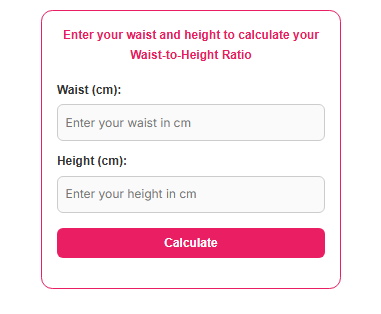
Follow these five steps to get your waist to height ratio.
- Measure your waist. Stand straight, breathe out normally, and wrap a tape measure around your waist at the level of your belly button. Keep the tape level and snug, but not tight. Note the number in centimetres.
- Measure your height. Stand barefoot against a flat wall, look straight ahead, and measure from the floor to the top of your head. Note the number in centimetres.
- Enter your waist in the first box and your height in the second box. Both boxes use centimetres, so there is no need to convert units first.
- Click Calculate. The calculator divides your waist by your height and shows your ratio at once, along with the category it falls in.
- Read your result and compare it with the interpretation guide below. Note the number if you plan to check again later, and measure the same way each time.
Waist to Height Ratio Calculator Formula
The formula is simple. Your waist to height ratio equals your waist divided by your height, with both numbers measured in the same unit.
In short, waist to height ratio = waist / height. If your waist is in centimetres, your height must also be in centimetres. This calculator expects both numbers in centimetres, so you can enter them as measured.
Because the two units cancel out, the result has no unit. It is a plain number, usually between 0.3 and 0.7. A lower number means a smaller waist for your height.
Worked Example
Here is an example using the calculator on this page. A man has a waist of 80 centimetres and a height of 170 centimetres.
Enter 80 in the waist box and 170 in the height box, then click Calculate.
The calculation is 80 divided by 170, which equals 0.47. The calculator shows a waist to height ratio of 0.47, with the category Healthy (Men).
A ratio of 0.47 sits below 0.5, which is the commonly used healthy limit. It is a reassuring result, but it does not tell the whole story, so keep the other checks on this page in mind too.
How to Interpret Your Waist to Height Ratio
In general, a waist to height ratio below 0.5 is seen as healthy for most adults. Many health guidelines use 0.5 as the key cut-off, because a waist that is less than half your height is linked with lower health risks.
A ratio from 0.5 to 0.59 suggests increased risk, and a ratio of 0.6 or above suggests a higher risk. A ratio well below 0.4 can also be worth noting, as a very low waist size can sometimes point to being underweight.
The categories shown by this calculator can differ slightly for men and women, and age and body shape matter too. Use the cut-off of 0.5 as a guide, and talk to a doctor if your result is high or if you are unsure what it means for you.
When to Use This Waist to Height Ratio Calculator
Use this calculator when you want a quick check on weight carried around your middle. It suits people who are starting a fitness plan, tracking weight loss, or checking progress after a change in diet or exercise.
It is also handy alongside a BMI Calculator. If your BMI looks normal but your waist is large for your height, the ratio can flag a risk that BMI misses. Checking once a month is enough for most people, as waist size changes slowly.
Limitations of a Waist to Height Ratio Calculator
This ratio is a screening tool, not a diagnosis. It cannot tell muscle apart from fat, so a very muscular person can get a higher reading without carrying extra fat. It also does not allow for pregnancy, and it is not made for children.
A single number cannot cover your whole health picture. Blood pressure, blood sugar, cholesterol, family history and how active you are all matter too. Treat a high result as a prompt to seek advice, not as a verdict on your health.
To estimate how much of your body weight is fat rather than muscle, try a Navy Body Fat Calculator.
FAQs
What is a healthy waist to height ratio?
A ratio below 0.5 is generally seen as healthy for most adults. This means your waist is less than half your height. The calculator on this page shows a category with your result, and a value of 0.47, for example, falls in the healthy range for men.
Can this calculator replace professional medical advice?
No. It gives general information only and should not replace advice from a doctor or another health professional. If your ratio is high, or if you have any health concerns, speak to a healthcare professional for advice that fits your situation.
Is this ratio better than BMI?
The ratio is often more useful than BMI for spotting fat carried around the middle, because BMI only compares weight with height and cannot show where fat is stored. Both measures have limits, and using them together gives a fuller picture than either one alone.
How often should I check my ratio?
Checking once a month is enough for most people. Waist size changes slowly, so weekly checks rarely show a real change. Measure at the same time of day and in the same way each time so your results can be compared fairly.
Does height affect the ratio?
Yes. The ratio divides waist by height, so a taller person can have a larger waist and still get a healthy result. That is the point of the measure. It adjusts your waist size for your height so the result is fair for short and tall people alike.
Disclaimer: This Waist to Height Ratio Calculator is for general information and education only. It is not medical advice and it does not diagnose or treat any condition. Always consult a qualified healthcare professional before making decisions about your health, diet, or exercise.